Five years ago, if you’d suggested I pair a sleek, tapered-leg vanity with a rustic wooden beam, I would’ve side-eyed you pretty hard. Modern Farmhouse meant shiplap on every wall, mason jars on every shelf, and enough galvanized metal to stock a hardware store. I was all in. We all were. There was something so comforting about that aesthetic—like wrapping your whole house in a warm, neutral-toned hug.
But design evolves. And if you’ve been following along here at The Painted Hinge, you know I’ve been on my own journey lately. I’ve drifted away from the “farmhouse everything” approach and started leaning into what I call “Moody Modern” territory. Deeper earth tones. Richer textures. A willingness to mix styles that seem like they shouldn’t work together.
That’s what we’re getting into today: the surprisingly harmonious marriage of farmhouse warmth and mid-century modern sophistication. After years of painting walls, styling shelves, and obsessing over undertones, I’ve learned that the most interesting homes aren’t the ones that follow a single aesthetic religiously. They’re the ones that feel collected. Layered. Like they evolved over time with a person who actually lives there, not a person who bought everything from the same catalog on the same afternoon.
Where Farmhouse Has Been and Where It’s Going
The Modern Farmhouse movement exploded in the mid-2010s for good reason. After years of cold, minimalist spaces dominating design magazines, people were craving warmth. Comfort. A sense of home that felt approachable rather than aspirational.
Farmhouse delivered. We painted our kitchen cabinets white, hunted for vintage signs at flea markets, and debated the merits of Agreeable Gray versus Repose Gray. (I will still have this debate with anyone, anytime.)
But as with any trend that reaches saturation, something shifted. The look started feeling predictable. Safe. And for those of us who live and breathe design, “safe” gets boring fast.
Over the past couple of years, I’ve watched the farmhouse aesthetic mature into something more nuanced. The bones are still there but the appreciation for natural materials, the emphasis on comfort, the rejection of anything too precious or untouchable. But now we’re layering in elements that add edge and sophistication. Visual interest that makes you look twice.
Mid-century modern, with its clean lines, organic shapes, and warm wood tones, turns out to be an ideal partner for farmhouse’s cozy sensibilities. It’s a pairing that shouldn’t work on paper but absolutely sings in practice. The key is understanding why it works and then applying that knowledge intentionally throughout your space.
The Anchor Piece: Your Bathroom Vanity Sets the Tone
I tell every client, every friend who asks for design advice, every person who corners me at a dinner party (it happens more than you’d think): every room needs an anchor piece. One statement element that everything else revolves around. In living rooms, it might be a sofa or a fireplace. In bedrooms, it’s usually the bed. In bathrooms? It’s the vanity. Every single time.
When you walk into a bathroom, the vanity commands the space. It sets the tone for everything else—the mirror you choose, the lighting, the hardware, even the paint color on the walls. Get the vanity right, and the rest of the room practically designs itself. Get it wrong, and you’ll be fighting an uphill battle no matter how perfect your tile selection is.
This is why I’ve become a little obsessed with bringing mid-century modern vanities into farmhouse-inspired spaces. I know it sounds like mixing stripes and polka dots. But stay with me.
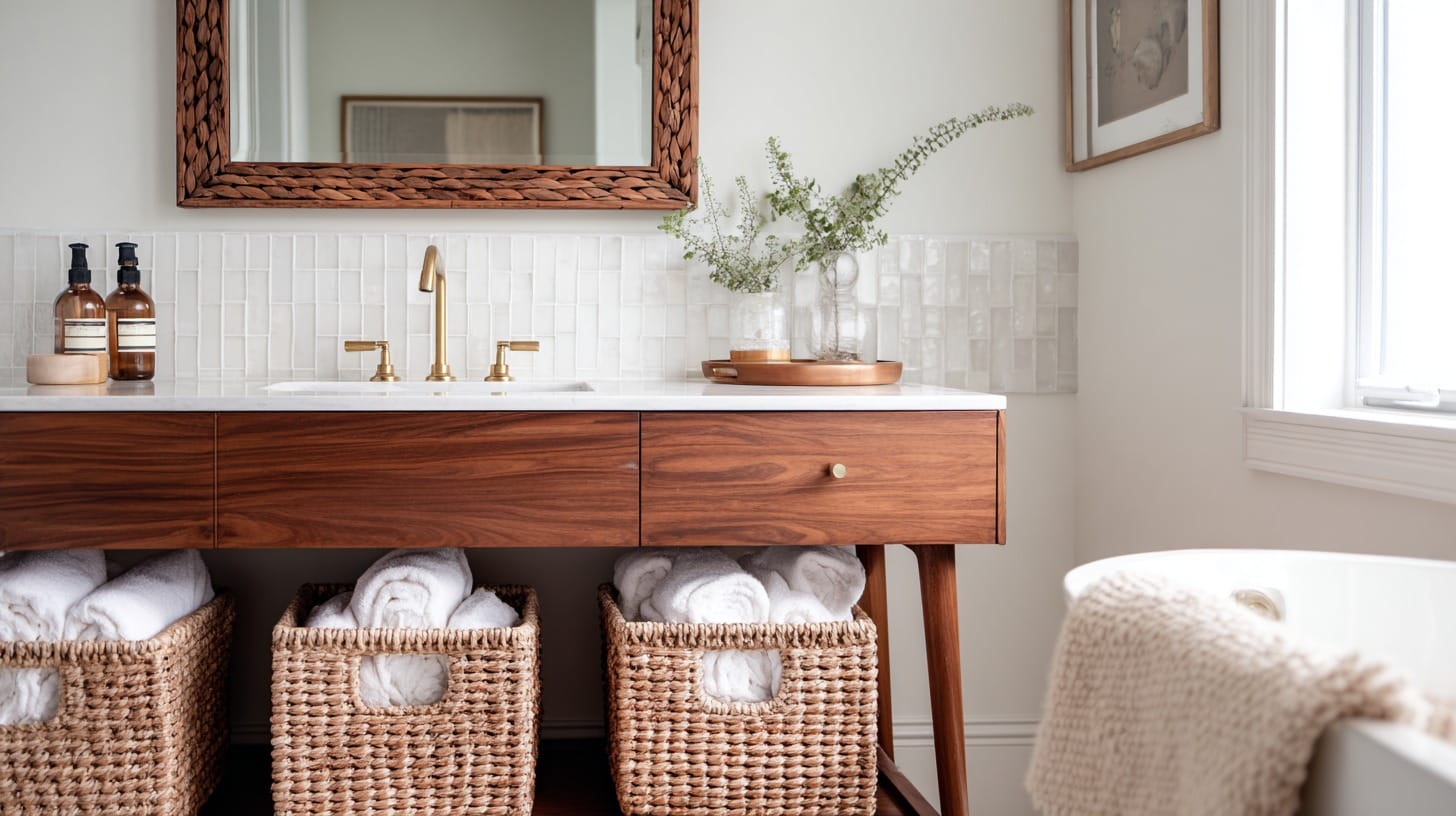
A mid century modern bathroom vanity brings something that traditional farmhouse pieces often lack: clean lines and intentional simplicity. Those tapered legs that define mid-century design create visual lightness, making even a substantial piece of furniture feel like it’s floating slightly off the ground. The warm wood tones—walnut, teak, oak—speak directly to farmhouse’s love of natural materials. And the streamlined silhouettes add sophistication that elevates the entire space without sacrificing warmth.
I think of it as the Rule of Three in action. You’ve got your anchor piece (the vanity) representing one style era. Then you layer in two supporting elements from your farmhouse vocabulary—maybe a vintage-inspired mirror and some woven baskets for storage. Suddenly, you’re not looking at a mid-century bathroom or a farmhouse bathroom. You’re looking at your bathroom. A space that feels intentional and completely unique to you.
The tension between sleek and cozy is where the good stuff happens. The vanity’s clean lines create breathing room, while the farmhouse textures around it add soul. Neither style dominates. They elevate each other.
Color Palettes That Bridge Two Worlds
You knew this was coming. We need to talk about paint.
If you’ve been around The Painted Hinge for any length of time, you know I can’t discuss a design concept without getting into color theory. You can have the most gorgeous vanity in the world, but put it against the wrong wall color and the whole thing falls flat. Paint is what separates a “nice” room from a room that stops people in their tracks.
When you’re blending mid-century modern and farmhouse styles, your color palette needs to do some heavy lifting. It needs to be warm enough to honor farmhouse’s cozy roots, sophisticated enough to complement mid-century’s clean aesthetic, and interesting enough to create that moody, collected vibe we’re after.
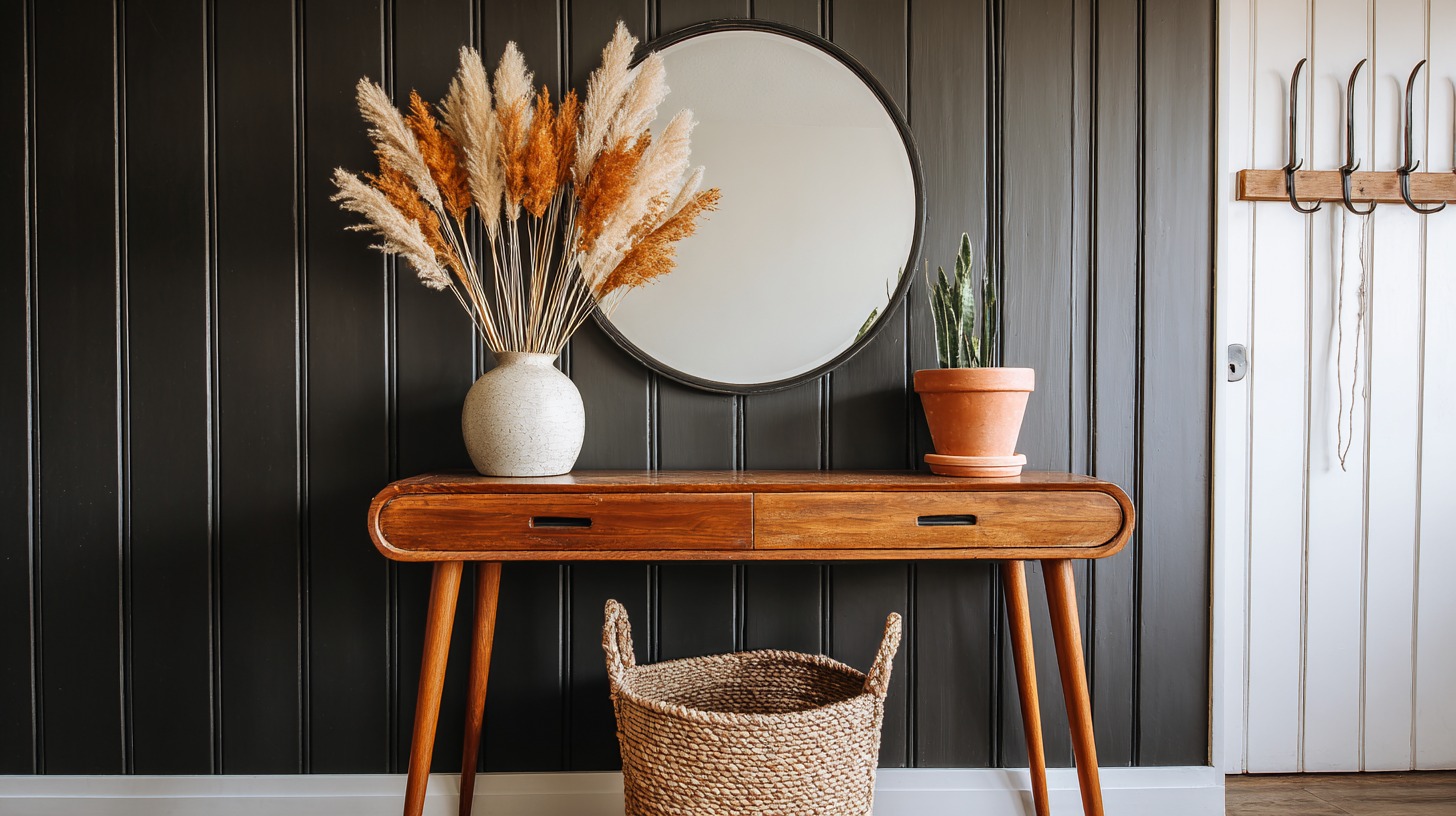
My current obsession is Sherwin-Williams Iron Ore (SW 7069).
If you haven’t met Iron Ore yet, you’re in for a treat. This is a deep, rich charcoal with the slightest whisper of brown undertone. It’s not a true black—it’s softer, more complex, more livable. The LRV (Light Reflectance Value) is just 6, which means it absorbs a lot of light and creates incredible depth on your walls.
Iron Ore works so well for this style mashup because it provides a moody, dramatic backdrop that makes warm wood tones glow. Picture a walnut mid-century vanity against an Iron Ore accent wall. The contrast is stunning without being jarring. The dark paint recedes, making the vanity the undeniable star of the show, while the brown undertones in the charcoal create a subtle harmony with the wood grain. I’ve used this combination in my own powder room, and I still walk in there just to admire it sometimes. (Don’t judge me.)
But maybe you’re not ready to go full moody. Maybe you want that farmhouse brightness with just a hint of mid-century sophistication. In that case, look at Benjamin Moore White Dove (OC-17).
White Dove is one of those rare whites that designers reach for again and again because it actually works. With an LRV of 85, it’s bright and airy without feeling sterile or cold. The secret is in its undertones—a gentle mix of cream and the faintest touch of gray that keeps it from veering into yellow territory. It’s warm, it’s welcoming, and it plays beautifully with both the honey tones of oak and the deeper richness of walnut.
Against White Dove, a mid-century vanity feels fresh and approachable. The clean lines read as modern rather than stark, and the warm wood becomes a natural focal point without competing with the walls for attention.
Whatever paint color you choose, pay attention to how its undertones interact with the wood tones in your vanity. Warm woods (walnut, oak, teak) pair best with paints that have warm undertones—creams, taupes, greiges, or charcoals with brown bases like Iron Ore. Cool woods (ash, maple, whitewashed finishes) can handle paints with cooler undertones. Get this relationship right, and your space will feel effortlessly cohesive. Get it wrong, and something will feel “off” even if you can’t pinpoint why.
Mixing Textures: Wood, Metal, and Stone
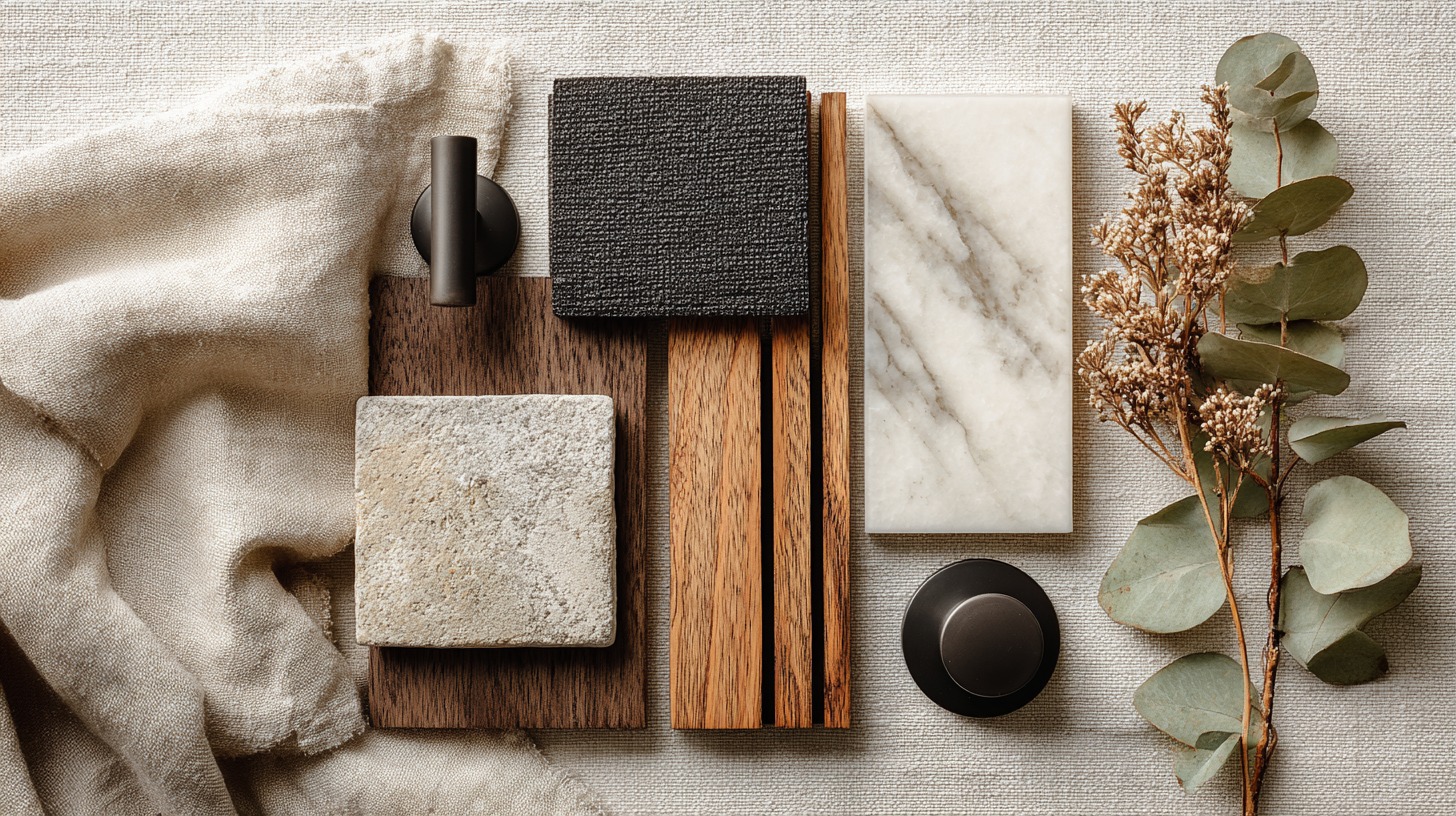
Color gets a lot of attention in design conversations, but texture is what makes a room feel truly finished. When you’re blending two distinct styles like mid-century modern and farmhouse, texture becomes your best tool for creating visual interest without chaos.
I think of it as a texture triangle—three distinct material categories that balance and complement each other: wood, metal, and stone.
Wood is your warmth. It’s the element that makes a space feel inviting and lived-in. In our mid-century-meets-farmhouse bathroom, the vanity handles a lot of this work. Those warm wood tones ground the space and provide that essential farmhouse coziness. But don’t stop there. Consider adding a wooden mirror frame, floating shelves in a complementary wood tone, or a small wooden stool for towel storage. The key is varying the wood tones slightly—mixing walnut with oak, for example—so the space feels collected rather than like you bought a matching set.
Metal is your edge. This is where mid-century modern really shines. Think tapered legs on your vanity, sleek hardware pulls, and lighting fixtures with clean geometric shapes. For a moody modern vibe, I love matte black metal. It’s bold without being flashy, and it creates beautiful contrast against warm wood tones. If you want something softer, brushed brass or aged bronze brings warmth while still reading as sophisticated. The trick is committing to one or two metal finishes throughout the space. Too many competing metals, and things start feeling chaotic rather than curated.
Stone is your organic anchor. Whether it’s a marble countertop, a natural stone vessel sink, or even just some river rocks in a decorative bowl, stone brings an earthiness that bridges both styles beautifully. For farmhouse vibes, lean toward honed or matte finishes rather than high-polish—they feel more relaxed and approachable. For a moodier mid-century feel, consider darker stones like soapstone or black granite. Either way, stone adds a textural weight that makes the whole room feel more substantial.
The goal with texture mixing is balance. You want enough variety to create visual interest, but not so much that the eye doesn’t know where to land. If you can identify your texture triangle clearly—”wood vanity, matte black hardware, marble counter”—you’re on the right track.
Your Permission to Mix Styles
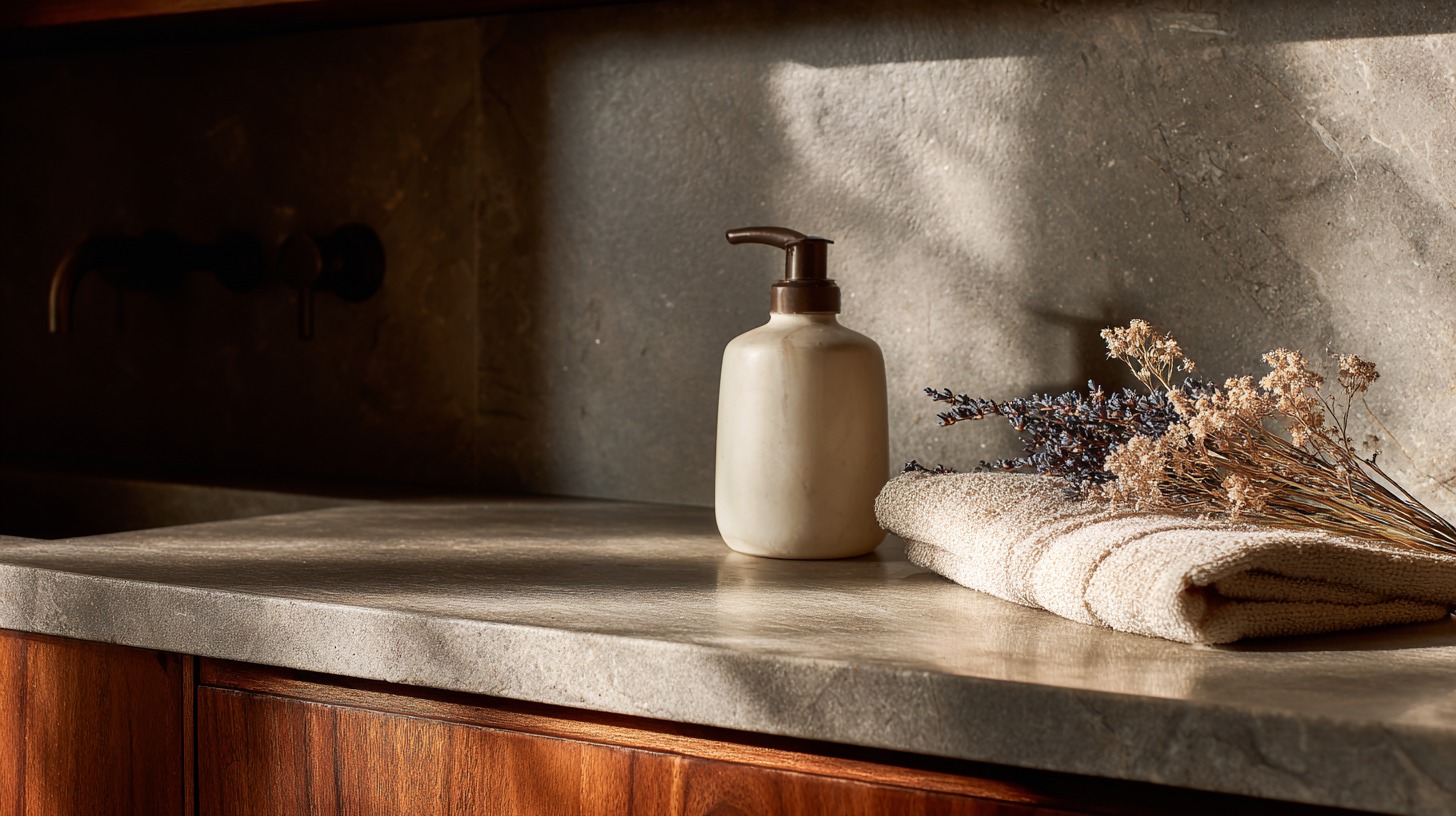
I want you to walk away from this with one thing: design rules are guidelines, not laws. The most beautiful, interesting, soul-filled homes I’ve seen are the ones that break the “rules” intentionally. They mix eras. They blend styles. They prioritize feeling over formula.
If you’ve been hesitant to bring a mid-century piece into your farmhouse-inspired space, or vice versa, consider this your green light. Start with one anchor piece that speaks to you. Build around it with complementary textures and a paint color that makes it shine. Trust your instincts. The goal isn’t a magazine-perfect room. It’s a space that feels like you.
The evolution of farmhouse style isn’t about abandoning what we loved. It’s about growing, layering, and allowing our spaces to mature alongside us. Clean lines can coexist with cozy textures. Moody walls can frame warm wood tones. A bathroom vanity with tapered legs can feel perfectly at home next to a vintage mirror and a basket full of rolled towels.
That’s what I love about mixing styles. That’s what makes a home feel collected rather than decorated.
I want to hear from you—have you experimented with blending mid-century modern into your farmhouse spaces? What’s your anchor piece? Drop a comment below or tag me on social media. I love seeing how you make these ideas your own.
Happy decorating.