You’ve picked the design, maybe even browsed composite materials. But before any work starts, there’s one thing that quietly derails more deck projects than budget issues or material choices: setback rules. Most homeowners don’t think about them until a permit gets rejected or, worse, a neighbor files a complaint. If you’re planning to hire deck builders near me or anywhere in your area, understanding setbacks before the first contractor conversation will save you time, money, and a serious headache.
What Is a Setback, and Why Should Deck Owners Care?
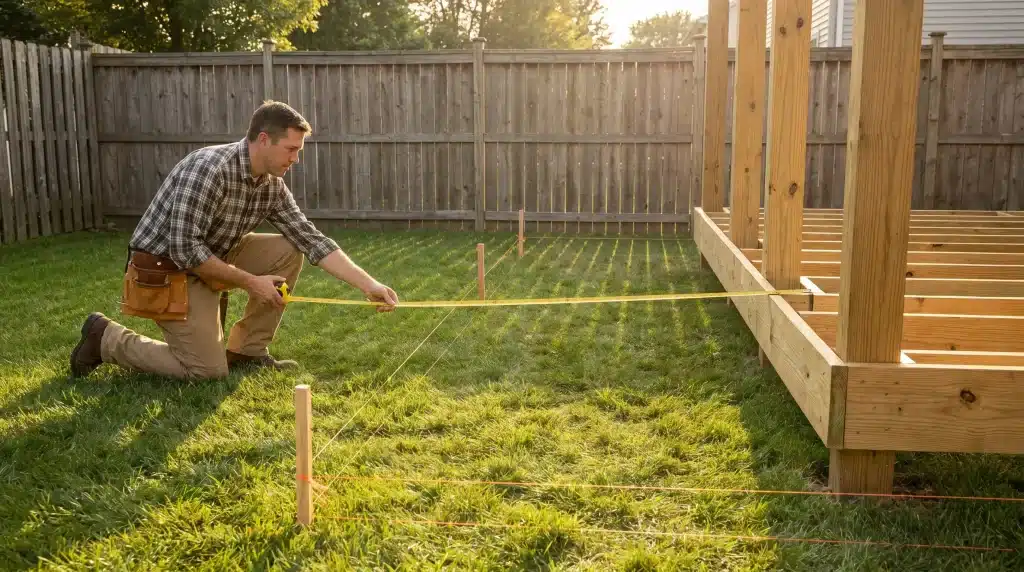
A setback is the minimum distance your structure must sit from a property line. Think of it as a buffer zone that the city or county requires between your build and the lot boundary. It applies to permanent structures, and a deck absolutely counts.
There are three main types:
- Front setback: The distance from your home’s front boundary. Usually, the largest of the three.
- Side setback: The gap required between your deck and the side property lines.
- Rear setback: The distance from the back boundary line. This one matters most for backyard decks.
So why should you care? Because if you build without checking setbacks, the consequences are real. We’re talking fines, a stop-work order that halts construction mid-project, or being forced to tear down what you just built. An unpermitted structure flagged during a home sale can kill the deal entirely. Title companies and buyers’ inspectors catch this stuff.
Front, Side, and Rear: How Each Type Affects Your Deck
Let’s break down how each setback plays out in practice.
Front setback is usually the strictest, often 20 to 30 feet from the street-facing boundary. Most backyard decks won’t touch this one. But if you’re thinking about a front porch or a wraparound design, you’ll need to know exactly where this line sits.
Side setbacks are typically somewhere between 3 and 6 feet, though this varies a lot by municipality. If you’re hoping to build a wide deck that runs close to a fence line, side setbacks will directly affect how many feet of width you can actually use. A 3-foot setback sounds minor until you realize your lot is only 40 feet wide.
Rear setbacks are the ones that come up most often. For a standard backyard deck, you’re looking at anywhere from 5 to 25 feet, depending on local codes. That range is huge, and it genuinely determines how deep your deck can be.
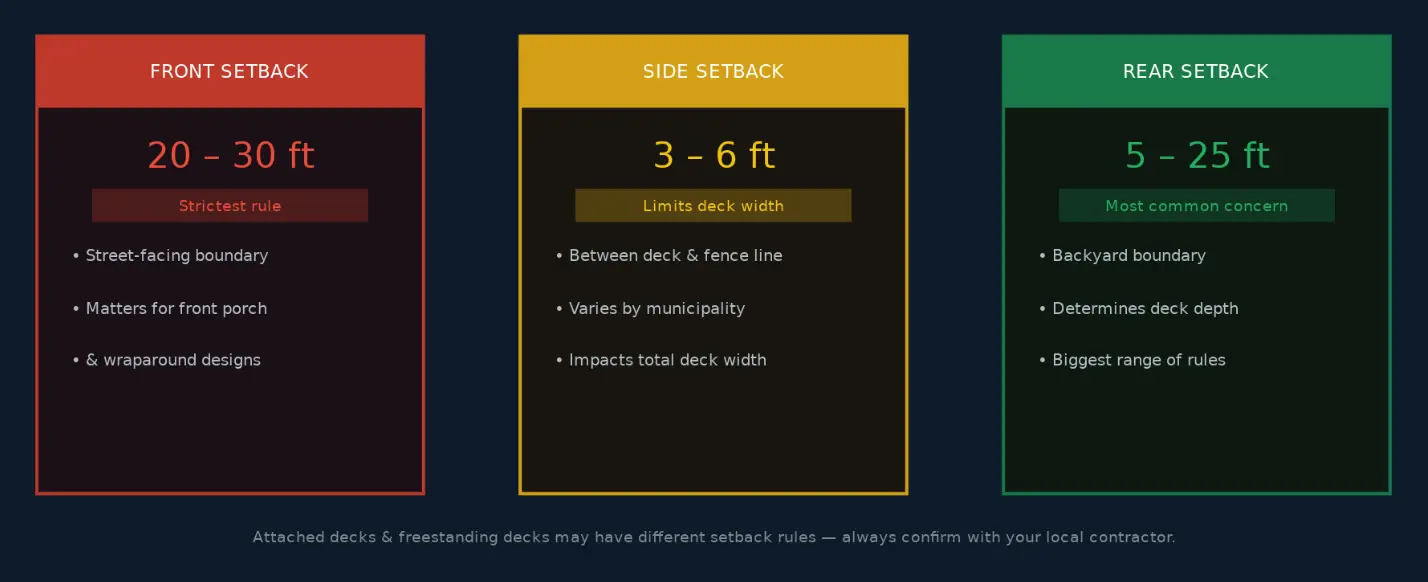
One more thing worth knowing: attached and freestanding decks are sometimes treated differently under local zoning rules. A freestanding deck that doesn’t connect to the house might qualify as an “accessory structure” with looser setback requirements in some areas. A good contractor will know if this applies to your situation.
Why Setback Rules Vary So Much by Location
Here’s where it gets frustrating. There’s no federal standard for residential deck setbacks. Every municipality writes its own rules. One city might allow you to build as close as 3.5 feet from a side property line. A town 20 minutes away might require 10 feet of clearance. Same state, completely different requirements.
On top of that, if you live in a community with a homeowners association, their rules layer on top of local codes. An HOA can require larger setbacks than the city does, and the city won’t override that.
Corner lots add another layer of complexity. If your property borders two streets, both boundaries are typically treated as front setbacks. That means stricter restrictions on two sides instead of one.
Irregular lots, like pie-shaped parcels or oddly angled properties, make this even more complicated. The setback still applies from the actual property line, which might not run parallel to anything on your lot. Bottom line: don’t guess, and don’t assume your neighbor’s deck is built to the correct setback either.
Common Situations Where Setbacks Become a Problem
Some scenarios come up over and over again.
Small or narrow yards. You might want a 16-foot-deep deck, but a rear setback of 20 feet on a shallow lot leaves you very little usable space. The deck ends up smaller than expected, or the project gets rethought entirely.
Pie-shaped or irregular lots. On a standard rectangular lot, calculating setbacks is straightforward. On a lot that tapers at the back, the usable build zone shrinks fast. Professional builders survey these carefully before drawing anything up.
Corner lots. Double front setbacks catch homeowners off guard. You plan for a deck along the side yard, then find out that the side faces a street and carries the same restrictions as the front.
Existing structures are eating into the zone. A shed, a detached garage, or even a large fence sometimes sits closer to the boundary than you’d expect. That affects how your deck gets positioned, especially if local code also restricts how close two structures can be to each other.
Experienced deck builders deal with these situations regularly. Part of the value they bring is recognizing setback conflicts before the design gets locked in, not after.
What Is a Variance and When Do Builders Apply for One?
A variance is an official exception to a zoning rule. If your property makes it impossible to comply with setback requirements while still building a functional deck, you can apply to your local zoning board for permission to deviate from the standard.
Generally, the process looks like this: you submit a written application explaining why you need the variance, pay a filing fee (typically $200 to $1,000 or more), and attend a public hearing where the board reviews your case. In some areas, neighboring property owners are notified and can object.
The timeline can stretch from a few weeks to several months, depending on how backed up the local board is.
Variances aren’t guaranteed, though. Boards typically want to see that strict compliance creates genuine hardship, not just that you’d prefer a bigger deck. Having a contractor who knows the local zoning board and has navigated this process before significantly improves your chances of building a solid case.
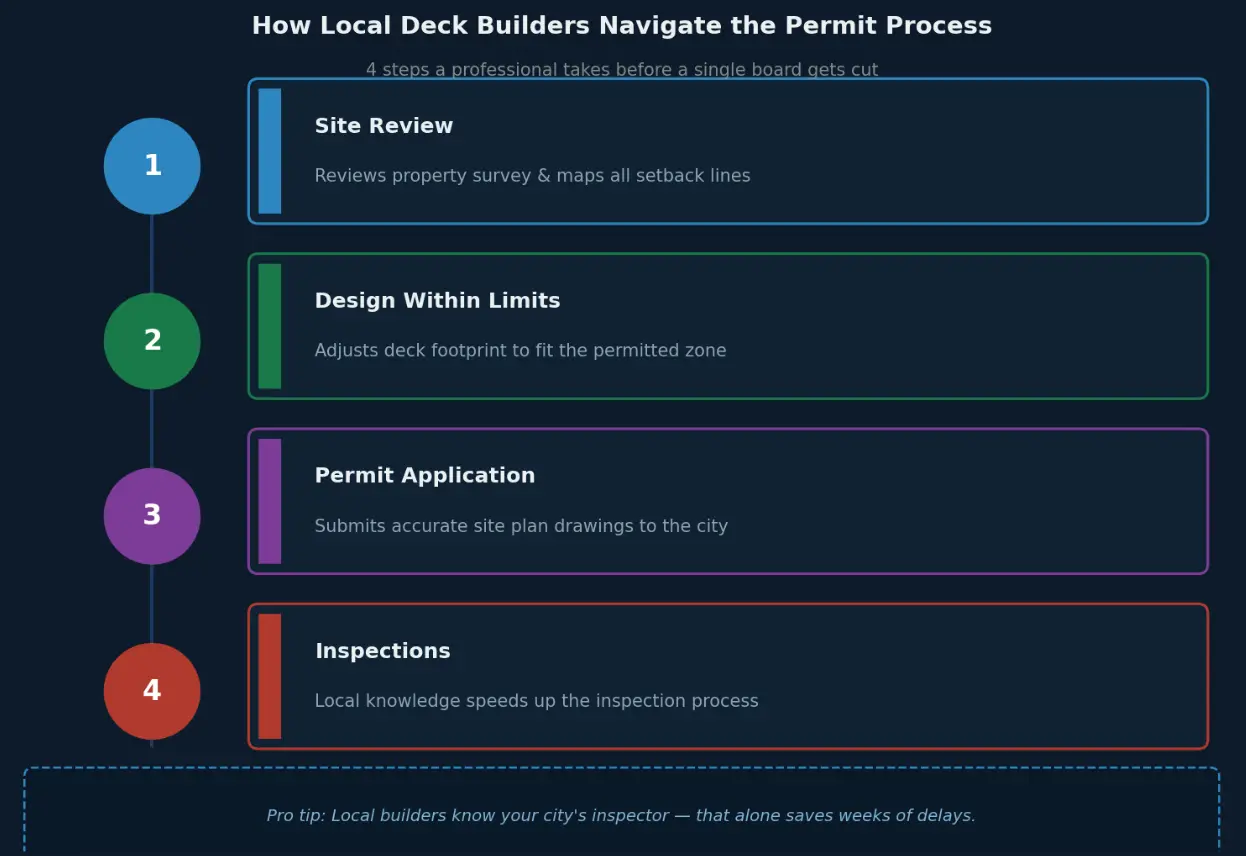
How Local Deck Builders Navigate the Permit Process
This is where hiring someone local really pays off. Here’s what a thorough contractor does before a single board gets cut.
- Step 1: Site review. A good builder reviews your property survey upfront. They identify all four setback lines and map out exactly how much buildable space you have. If you don’t have a current survey, they’ll flag that early.
- Step 2: Design within limits. The deck footprint gets adjusted to fit the permitted zone before any drawings are finalized. No surprises at the permit stage.
- Step 3: Permit application. Permit submissions require accurate site plan drawings showing the deck’s dimensions and its position relative to property lines. A professional handles this correctly the first time.
- Step 4: Inspections. Local builders know what the inspector in their area looks for. That familiarity speeds things up and reduces the chance of a failed inspection.
An out-of-area contractor can build a solid deck. But if they’re not familiar with your municipality’s specific requirements, the permit process gets slower and riskier.
The Real Risk of Getting Setbacks Wrong
Let’s be direct about what happens when setbacks are ignored.
If a neighbor notices the construction and files a complaint, your local building department will investigate. If they find a violation, you can expect a stop-work order immediately. Depending on the severity, you may be required to remove or modify the structure at your own expense. Some homeowners end up spending over $8,000 to relocate a deck that was built too close to a property line, on top of what they already paid for the original build.
Then there’s the home sale issue. A title search and inspection will flag unpermitted structures. Buyers can walk, or demand you remove it before closing. Insurance is another angle: some carriers won’t cover damage to structures that weren’t properly permitted.
Questions to Ask Before Hiring Deck Builders Near You
Before you sign anything, run through this checklist with your contractor:
|
Question |
Why It Matters |
|---|---|
|
Are you familiar with setback rules in my specific municipality? |
Local knowledge prevents permit rejections |
|
Do you handle the permit application? |
Saves time and reduces errors |
|
What happens if my project conflicts with setback limits? |
Test their problem-solving approach |
|
Have you filed variance applications before? |
Relevant if your lot has unusual constraints |
|
Will you request a property survey before designing? |
Skipping this step leads to costly redesigns |
If a contractor brushes off any of these questions or acts like permits are optional, that’s a red flag worth taking seriously.
Final Thoughts
Setback rules have a direct impact on how big your deck can be, where it can sit, and whether it stays standing without legal issues. Before you get attached to a specific design, make sure whoever you’re working with has actually pulled permits in your area and knows the local requirements. That’s the kind of groundwork that keeps a project moving forward instead of getting stuck in zoning limbo.