

Punch needle is one of those crafts that looks intimidating at first glance but turns out to be surprisingly approachable once you understand the basics. You push a hollow needle through fabric, loop by loop, and a textured design builds up on the other side. Simple in concept, deeply satisfying in practice. Before you immerse, though, there are a few things worth knowing so your first project doesn’t stall out halfway through. This guide covers everything from tools and setup to the beginner pitfalls that catch most people off guard.
What Punch Needle Actually Is (and Why It’s Worth Trying)
Punch needle is a textile art that uses a hollow, pointed tool to push yarn or thread through a woven fabric backing, creating loops on the reverse side that form a raised, velvety surface. The finished result can look like a rug, a wall hanging, or a framed piece of art, depending on the materials and scale you choose.
It sits somewhere between embroidery and rug hooking, borrowing elements from both. But, it moves much faster than traditional embroidery because each press of the needle creates an even loop without the need to pull the thread through by hand. Many people find they can complete a small design in a single afternoon, which makes it one of the more rewarding crafts to pick up as a beginner.
Punch needle kits from UK suppliers are a great starting point if you’d rather not source materials individually. These kits typically include a pre-printed fabric, a needle, and enough thread or yarn to finish the design, so you can focus entirely on learning the technique rather than second-guessing your supplies.
The craft also suits a wide range of budgets and skill levels. You don’t need artistic training or years of crafting experience. If you can follow a pattern and hold a tool, you can do punch needle.
Essential Tools and Materials You’ll Need
Choosing the Right Punch Needle and Fabric
The punch needle itself is the most important piece of equipment you’ll buy. These tools come in different sizes, and the size you choose should match the weight of your thread or yarn. Fine needles suit embroidery thread and produce small, tight loops. Larger needles are built for chunky yarn and create a bold, thick pile.
For beginners, a medium-size adjustable needle is often the smartest choice. It gives you flexibility to experiment with different loop heights and materials without committing to one fixed setting. Look for a needle with a smooth interior channel so the thread flows through without catching or snapping.
Fabric choice matters just as much. Monk’s cloth and weavers’ cloth are the most commonly used options in punch needle. Both have an open, even weave that allows the needle to pass through smoothly and holds loops in place without tearing. Avoid standard cotton fabric or canvas, as the weave is too tight for the needle to move freely.
Hoops, Thread, and Other Must-Have Supplies
A sturdy hoop or frame is non-negotiable. The fabric needs to stay drum-tight throughout your project, because loose fabric causes loops to fall out or sit unevenly. Traditional embroidery hoops work for smaller projects, though many punch needlers prefer a gripper frame or a no-slip hoop specifically designed for this craft.
For thread, six-strand embroidery floss or specialty punch-needle thread both work well for fine needlework. If you use a larger needle with yarn, choose a smooth, plied yarn rather than a fluffy or textured one. Fluffy fibres tend to catch inside the needle and break mid-loop.
A few other supplies worth having: a yarn threader or wire loop threader to thread the needle (this step is fiddlier than it sounds), scissors with a sharp point for trimming loops, and a transfer pen or light box to copy your pattern onto the fabric.
How to Set Up Your First Project the Right Way
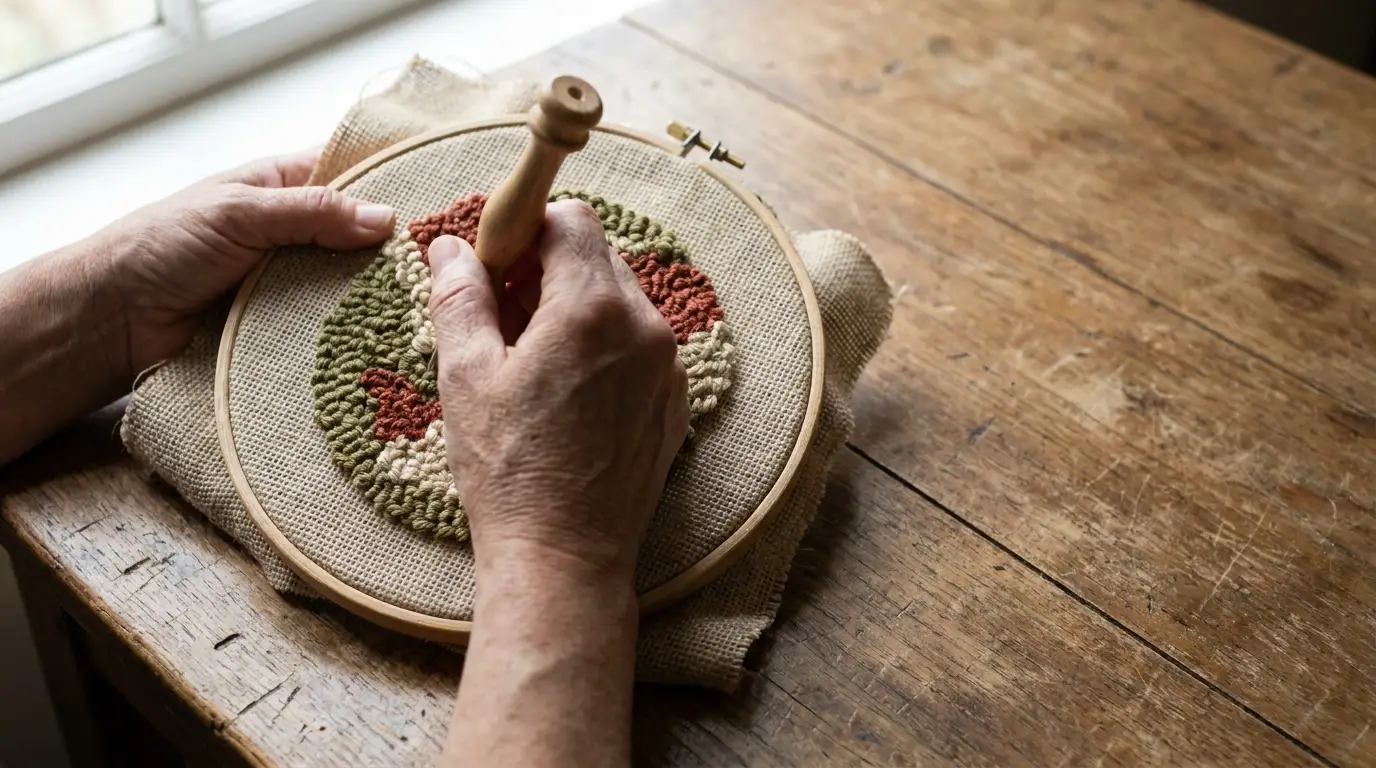
Setup is where a lot of beginners quietly go wrong, and sorting it out before you start saves a great deal of frustration later.
First, transfer your pattern onto the fabric. You’ll work from the back of the fabric, not the front, so the pattern needs to be mirrored before you trace it. Use a light box, a sunny window, or a transfer pen to get clean lines. Once the pattern is on the fabric, mount it in your hoop or frame and pull it taut from all sides.
Next, thread the needle. Feed the thread down through the hollow handle and out through the tip of the needle, then loop it through the eye. Many beginners skip checking the thread direction here, but it matters. The open side of the needle eye must face the direction you intend to move as you work. If it faces the wrong way, the loops won’t form correctly.
Start punching in a small, inconspicuous area first to check your loop height and tension. Hold the needle perpendicular to the fabric, push it fully down to the handle, then drag it along the surface before pushing again. Keep the needle in contact with the fabric between punches: if you lift it too high, you’ll pull out the loops you’ve just made.
Work in rows, following the outlines of your pattern before filling in larger areas. This approach gives your design clean edges and a neat, consistent finish.
Common Beginner Mistakes and How to Avoid Them
Most first-time punch needlers run into the same handful of problems. The good news is that nearly all of them come down to technique rather than talent, so they’re straightforward to correct once you know what to look for.
- Loops that fall out. This usually means the fabric isn’t tight enough in the hoop, the needle isn’t pushed all the way down on each punch, or the needle is being lifted too far off the surface between punches. Retighten your fabric and slow down your pace.
- Uneven loop height. If your loops look inconsistent, check that you’re pushing the needle to the same depth on each punch. An adjustable needle with a depth stop makes this much easier to control.
- Thread breaking mid-project. Thin or loosely twisted thread tends to snap if there’s friction inside the needle channel. Switch to a smoother thread, and check the interior of the needle for any rough edges that might catch the fibre.
- Distorted fabric. Too much tension in one direction, or punching rows too close together, can pull the fabric out of shape. Leave a small amount of space between rows and re-tension your hoop as you work if the fabric loosens.
- Not leaving enough tail. At the start and end of each colour, leave a short tail of thread on the loop side of the fabric. Once you’ve finished the project, trim these tails neatly rather than pulling them through, as pulling can unravel nearby loops.
Take your time with the first few inches of any project. That initial practice area teaches you more about your specific tools and materials than any written guide can.
Conclusion
Punch needle rewards patience and a little preparation. If you take the time to understand your tools, set up your fabric correctly, and stay aware of the common slip-ups, your first project is far more likely to turn out the way you pictured it. Start small, choose a simple design, and give yourself permission to practise without pressure. The technique clicks faster than most people expect, and from there, the possibilities for what you can create are genuinely wide open.