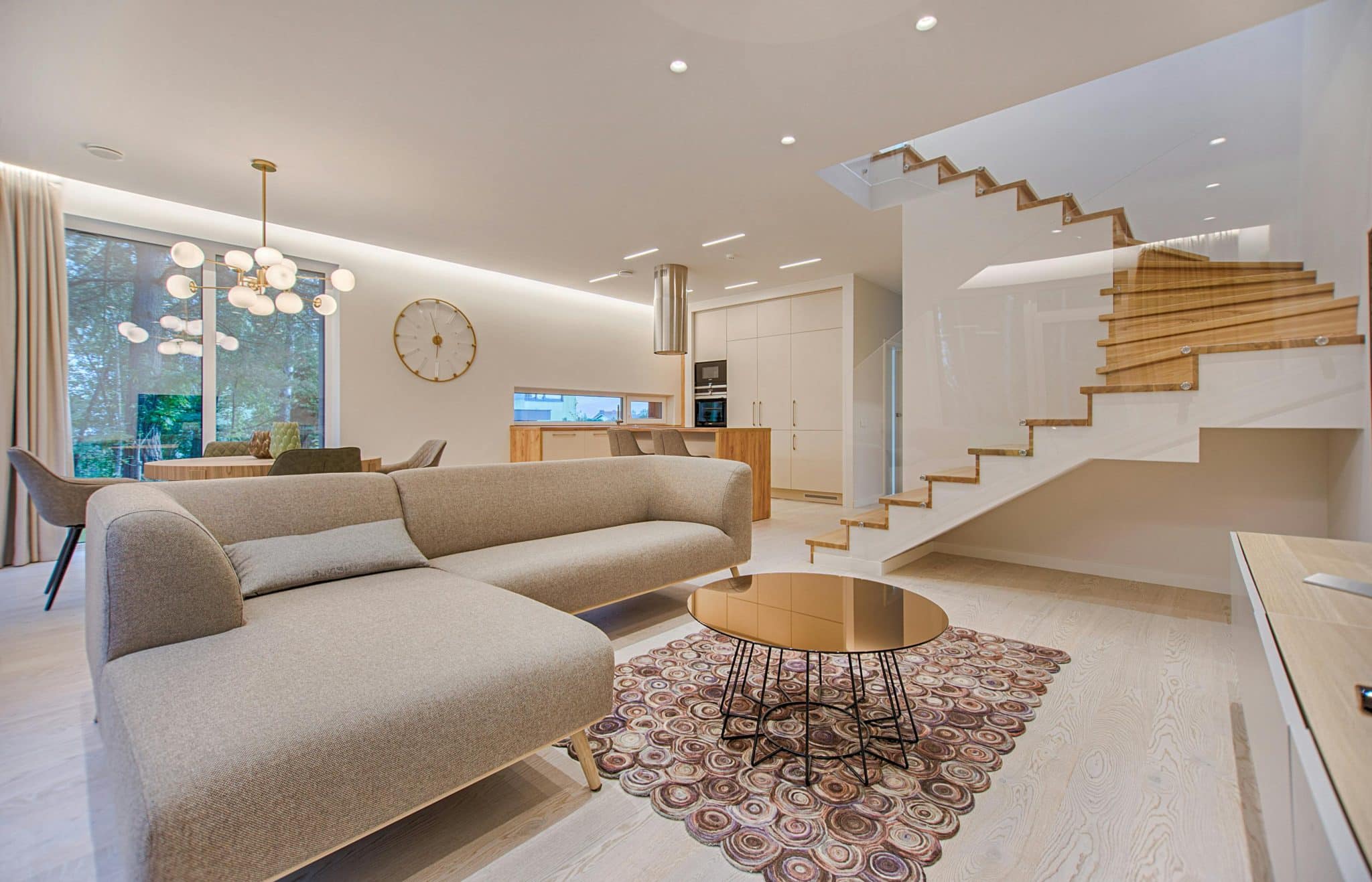

While walking up and down your staircase, you don’t think about them because they’re functional and they work. But they could be so much more.
The right lighting transforms your stairs from invisible infrastructure into a design feature. From purely functional to genuinely beautiful.
Most people never think about staircase lighting. They focus on living rooms, kitchens, and bedrooms. Stairs get whatever light spills down from the top. But stairs deserve better. They deserve to be both safe and beautiful.
Staircase Lighting Approaches: Function vs. Style
|
Lighting Type |
Safety |
Style |
Installation |
Cost |
Best For |
|---|---|---|---|---|---|
|
Recessed Lights |
Excellent |
Minimal |
Moderate |
Moderate |
Modern minimalist |
|
Linear Pendant Lights |
Good |
Excellent |
Moderate |
Moderate-High |
Contemporary style |
|
Wall Sconces |
Good |
Excellent |
Easy |
Low-Moderate |
Varied aesthetics |
|
LED Strip Lights |
Excellent |
Good |
Easy |
Low |
Under-step glow |
|
Handrail Lights |
Excellent |
Good |
Moderate |
Moderate |
Safety + function |
|
Chandelier |
Minimal |
Excellent |
Moderate |
High |
Statement piece |
Why Staircase Lighting Actually Matters
Staircases need two things from lighting. The safety and style. Most people focus on one or the other. They get good lighting that’s ugly or beautiful lighting that’s not safe, while finding both is rare.
But it’s possible when you get it right, something shifts. Your entire entry or stairwell transforms.
Interior designer Sarah Chen explains it simply: “Staircase lighting is one of the most underutilized design opportunities in homes. It’s visible from multiple levels. It sets the tone for the entire space. When done well, it becomes architectural. When done poorly, it’s just functional. Most people settle for functional and never realize what they’re missing.”
That’s exactly what Light House Co understands. Staircase lighting isn’t an afterthought. It’s a design opportunity. It needs to balance safety with style.
Staircase Lighting For Safety First
1. Visibility Prevents Falls
I didn’t think much about staircase lighting until someone stumbled on my poorly lit stairs. They caught themselves. But it made me realize: unclear visibility creates accidents.
Each step needs clear visibility. Shadows on stairs are dangerous, and the light needs to reach every step, every corner, and every potential hazard.
When you can see clearly, you don’t stumble. When you can’t, you do.
What matters for safety:
- Each step needs clear visibility
- Shadows create safety hazards
- Light must reach all areas
- Proper illumination prevents accidents
2. Consistent Lighting Prevents Confusion
I added lights, but they weren’t evenly spaced. Bright in one area. Dark in another. My eyes would adjust to bright light, then hit a shadow. Suddenly, I couldn’t see the next step clearly. That transition is dangerous.
Consistent lighting throughout prevents that. Your eyes adjust once and stay adjusted. No sudden dark zones. No confusion about where the next step is.
What matters:
- Dark spots create confusion
- Eyes need time to adjust
- Consistent light prevents missteps
- No sudden dark zones
3. Foot-Level Lighting Adds Real Safety
I was skeptical about under-step lights. Then I added them, and they make navigating stairs at night entirely different.
You don’t need to turn on bright overhead lights. The under-step lights show you where the edges are. You can walk safely without full illumination. It’s safer at night than full bright lights that wake people up.
What this does:
- Shows stair edges clearly
- Helps at night without full lights
- Guides movement naturally
- Reduces stumbling risk
Night-Friendly Lighting Matters
Full bright lights on stairs at night are harsh, but complete darkness is dangerous. You need a middle ground, softer lighting that provides visibility without jarring you awake at 2 a.m.
Night-friendly lighting balances safety with comfort. You can navigate safely. You’re not shocked awake by bright lights.
What works:
- Full lights at night can be harsh
- Softer lighting enables safe navigation
- Doesn’t disturb sleep
- Still provides necessary visibility
How Lighting Turns Stairs Into Design Features
1. Statement Lighting Defines The Space
I didn’t realize how much my entry looked unfinished until I added real staircase lighting. Suddenly, it had personality and had intention.
The stairs weren’t just there anymore. They were a feature. A design element worth noticing.
That’s what statement lighting does. A chandelier above the landing. Pendant clusters along the stairwell. Something that says, “I designed this intentionally.”
2. Modern Minimalist Approaches
Modern minimalist staircase lighting means the light fixtures disappear. Recessed lights in the ceiling. Linear lights are integrated into the structure. The light itself is the design, not the fixture.
It works beautifully in contemporary homes. The lighting serves the architecture without competing with it.
3. Contemporary Style With Purpose
Contemporary design is about function meeting beauty. The staircase lighting in contemporary homes works hard and looks good doing it. The linear fixtures, wall sconces, and clean geometry. Everything serves a purpose and makes a statement.
Contemporary staircase lighting doesn’t apologize. It’s intentional, visible, and it’s part of the design.
Contemporary styles work beautifully for staircases. Linear pendant lights hung along the stairwell create clean lines and modern aesthetics while providing the light you actually need.
4. Architectural Details Enhanced By Light
Some stairs have interesting architectural details. Curves, heights, and interesting walls.
Good lighting emphasizes those, while accenting them makes them visible. Bad lighting hides them.
When you light stairs right, you’re highlighting the architecture. You’re making the space more interesting.
Finding The Right Lighting For Your Aesthetic
1. Recessed Lights
I wanted modern and clean, and recessed ceiling lights seemed perfect. They disappear and don’t compete for the space. The light comes from the architecture itself.
Installation requires planning. Usually, during renovation, the result is seamless.
What this offers:
- Disappears into the ceiling
- Creates clean lines
- Good for modern homes
- Requires planning during renovation
2. Wall Sconces
Wall sconces are flexible. They work with traditional, contemporary, and varied home styles.
I added them to my stairwell, and suddenly, it had personality. They’re easier to add to existing stairs than recessed lights. No major renovation needed.
What this offers:
- Works with various styles
- Easy to add to existing stairs
- Creates ambient light
- Adds personality
3. Under-Step Lighting
Under-step lighting transformed my stairs at night. The floating effect is beautiful, and the practical safety is a plus. Modern homes especially benefit from this approach.
It’s one of the easier lighting upgrades you can add without a major renovation. The impact is immediate.
What this offers:
- Shows stair edges clearly
- Creates a floating effect
- Modern and functional
- Especially good for night navigation
Statement Fixtures: Making A Statement
A chandelier above a landing, pendant clusters down the stairwell. These aren’t practical solutions. their statements. They say, “I designed this intentionally. I care about this space.”
Statement fixtures work when you want stairs to be noticed. When you want them to be a centerpiece.
What this offers:
- Chandelier above the landing
- Pendant clusters along the stairwell
- Defines architectural importance
- Becomes centerpiece
Before You Choose, Think About Installation
What looks beautiful might be complicated to install. Recessed lights require ceiling work, sometimes structural changes. Wall sconces need electrical outlets. Under-step lights need proper mounting.
Think about timing. Can you do this during renovation? Or do you need something easier for existing stairs?
Think about the budget. Installation costs matter. Professional electricians cost money. DIY isn’t always possible.
Weigh beauty against practicality. Sometimes the most beautiful solution isn’t the most practical for your situation.
Frequently Asked Questions
How much light do stairs actually need?
Enough to see every step clearly. You should be able to identify the edge of each stair; complete darkness isn’t safe. Harsh brightness isn’t necessary. Middle ground.
Can I add lighting to the stairs without renovation?
Yes. Wall sconces are easy. Under-step lights are doable. Pendants can work. Recessed lights require ceiling work. Choose based on your renovation tolerance.
What’s the best style for modern homes?
Recessed lights for clean minimalism. Linear pendants for contemporary. Under-step lights for the floating effect. Modern homes give you flexibility.
Should stairs be lit with bright or soft light?
Both. Bright enough to see clearly. Soft enough to be comfortable around. Not harsh. Not dim. Balanced.