

I spent three weeks staring at a blank wall in my dining room trying to decide: paint it a bold color or go with wallpaper? I had my paint chips fanned out on the table, two browser tabs open, and absolutely no idea which direction to go. Sound familiar?
If you’ve ever stood in that same spot of indecision, this post is for you. I’m going to walk you through exactly how I now make that decision every time, and it all comes down to reading your existing color palette first.
Why Your Existing Colors Should Always Come First
Before you even think about whether to paint or wallpaper, you need to look at what’s already in the room.
Pull the three dominant colors from your space: your wall paint (or floor color if it’s a statement), your largest upholstered piece, and whatever your eye lands on first when you walk in. These three form your palette anchor, and every accent wall decision needs to work within or deliberately contrast that anchor.
Start by identifying the three dominant colors already in your room before committing to any wall treatment.
If your room already has high color contrast (say, dark floors, white walls, and bold furniture) a painted accent wall in a deep tone can feel powerful without overwhelming the space. But if your room reads as tone-on-tone, think beige walls, oatmeal sofa, natural wood, a paint color alone rarely creates enough visual punch. That’s where wallpaper wins.
When Paint Is the Right Call
Paint is the right choice for your accent wall when:
- Your color palette is already bold. If you’re living with Benjamin Moore Saybrook Sage or Sherwin-Williams Cascades on two walls already, a painted accent in a complementary deep tone (think warm terracotta against a cool sage) creates drama without chaos.
- You want architectural definition. A single painted wall in a slightly darker or cooler shade of your main color makes a room feel more intentional, especially in open floor plans.
- Your budget is tight. A quart of paint covers an average accent wall and typically costs under $20, which is hard to beat for impact per dollar.
The rule I use: if the color itself is the statement, paint it. If you need pattern and texture to carry the wall, keep reading.
When Wallpaper Is the Right Call
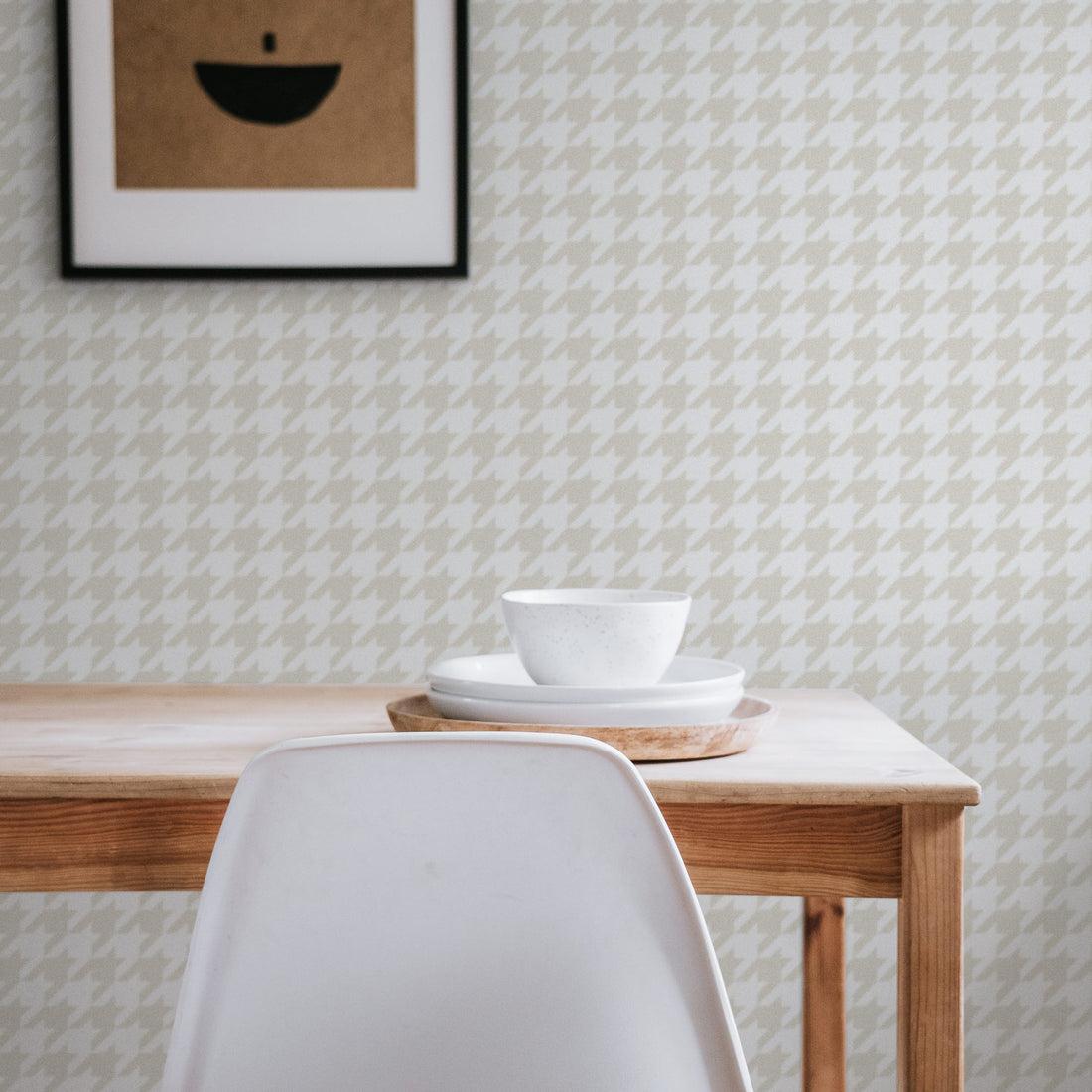
A patterned accent wall can completely transform a neutral room without a single nail hole.
Wallpaper earns its place when paint simply can’t do the job alone. Specifically:
- Your color palette is neutral and needs texture. Tone-on-tone rooms with Sherwin-Williams Alabaster, Benjamin Moore Pale Oak, or Benjamin Moore Edgecomb Gray on the walls need something with surface interest. A geometric, botanical, or linen-texture wallpaper reads as designed rather than unfinished.
- You’re renting or want flexibility. This is where modern peel and stick wallpaper completely changes the game. You get the same visual impact as traditional wallpaper with zero permanent commitment. It comes down cleanly when you’re ready for a change, which has made it a go-to for renters and frequent redecorators alike.
- You want to set a mood that color alone can’t. A floral wallpaper in a powder room feels intimate and intentional in a way that even the most beautiful paint color can’t replicate.
How to Match Wallpaper to Your Existing Palette
This is where most people go wrong. They fall in love with a wallpaper design and then try to force it into their room. Do it the other way around.
Step 1: Identify your palette’s undertone. Is your space warm (beiges, creams, terracottas) or cool (grays, blues, sage greens)? Warm rooms pair with wallpapers that have cream or warm white backgrounds. Cool rooms need papers with gray or bright white bases.
Step 2: Let one color in the wallpaper echo the room. Your wallpaper doesn’t need to match your paint, it needs to relate to it. If your walls are Sherwin-Williams Accessible Beige, a botanical wallpaper with dusty green leaves and a warm cream background will feel intentional. If you pick a bright white-background floral in the same room, it will fight the walls.
Step 3: Use the wallpaper’s secondary color as your accent elsewhere. Whatever the secondary color is in your chosen pattern, bring it into a throw pillow, a candle, a vase. This is how a wallpaper accent wall feels designed rather than decoratively dropped in.
The Room-by-Room Cheat Sheet
The right wall treatment depends on the room. Here’s how to read the space before you decide.
|
Room |
Choose Paint If |
Choose Wallpaper If |
|---|---|---|
|
Bedroom |
You want a calm, enveloping feel |
The room is neutral and needs a cozy focal point behind the bed |
|
Dining Room |
You already have a bold rug or statement art |
The room is understated and gathering moments need elevation |
|
Powder Room |
It’s tiny and you want it to feel larger |
It’s small, so use that as an excuse for something truly dramatic |
|
Living Room |
You have bold furniture you love |
The furniture is neutral and the wall should do the heavy lifting |
A Note on Kitchens
For most kitchen walls, I’d actually steer you away from traditional wallpaper entirely. Steam, splashes, and grease are tough on any paper-based product. What works brilliantly instead is a peel and stick backsplash. The waterproof vinyl material holds up against everything a kitchen throws at it, and the tile and marble designs look genuinely stunning behind a range or sink without requiring any grout, tools, or a contractor.
My Final Tip Before You Decide
Order samples before committing. This applies to both paint and wallpaper equally. Your screen, your phone, and even the store display all lie. A 12-inch wallpaper sample on your actual wall in your actual light is the only honest preview you’ll get. Most quality wallpaper brands offer them, and it’s the best small investment you’ll make before a room refresh.
Whether you end up painting or papering, the most important thing is making the decision confidently. That confidence comes from trusting your palette first, then finding the material that serves it.
Now go make that accent wall decision. Your dining room (or bedroom, or powder room) has been waiting long enough.