
The funny thing about making art is that the process is never truly done. The last brushstroke may dry, and the studio may get quiet, for a moment at least, but then other responsibilities show up; responsibilities that involve doorframes, elevators, and deadlines.
Art transportation is a tricky business, given how much could go wrong between Point A and Point B, and the piece you poured your heart and soul into could be ruined.
That said, art usually moves for the best reasons. A painting or sculpture leaves your studio because it’s getting its first moment under the spotlight. It’s going to be seen every day by someone who loved it enough to bring it closer, so you should treat this step as the next stage of care, rather than an afterthought. Here’s how.
Don’t Do It Yourself
In a perfect world, artworks would glide around on clouds, never bumping into anything sharper than a compliment. But in the real world, most of the risk show up precisely during handling and transit, accounting for around 60% of all artwork damage claims. This is when pieces are lifted, tilted, set down, rolled across thresholds, or left for a moment in the wrong environment.
That’s not meant to scare you into never moving a piece again. It’s simply meant to underline that transportation is the danger zone.
The good news is that you can hire professionals and let them obsess over how a frame is held, how corners are protected, how vibrations travel through a crate, how long a piece sits in a truck, and how quickly it goes from cold air to warm air.
Art isn’t only moving from studio to gallery or directly to collectors anymore, either. It’s also going to pop-up shows, short-term installations, photo shoots, and back again. The global art market itself is still huge, even though a major annual report estimates that it fell 12% to $57.5 billion in 2024.
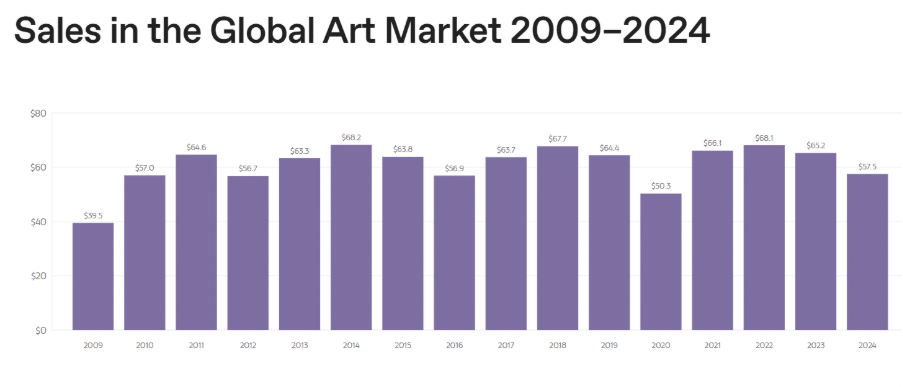
[Source: Art Basel]
The point is that an enormous volume of objects is traveling, and a lot of that travel happens under real-world conditions that no longer include dedicated museum loading docks as often as they used to. Now, plenty of artworks have to find their way through tight stairwells and busy streets, increasing the risk of damage.
So, bubble wrap and wishful thinking are simply not going to cut it. Protecting art beyond the studio must involve a repeatable process that you can rely on, and that’s where professionals can make a difference.
Art Can Be Deceptively Fragile
We tend to judge durability with our eyes. If a sculpture looks solid, it feels like it can take a hit, but materials often don’t behave like our brains want them to.
This is especially true with paint finishes, because the top layer is where micro-scratches, scuffs, impressions, and tackiness show up first. A surface that’s dry to the touch can still be soft enough to take a faint texture transfer from foam or even the wrong kind of paper.
Glossy layers can show abrasions that matte surfaces hide, while matte layers can burnish into shiny spots from pressure. So, the safest mindset is to treat every surface as if it can be marked by pressure, friction, or contact, because it can.
Temperature and humidity can affect materials, too. A canvas tension can change, and adhesive can soften. Trouble is, different layers respond at different speeds, which is how you get warping and cracking.
Even conservative guidelines for paintings emphasize stability, recommending storage and display around 15–25°C and 45–55% relative humidity, with limited daily fluctuation. Basically, dramatic swings, like you get when you move a piece from a hot car to a cold hallway, or from a damp loading area to a dry heated room, add stress fast.
A short trip in harsh conditions can do more harm than a long trip done thoughtfully, so don’t think that you’re safe because you’re only moving a painting “down the road.”
Some works are fragile because they’re old, while others are fragile because they’re intentionally complex. Special finishes and techniques could create a raised powdery, tacky, metallic, layered, or intentionally uneven surface. That means they could chip, smudge, pick up marks, or catch on packing material.
For pieces like this, generic packing is rarely good enough. The packing has to match the work, not the other way around.
The Care Continues
Protecting art isn’t separate from creating it. It’s the same mindset in a different outfit. Making something worth moving means it’s worth caring for, and caring for it during the move lets the work arrive as itself, rather than a slightly damaged version of what it used to be.
The thing is that when art moves, it carries your time and your intention into a new space. The least you can do is help it get there safely.