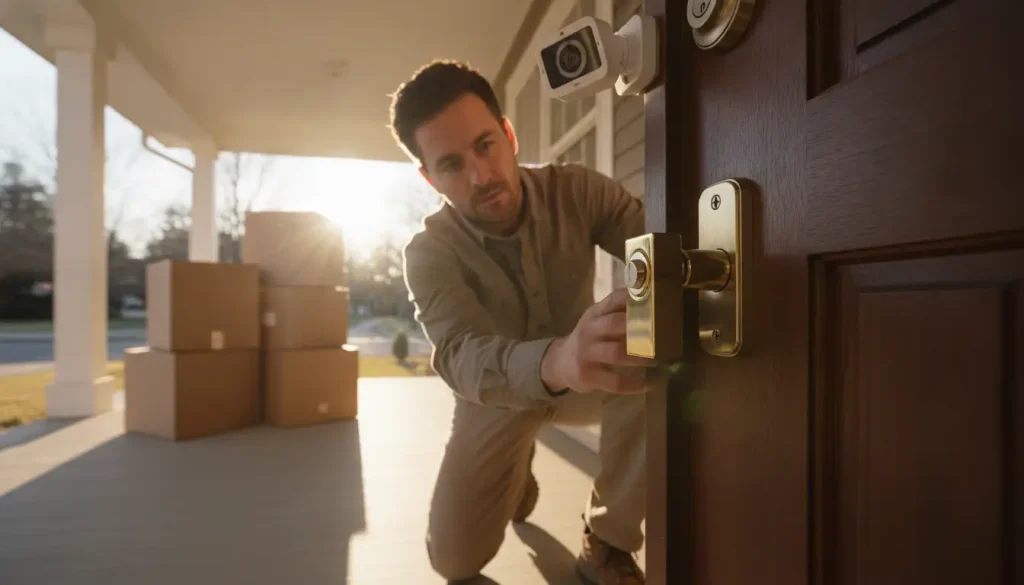
When you move into a new place, you should remember that the previous owners could still have keys to your brand new front door, which is a security hazard. You never know how many people have keys to your front door!
Why the First 48 Hours Count Most
As soon as you shift into a new place, it is unsafe as you have no idea how many people have been given spare keys to your front door by the owner. For example, the cleaner, neighbors, and building contractor working on the house, maybe even the person who fixed the sink, could have copies of the keys
Thus, the moment when the last box gets unpacked becomes the moment when you have to start securing your new home. Not a fortnight later, when you have settled in nicely.
Day One: Audit All Possible Entry Points Before You Start Unpacking
Walk around the house noting all the possible entry points before you start unpacking. You are looking for all exterior doors such as the one connecting the garage to the house, but many people forget to look at ground-level windows, sliding glass doors, and pet doors large enough to allow access
- If there is a basement or even outbuildings, make sure to add them to your list.
- Write down all exterior doors, including the front and back doors of course, and their lock type.
- Check for sliding glass doors and any windows that might have additional locks or only the manufacturer’s standard latch
- Assess the condition of door frames bearing in mind that a door is only as secure as its frame
Though it will take twenty minutes, this exercise will set the foundation for everything else and it will help you decide what requires your attention most
Rekeying Versus Replacing: Where to Spend Your Money
Many people will assume that you have to change the locks on a new house, but it is rarely the best option. The lock rekeying is a process which adjusts a lock’s internal mechanism so that only the new key works, while the cylinder itself remains the same. This way, you can save significantly on the overall cost as compared to full replacement.
A lock rekeying on day one is exactly the kind of security investment to make as all the keys ever made for that cylinder now cease to function. Unless you have old, low-security deadbolts with minimal entry resistance, thin keyholes, and no turnpiece, rekeying is an option for all the deadbolt locks in your home. The rekeyed lock cylinders retain the security of the existing hardware without spending money on new deadbolts unnecessarily.
A Melbourne Locksmith can assess the existing hardware and advise whether each lock is suitable for rekeying or should be replaced.
On the other hand, it goes without saying that rekeying will not suffice for damaged or low-security locks
The Strike Plate Problem Most Homeowners Don’t Even Consider
The strike plate is the bit of hardware set into the door jamb that a deadbolt slides into when the lock is engaged. Residential door frames tend to have massive security flaws as their standard strike plates are mounted with half-inch screws. The strike plate itself barely extends beyond the thin door casing to make contact with the timber of the wall stud. This way, a potential intruder can easily kick in your front door. The force of the kick is absorbed by the thin casing which simply bends and gives way to the pressure until the door swings inwards
A heavier gauge extended reach steel strike plate replaces the factory one on all exterior doors the week you move in and is attached to the door jamb with three-inch screws. This way, the strike plate overlaps the two-by material and extends far beyond the casing, making it much harder to kick in. A weakness in the door assembly turns into a strength with minimal investment
Make sure to do this to all the exterior doors within Week 1. It will cost you less than an average dinner out, but it will increase the forced entry resistance of all your exterior doors substantially
Sliding Doors and Windows: The Security Threats Homeowners Overlook
Sliding patio doors pose a significant security threat as their standard latch mechanisms only serve to keep pets or toddlers in. Most of the sliding doors on the market can be opened from the outside with alarming ease, and many can also be slid open if the door’s track can be manipulated
The solution is to install a patio door loop lock or a lock bar which will prevent criminal activity such as the sliding door being lifted or opened from the outside, even when the latch is open. A bar of wood or a purpose-made drop bar can then be placed in the track so that the door cannot be moved.
Ground Floor Windows: A Zone-Based Approach to Making Them Less of a Security Risk
The purpose of the ground floor windows is to allow light into the house and to provide cross-ventilation. However, many homeowners forget to secure them as much as the front door. Windows can be secured without being locked completely shut
The best solution for homeowners is to limit the opening of their windows using inexpensive windoor vent locks. It is possible to leave the windows partially open to ensure that there is enough airflow, and the locks prevent the opening from being larger than that. In addition to that, security film added to the windows will hold them together if they are smashed, thus preventing silent entry through the glass panes
Securing Your Garage: Including the One Thing No One Tells You About
Most garage doors have some sort of emergency release cord on the inside so that the door opener can be released in the event of a power failure. Unfortunately, the garage door release cord is a well-known weakness and can be pulled from the outside with a wire hook attached to a string. A potential intruder only has to reach over the edge of the garage door, find the release mechanism, and pull it to open the door.
Preventing such intrusions only takes a moment and a couple of dollars. A zip-tie fastened around the release lever limits its travel and makes it inaccessible to potential trespassers
There are also specialized release safety devices that come in shield form and attach to the release lever. However, zip-tying the lever is a cheaper and faster solution.
In addition to sliding doors and windows, the door between the garage and the residence itself is of huge concern. More often than not, it is hollow core with little security other than a passage set.
Like with other exterior doors, the garage door between the main house and the garage should be made of solid material and have a deadbolt for extra security. It is recommended to reinforce the strike plate as well
Outdoor Lighting and Cameras: Creating a Zone-Based Perimeter Security System
The easiest way to stop masked intruders using the cover of darkness is to deny them that cover. Floodlight security cameras are a great way to do that as they allow motion-activated lighting up to thousands of lumens, which is plenty to scare anyone off
However, it is advisable to spend the money on the right places as cameras and lights are not a one-size-fits-all solution to security
You should concentrate on three main zones of a single-story residence: the front door and its approach, the windows at the rear and sides, and the area between the carport or garage and the house. All of these are the most common places for break-ins to occur, so it is paramount to secure them first. This way, the potential intruder will be forced to get past the light beams of the floodlights and the field of view of the security cameras.
CCTV and IP cameras play a slightly different role that involves being a deterrent and providing evidence as opposed to actually stopping anyone. Mount them so that they cover the entry areas, and make sure that the fields of view overlap so that there are no blind spots. A video doorbell covering the front visitors and deliveries acts as a camera for the first security zone, negating the need for one there. In addition to that, if you start tying your floodlights, cameras, and video doorbell to a home security system, you will also be able to set up lights to simulate the presence of people in a house when it is empty
This is a useful security measure because a recently occupied home can attract unwanted attention during the first few weeks of your move. Thus, the lighting should be programmed to come on in different patterns so that they cannot get used to seeing your house empty at certain times of the day. It is best to set this up at the same time as installing the floodlights.
Create a Digital Inventory of Your Possessions While You Are Unpacking
Many people will not think of this essential step as a security measure, but it is one of the most important tasks to do.
While you are unpacking boxes and throwing away the packaging materials from your expensive electronics, jewelry, and other valuables, snap a picture and write down the serial numbers. Make sure to store the inventory elsewhere, at a safe location, in case the items are stolen and have to be reclaimed or you have to file an insurance claim.
If the items are insured, this will facilitate the claims process, and if the items are recovered, the photographs and serial numbers will be needed to show that they belong to you
And in the unlikely event that you are burgled more than once (sadly not unheard of – about 20% of burglaries are repeat visits, according to the Australian Institute of Criminology), it will help the police with the second incident as the thief is likely to have taken things they were able to see the first time
Moving Into the Second Week
After the first week, you should have done all the physical security upgrades, such as rekeying or replacing the locks, reinforcing door frames, sliding door reinforcement, and garage door reinforcement. It is recommended to secure the ground floor windows as well; however, it can wait until the second week.
During the second week, set up your perimeter security by installing cameras and motion-activated lights. These two items are a must-have for perimeter security as they help deter intruders and provide visibility and evidence.
It is worth mentioning that the different components of home security work best when they overlap. For example, reinforced door frames prevent the door from being kicked in, while a camera can record the would-be burglar attempting to do so. At the same time, the motion-activated light outside will ensure they are visible to anyone on the street. No system is foolproof, but they are all beneficial and worth the time and effort.
First, make sure to address the physical security upgrades; everything else should supplement them.