Artificial wedding flowers can take some of the timing pressure out of wedding planning. They can be ordered in advance, are not limited by natural blooming seasons, and make it easier to coordinate flowers across different parts of the day.
But choosing faux flowers is not simply a matter of replacing every fresh flower with an artificial version.
Quality varies. A bouquet photographed from three feet away needs more attention to texture than flowers placed high on a ceremony arch. A centerpiece has different proportions from an aisle arrangement. And a ready-made bridal bouquet solves a very different problem from a box of individual stems waiting to be arranged at home.
The easiest way to get good results is to think about where the flowers will appear, how closely they will be photographed, and how each arrangement connects with the rest of the wedding.
Can Faux Wedding Flowers Look Real?
Yes, but realism has much more to do with construction than with the word “faux.”
The quickest giveaway is usually shine.
Highly glossy petals tend to reflect direct light in a way that makes synthetic material obvious, particularly under phone flash. Matte surfaces generally photograph more softly.
Variation matters too.
Real flowers are rarely identical. Petals sit at slightly different angles, blooms open to different sizes, and colors vary subtly from flower to flower. Artificial arrangements often look more natural when they reproduce some of that irregularity.
Look for:
- matte rather than highly reflective petals;
- subtle variation within the same color;
- several bloom sizes instead of identical flowers;
- greenery positioned at different angles;
- natural spacing between flowers;
- stems or wired elements that allow some reshaping;
- an outline that is not perfectly symmetrical.
Do not judge an arrangement from one product photograph alone.
If possible, look at customer photos and product videos. Once the flowers arrive, photograph them in daylight, ordinary indoor lighting, and direct phone flash. Something that looks convincing beside a window may behave differently under artificial lighting.
That matters most for flowers that will appear close to the camera.
Where Should You Use Faux Flowers at a Wedding?
One advantage of artificial flowers is that they can work in many parts of the wedding, but each area has different requirements.
Bridal Bouquet
The bridal bouquet deserves the closest inspection because it appears repeatedly in portraits.
Size is just as important as realism.
A bouquet should frame the dress rather than hide the waistline, bodice details, or natural silhouette. If you are wearing a simple dress, a wider garden-style bouquet may add texture. With an elaborate gown, a more restrained arrangement may keep the overall look balanced.
Pay particular attention to petal texture, greenery, ribbon, and the visible areas near the handle because these may all appear in close-up photographs.
Bridesmaid Bouquets
Bridesmaid bouquets are useful places to create repetition without making every arrangement identical.
They can use the same main colors and greenery as the bridal bouquet while being smaller or simpler.
For example, if the bridal bouquet combines ivory flowers, dusty rose accents, and eucalyptus, the bridesmaid bouquets might repeat ivory and eucalyptus with only a small amount of dusty rose.
The result feels coordinated rather than copied.
Boutonnieres and Corsages
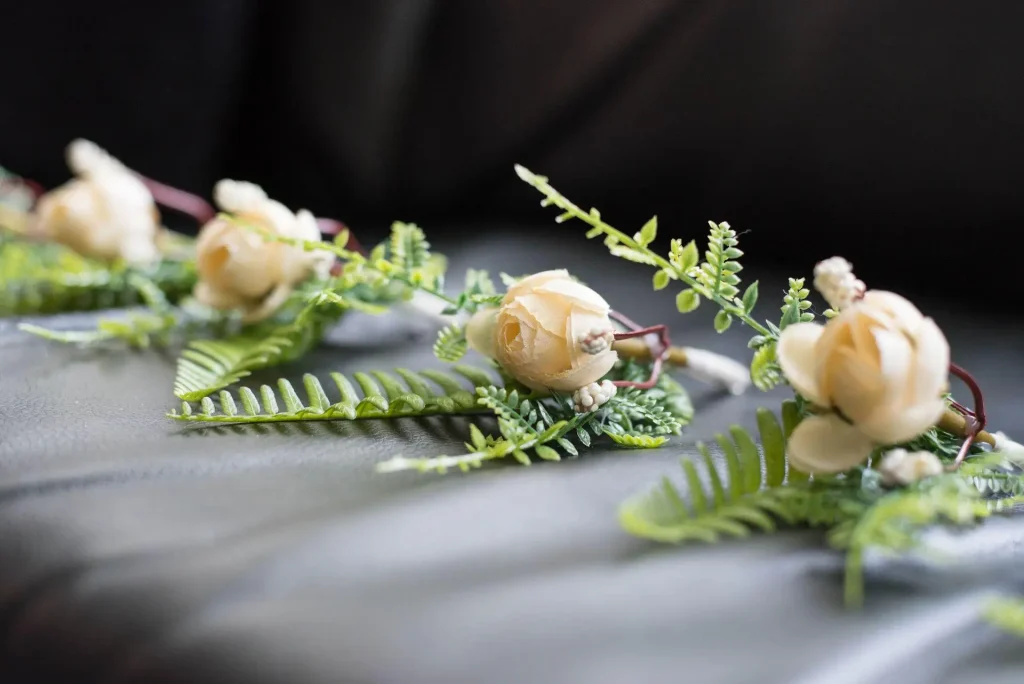
Small personal flowers are easy to overlook, but they often appear in family portraits.
Keep these pieces proportionate. Oversized flowers can look awkward against a suit lapel or wrist.
Repeating one flower or greenery variety from the bridal bouquet is usually enough to connect them visually with the rest of the floral plan.
Ceremony Aisle Flowers
Aisle flowers are viewed from farther away, so overall silhouette and color usually matter more than tiny petal details.
Artificial arrangements can be useful here because multiple pieces can be prepared in advance and checked for consistent color.
You also have time to experiment with spacing before the wedding instead of making those decisions during setup.
Wedding Arches
An arch is a large visual element.
Trying to cover every inch with flowers can become visually heavy and expensive. Often, concentrating flowers around two or three sections of the structure creates more impact.
Artificial flowers can also be combined with fabric, greenery, candles, or architectural details already present at the venue.
Think about the entire frame rather than the flower count.
Reception Centerpieces
Centerpieces have to work with the table, not just look attractive on their own.
Before choosing a height or width, consider plates, glassware, candles, menus, and how guests will see one another across the table.
Low arrangements should leave enough usable table space. Tall arrangements need a narrow enough base that they do not dominate the setting.
Artificial flowers make it possible to assemble and test a complete table arrangement in advance.
Sweetheart Table
The sweetheart table already attracts attention because it frames the couple.
Rather than adding an unrelated arrangement, repeat a few details from the bridal bouquet or ceremony flowers.
This could be the same greenery, one recognizable flower, or a repeated accent color.
The connection can be subtle.
Cake Flowers
Artificial cake flowers can create a coordinated look, but they need additional care because they are being used around food.
Do not simply insert decorative stems directly into a cake. Discuss the design with the baker and use an appropriate food-safe barrier or decorating method.
The visual goal is usually repetition rather than volume: one or two floral details from the wedding palette may be enough.
How Do Faux and Fresh Flower Costs Compare?
Fresh and artificial flowers are often compared using numbers that do not describe the same purchase.
Wedding-flower studies may report the total amount couples spend across an entire wedding. That can include bouquets, boutonnieres, centerpieces, ceremony installations, florist labor, delivery, setup, and breakdown.
A price shown on a premade artificial bouquet normally describes one finished product.
Those figures should not be treated as direct equivalents.
A fair comparison means putting the same items on both sides.
For example:
Fresh option
- one bridal bouquet;
- four bridesmaid bouquets;
- five boutonnieres.
Artificial option
- one bridal bouquet;
- four bridesmaid bouquets;
- five boutonnieres.
Then compare not only the purchase price but any setup, delivery, preparation, and after-wedding costs that apply.
A more useful comparison looks like this:
| Consideration | Fresh Flowers | Artificial Flowers |
| Upfront pricing | Depends on florist, flower variety, season and labor | Usually priced by finished arrangement or set; varies with material and complexity |
| Setup | May include professional delivery and installation | May require unpacking, reshaping and placement |
| Seasonality | Some varieties become harder or more expensive to source out of season | Not restricted by natural blooming seasons |
| Preparation | Usually completed close to the event | Can often be inspected and prepared earlier |
| After-wedding use | May be donated, dried, pressed or preserved | Can be stored, donated or reused in its existing form |
| Customization | Often florist-designed for the event | May be ready-made or customized, depending on the seller |
Artificial flowers are therefore not automatically cheaper in every situation.
Their advantage may instead be more predictable planning and the ability to see exactly what you have before the wedding.
Ready-Made or DIY?
This is one of the most important decisions for beginners.
DIY looks attractive because buying individual stems gives you complete control over the final design. But building a balanced bouquet is not simply a matter of putting flowers together and tying a ribbon around them.
You need to consider proportion, stem length, focal flowers, filler flowers, greenery, spacing, handle construction, and how the bouquet looks from every angle.
A simple hand-tied arrangement can be manageable for a beginner. A large garden-style or cascading bridal bouquet is considerably harder.
There is also a hidden time cost.
If you need to make one bridal bouquet, four bridesmaid bouquets, several boutonnieres, and other wedding flowers, a seemingly small craft project can quickly become several evenings of work.
Ready-made arrangements are better suited to couples who want to choose the finished shape and color palette rather than assemble every individual flower.
Couples who prefer a finished bouquet rather than arranging individual stems can explore Rinlong faux wedding flowers designed as ready-made bridal arrangements in coordinated colors and shapes.
The decision is less about whether DIY is “better” and more about how much time and control you actually want.
How to Check Quality Before Ordering
Product photos deserve more scrutiny when flowers will be photographed close up.
Zoom in.
Look at the edges of the petals. Are there obvious fabric cuts or fraying? Do the flowers appear excessively glossy? Are the leaves all exactly the same shade of green?
Check the arrangement as a whole too.
A bouquet can use attractive individual flowers and still look unnatural if everything is packed into a perfect sphere.
Look for some variation in height and direction.
Product dimensions are equally important.
A close-up photograph can make a small bouquet look much larger than it is. Check the listed width and height, then use a tape measure to visualize those dimensions against the person who will carry it.
Color should also be evaluated carefully.
“White” can mean pure white, ivory, cream, or champagne. Likewise, sage green can shift considerably between warm and cool tones.
Customer photography is particularly useful here because it shows the flowers outside controlled studio lighting.
When Should You Order Faux Wedding Flowers?
Artificial flowers reduce some last-minute pressure, but they should still be ordered early.
Do not plan around the shortest possible shipping estimate.
Rinlong currently lists standard delivery at approximately 5–30 days and express delivery at approximately 3–9 days, depending on the product and destination. Custom or temporarily unavailable products can take longer.
That is only part of the timeline.
You also need time to:
- unpack the flowers;
- compare the actual colors with your wedding clothing;
- reshape compressed elements;
- photograph the bouquet;
- decide whether the size is right;
- arrange an exchange if necessary.
For that reason, ordering at least several weeks before the wedding is safer than relying on the fastest possible delivery window.
If you are uncertain about the material or color, consider testing one smaller finished arrangement, such as a bridesmaid bouquet, rather than looking for a single sample stem.
That gives you a much more realistic idea of how the finished design will look.
How to Reshape Artificial Wedding Flowers After Delivery
This step is easy to underestimate.
Premade bouquets have to survive packaging and transportation, so flowers and leaves may arrive compressed toward the center.
Do not judge the final appearance immediately after opening the box.
Start by holding the bouquet upright and looking at its overall silhouette.
Gently separate overlapping flowers. Rotate blooms that are facing inward. Move greenery away from the center so that some leaves extend beyond the flower line.
If the design contains flexible wired elements, adjust them gradually rather than making sharp bends.
Then place the bouquet on a table and walk several feet away.
This gives you a better idea of how it will look in photographs than inspecting every flower from a few inches away.
Finally, take pictures from the front and sides.
Often a bouquet that looks balanced from the front has one unusually flat or crowded side that becomes obvious only in photographs.
Do this well before the wedding.
A Practical Buying Checklist
Before placing the full order, check the details that will actually affect how the flowers work on your wedding day.
Bouquet dimensions: Will the width suit the dress and the person carrying it?
Color undertones: Are the flowers bright white, ivory, cream, blush, peach, or another nearby shade?
Materials: Do the close-up images show matte petals and convincing greenery?
Shape: Is the bouquet compact, loose, asymmetrical, round, or cascading?
Photography: Are there customer images under natural light as well as studio photography?
Reshaping: Does the arrangement appear flexible enough to adjust after shipping?
Delivery: Is there enough time for processing, shipping, inspection, and a possible exchange?
Return conditions: What happens if the color or size does not work with your wedding plan?
Before ordering Rinlong artificial bridal bouquets, compare the listed bouquet width, color undertones, processing time, delivery estimate, and return conditions with your wedding timeline.
That kind of checklist is more useful than choosing purely by the first product image.
Bringing the Whole Floral Plan Together
Using faux flowers successfully is less about making every flower look identical to a fresh one and more about creating a coherent wedding.
Choose a small group of details to repeat.
For example:
- one dominant flower color;
- one supporting accent color;
- one greenery style;
- one overall arrangement shape;
- one signature flower or foliage detail.
The arrangements can become larger, smaller, simpler, or more elaborate as the day moves from the bridal bouquet to the ceremony and reception.
They do not have to match exactly.
They only need to look as though they belong to the same wedding.
Artificial flowers make that planning process easier because the arrangements can be seen and adjusted before the wedding day. But the best results still depend on proportion, texture, color, placement, and preparation.
Treat those decisions as part of the design—not just the purchase—and faux flowers can become a practical part of the wedding rather than simply an alternative to fresh blooms.