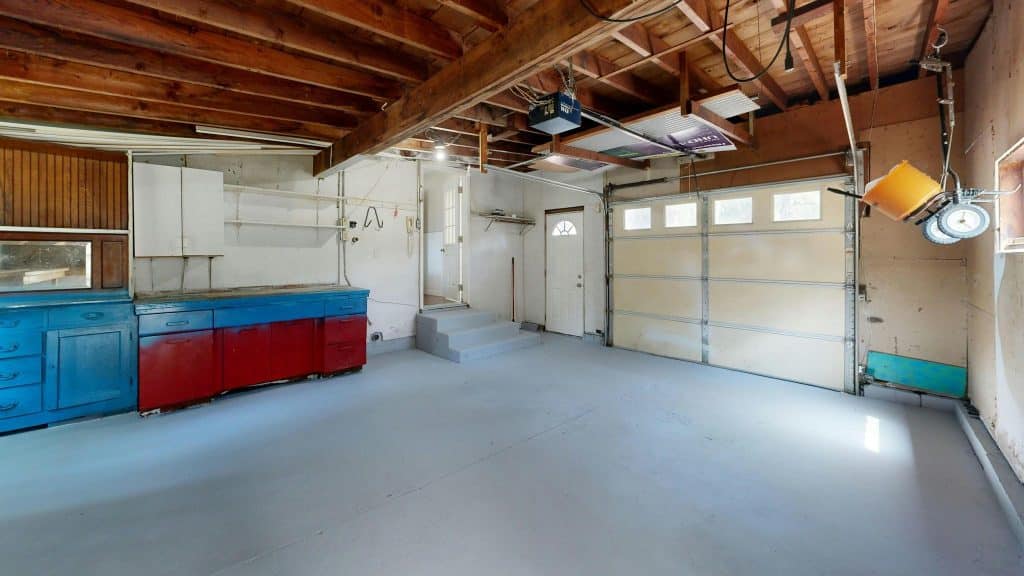
It is a uniquely modern frustration to own a garage that cannot actually fit a car because it has become a dumping ground for everything else.
What should be a dedicated parking area and highly functional workspace often devolves into an overwhelming obstacle course of scattered tools and forgotten boxes.
To reclaim your garage and clear that valuable floor space, you must implement a structured plan.
These four straightforward weekend garage projects require no major structural renovations but effectively eliminate heavy floor clutter.
By prioritizing vertical storage strategies and securing proper overhead access, you can organize your tools, sports equipment, and seasonal items efficiently.
The result is a total transformation that brings genuine utility back to your home.
1. Create Zones That Actually Make Sense
The very first step to decluttering the garage does not involve a trip to the hardware store, but rather deciding exactly where things belong.
A solid plan anchors all functional garage storage ideas, starting with dividing the room into distinct zones based on use frequency.
Walk the full space, group existing items by category, and apply a strict keep, donate, or discard decision to every single object.
Once grouped, you must assign these zones to appropriate physical locations, which often means pushing seasonal items into the attic space.
Because overhead garage storage is only useful if you can reach it safely, planning your access point during this zoning phase is critical.
To avoid the extreme risk of balancing heavy bins on a wobbly step stool, integrating Inventive Garage’s attic stairs with high weight capacity offers a highly stable, permanent solution alongside other standard pull-down models.
Zoning also involves maximizing the most important functional area, which is the primary vehicle parking bay.
For homeowners dealing with extremely limited square footage, mapping out a vertical parking zone allows you to stack cars instead of widening the building.
Incorporating a reliable garage lift from HeavyLift Direct or a similar heavy-duty stacking system effectively doubles your parking capacity and immediately frees up ground-level space for a workbench.
As you finalize your map, use painter’s tape to mark the boundaries on the concrete so you can test the layout before installing hardware.
Always maintain 36 inches of clear walking path between your active zones to ensure safe movement.
Sketching this rough map takes only fifteen minutes but will ultimately save you hours of exhausting trial and error.
|
Pro Tip: Use the “one-year rule” during your zone mapping. If you haven’t touched an item in twelve months, it doesn’t belong in a prime storage zone. |
|---|
2. Move Storage Off the Floor and Onto the Walls
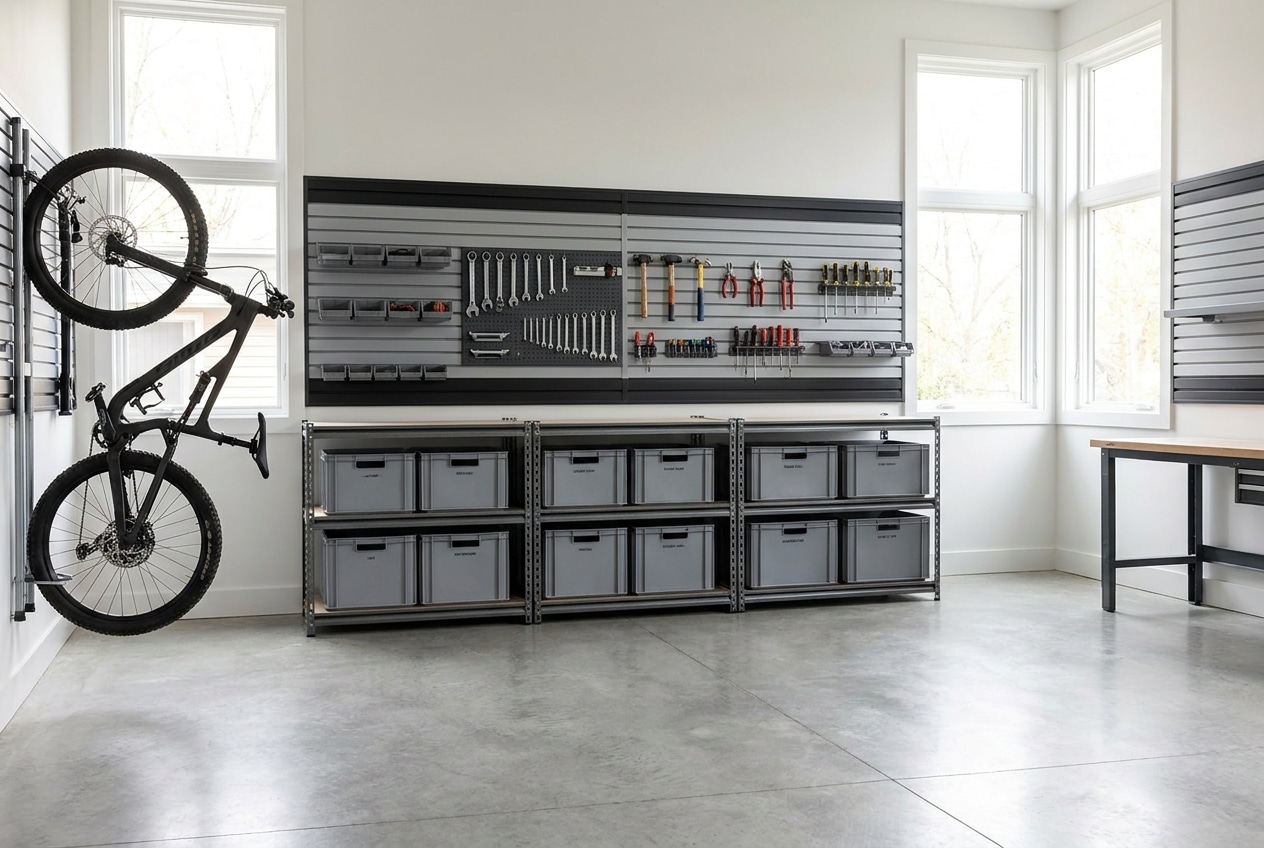
Floor clutter remains the ultimate enemy of any functional workspace, making it impossible to park or walk safely.
The walls surrounding that messy floor represent the most underused real estate in the entire building.
Moving your tools and equipment onto the walls is the absolute fastest fix for reclaiming your project areas and clear pathways.
When implementing vertical storage, selecting the proper hardware ensures your system will safely hold the necessary weight.
Pegboards and slatwall panels provide highly reconfigurable, low-cost options for organizing hand tools and smaller items.
For uniform storage bins, choose heavy-duty shelving brackets that are explicitly rated for the actual loaded weight of the containers.
Bulky recreational equipment takes up a disproportionate amount of floor space, so utilize specialized bike mounts and dedicated sports gear racks.
Before drilling into anything, always locate your wall studs with an electronic sensor, as guessing on load-bearing anchor points can cause catastrophic failures.
Match your anchor type precisely to the wall material, remembering that drywall and concrete anchors are completely non-interchangeable.
For standard bin sizing, mount your shelves eighteen to twenty-four inches apart vertically. Keep the lowest shelf at least seven feet above the finished floor to guarantee clearance for vehicle rooflines.
3. Make Your Attic Storage Actually Work

Most residential garages feature significant overhead space that sits empty, wasting a massive amount of potential capacity.
This area remains unutilized not because it lacks structural value, but because getting heavy objects up there safely is a difficult logistical problem.
Overhead storage is the perfect destination for camping gear and holiday decorations, but only if your attic storage access is genuinely secure.
Carrying awkward boxes up a standard portable step ladder while trying to maintain your balance is incredibly dangerous.
In fact, roughly twenty percent of workplace fall injuries involve a ladder, and in some states, ladder accidents account for dozens of fatalities over a decade.
Upgrading to fixed, pull-down stairway systems or motorized platforms eliminates this precarious balancing act.
Treating this overhead space as a true seasonal solution represents one of the smartest functional home upgrades available for organization.
Before loading the rafters, check the joist strength and install proper decking boards to create a flat, walkable surface.
Confirm that you have at least forty-two inches of vertical head clearance from the deck to the roof before dedicating this zone to storage.
To maximize efficiency, use stackable bins with clearly labeled sides facing the entryway.
Keep a digital photo inventory of what you pack away to prevent unnecessarily unloading everything just to find a single item.
|
Key Insight: Accessibility determines utility. If reaching your attic requires a shaky ladder, you will likely avoid using it. Installing fixed stairs transforms wasted rafters into a safe, functional secondary floor for your home. |
|---|
4. Reclaim Floor Space by Going Vertical with Your Vehicle
If the ultimate goal is getting the car back inside out of the elements, the most impactful solution involves thinking vertically.
For properties with limited square footage but generous ceiling heights, elevating the vehicles themselves completely transforms the room’s capabilities.
Stacking your automotive storage vertically can effectively double the usable footprint, instantly freeing the ground level for other activities.
This specialized approach perfectly serves families managing two vehicles in a single bay or collectors trying to protect a classic weekend car.
Elevating a vehicle reclaims the ground-level space directly beneath it, providing ample room for a comprehensive workshop or bulky tool chests.
Four-post parking systems from reputable manufacturers are ideal for this task, though you must carefully compare platform weight ratings before installation.
Before committing to heavy mechanical equipment, confirm your ceiling height by measuring at the absolute lowest point to account for hanging lights or garage door tracks.
Check your electrical access early in the process, as the majority of power units require a dedicated 220V outlet to function properly.
Your Next Steps
Reclaiming your cluttered property does not require an expensive, full-scale contractor renovation to see massive improvements.
The most important action you can take costs absolutely nothing and can begin right now with a simple visual assessment.
These four simple fixes build sequentially upon each other, starting with sensible zones and moving upward to the walls and ceiling.
Each completed phase creates the essential foundational conditions that the next project strictly depends on.
Grab a marker, walk the room, and sketch your initial zone map before you attempt to shift a single heavy box.
An optimized workspace is not just a frustrating storage problem solved, but rather a functional area reclaimed for the passions that deserve a proper home.