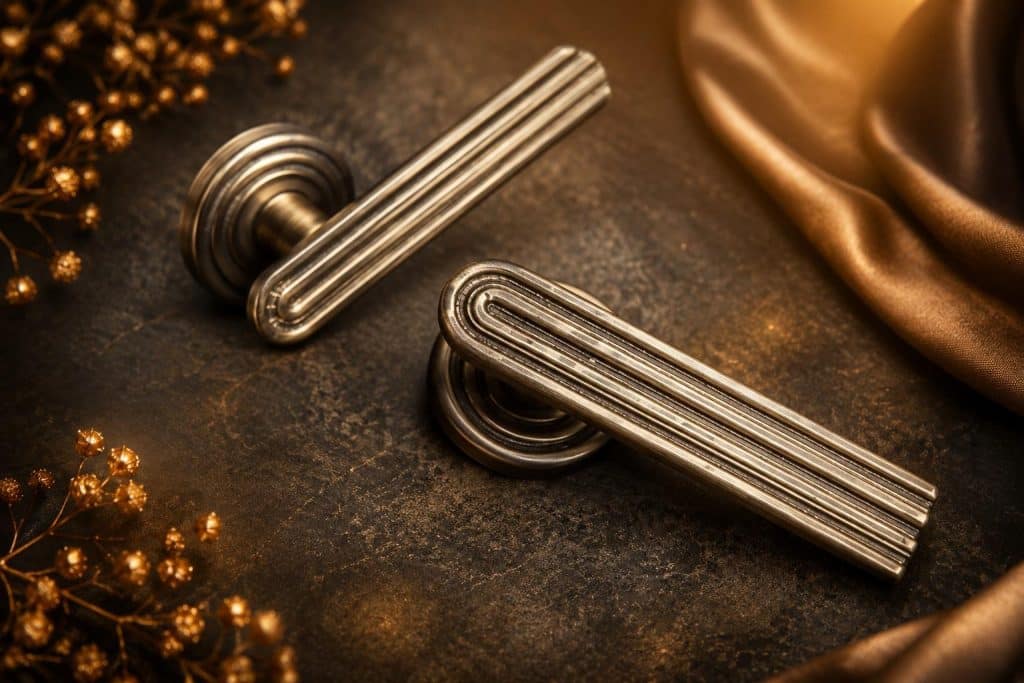
Every architect and interior designer has a version of the same story. A client spends months deliberating over marble slabs, cabinetry profiles, and paint colours. The space comes together beautifully. Then, days before handover, door handles are selected in twenty minutes from a builder’s catalogue — and something that was nearly perfect becomes, instead, merely good.
The door handle is where the human body makes first contact with a room. You push it, pull it, turn it, dozens of times a day, every day. It communicates — through weight, through texture, through the quality of its mechanism — exactly how serious the rest of the design is. And yet, in project after project, it remains the decision that receives the least attention relative to its visual and experiential impact.
Investing inluxury door hardware is not an indulgence. It is, for anyone who cares about a space being genuinely resolved, a necessity.
What Separates Luxury Door Hardware from Standard Options
The difference between standard door hardware and its luxury counterpart is not merely aesthetic — it begins at the material level and works outward from there.
Mass-market door handles are predominantly manufactured from zamak, a zinc-based alloy that is lightweight, inexpensive to cast, and accepts surface plating reliably. The problem is longevity. Plated finishes on zinc alloys wear at contact points — particularly on the grip and at the rose plate — often within a few years of regular use. In a high-traffic home, this wear becomes visible and, worse, it reads as neglect rather than age.
Solid brass is a fundamentally different proposition. It is denser, more resistant to corrosion, and develops a patina over time rather than degrading. A solid brass door lever installed today will look better — not worse — in a decade, assuming reasonable care. This is what designers mean when they talk about materials that “age well”: not materials that resist change, but materials that change in ways that add rather than subtract from a space.
Beyond material composition, luxury door hardware distinguishes itself through the precision of its mechanisms. A quality passage set should operate with smooth, consistent resistance — no rattle, no catch, no gradual loosening of the rose plate over time. These are mechanical properties that only emerge from tighter manufacturing tolerances, and they are deeply felt even when they’re not consciously noticed.
Understanding the Hardware Vocabulary: Passage, Privacy, Dummy, and Thumbturn
One of the most practical confusions homeowners encounter when specifying door hardware is the distinction between the different functional types. Getting this right matters both for how the door functions and for how the hardware is priced and specified.
A passage set is a non-locking lever or handle set used on doors that require no privacy — hallways, connecting rooms, wardrobes, and similar spaces. It operates from both sides and has no locking mechanism. A privacy set includes an interior locking function, typically a push-button or thumbturn mechanism on the interior side, and is the appropriate choice for bedrooms and bathrooms. A dummy handle is a purely decorative, non-functional piece — it doesn’t turn and has no latch — used on doors that are push-pull rather than latch-operated, such as wardrobe doors or bi-fold panels.
The thumbturn or escutcheon is a separate component that deserves more attention than it typically receives. It is the small rotating piece on the inside of a privacy door that engages the lock, and in luxury hardware collections it is often designed as a sculptural object in its own right — a detail that is visible at eye level every time you use the room and deserves to be treated accordingly.
Matching Door Hardware to Your Interior Style
The most effective luxury door hardware complements the broader design language of a space without competing with it. This requires understanding both the architectural character of the interior and the tonal range of the hardware finishes available.
In classical or heritage interiors — panelled doors, ornate cornicing, period joinery — brass and bronze are the natural partners. They read as appropriate to the era, but in their more refined, modern forms they avoid the pastiche quality of reproduction hardware. A slender, elongated lever in unlacquered brass against a painted panel door is simultaneously respectful of tradition and quietly contemporary.
In modern or minimalist interiors, the calculus shifts. Here, the handle becomes more of a graphic element — a line, a form, a material note in an otherwise restrained composition. Satin nickel and carbon black finish door hardware work particularly well in these contexts, providing contrast without decoration. The lever profile matters enormously: a clean, geometric lever on a plain flush door can read as genuinely architectural.
For interiors that blend periods — and the best residential design almost always does — hardware finish is a useful unifying thread. Maintaining a consistent metal finish throughout a floor or a residence creates cohesion between spaces that might otherwise feel disconnected.
The Case for Treating Every Door as a Design Moment
There is a tendency, even among design-conscious homeowners, to reserve specification-grade hardware for the “important” doors — the front entry, the primary bedroom — and to use lesser hardware elsewhere. This is a false economy. The handles on a bathroom door, a home office, a dressing room are touched just as frequently and seen just as regularly. The cumulative experience of a well-hardwared house is qualitatively different from one where only the headline spaces have been properly considered.
For those ready to take this approach seriously,Mi & Gei‘s luxury door hardware collection offers a cohesive range of solid brass lever sets, passage and privacy door handle sets, thumbturns, escutcheons, and dummy handles across a considered selection of finishes — brass, bronze, champagne bronze, satin nickel, polished nickel, and carbon black. Each piece is designed as part of a coherent system, which is essential when specifying an entire home rather than a single door.
The result, in every project where hardware has been given the attention it deserves, is the same: a space that feels finished not because nothing is left to do, but because everything that needed doing was done properly.
Frequently Asked Questions About Luxury Door Hardware
What is luxury door hardware made from? The defining material in high-quality luxury door hardware is solid brass. Unlike zinc alloy alternatives that are typically used in standard hardware, solid brass offers superior density, corrosion resistance, and longevity. It also develops a natural patina over time that adds character rather than signalling wear — making it a lasting investment for any interior.
What is the difference between a passage set and a privacy set? A passage set is a non-locking door handle or lever used on doors that don’t require privacy, such as hallways or connecting rooms. A privacy set includes an interior locking mechanism — usually a thumbturn or push button — and is designed for bedrooms and bathrooms where occupancy privacy is needed. Dummy handles are purely decorative, with no latch function, suited to push-pull doors or wardrobe panels.
Which door hardware finish is most durable? Solid brass in an unlacquered or hand-finished state is widely regarded as the most durable option for interior door hardware. It does not chip, peel, or degrade at contact points the way plated finishes on zinc alloys can. Other durable options include bronze and satin nickel in solid brass construction. The key factor is always the base material — finish applied over solid brass will outlast the same finish applied over a zinc alloy substrate.
How do I choose the right door hardware finish for my interior? Start with the dominant tonal character of your space. Warm-toned interiors with timber, stone, and soft whites generally suit brass or bronze hardware. Cooler, more minimal spaces tend to pair well with satin nickel, polished nickel, or carbon black. The most important principle is consistency: selecting a single finish and carrying it throughout connected spaces creates a sense of cohesion and considered design.
Can luxury door hardware be used in both modern and classical interiors? Yes — the best luxury door hardware collections are designed with enough range of form to work across architectural styles. A slender, geometric lever in brass reads as contemporary; a more curved, weighted profile in the same finish reads as more classical. The finish and the form language of the lever together determine whether a piece feels modern or traditional, which is why a well-curated collection offers multiple silhouettes in the same finish family.
Is luxury door hardware worth the investment? For any homeowner or developer prioritising long-term quality and design integrity, yes. Luxury door hardware in solid brass will outlast standard alternatives significantly, often by decades. Beyond longevity, the daily tactile and visual experience of well-designed, properly weighted hardware is genuinely meaningful — and it is one of the details that experienced buyers, designers, and guests notice immediately, even when they can’t articulate why.