Have you ever walked into a room, flipped on the switch, and watched the whole space just flatten out? That’s what overhead bulbs can do. The light feels harsh, the corners seem gloomy, and what should be a cozy space starts looking more or less like a waiting room.
And it’s just about aesthetics. The Sleep Foundation notes that excess or poor artificial light, particularly in the evening, can interfere with your circadian rhythm and disrupt your day-night cycle.
So how can you make things better? By layering your lights. Read on as we discuss what this is and how to do it.
What Is Layered Lighting?
Layered lighting is when you combine several light sources at different heights, brightness, and angles instead of just using one overhead light as usual. Done right, it controls mood, adds depth, and makes a room work for anything.
Layered lighting is usually grouped into three categories.
- Ambient Lighting. This is the general glow that fills the room so you’re not squinting into dark corners. Floor lamps are a natural fit here.
- Task Lighting. This is the light you need when reading a book, working on a laptop, or chopping vegetables. Table lamps are a good example.
- Accent Lighting. These are the smaller, decorative lamps that draw the eye to the important pieces in the room. They’re more for depth than anything else.
The beautiful thing about layered lighting is that you don’t need an electrician. Most lamps are plug-in. The only real trick is picking the right ones, which is where a solid guide to choosing lamps comes in handy.
Butler Lighting also supports the point about lamp selection, saying that choosing the right size lamp, whether it be on a table or floor, is highly important.
Let’s now look at how a floor lamp, a table lamp, and an accent lamp can work together.
Start with Floor Lamps for Ambient Light
A floor lamp is often your best starting point. Why? Because it reaches the spots your overhead fixture never quite gets to. Tuck one beside the sofa, place it behind an armchair, or stick it in that dim corner. Suddenly the whole room breathes a little easier.
Style matters here, too. Want to bounce light off the ceiling for a softer feel? Go for a torchiere or an uplight. An arc lamp makes sense when you need light to reach over a seating area.
Placement also deserves thought. You want to think of varying the height and direction of your light sources. You don’t want your space to feel flat, which it will if every lamp sits at tabletop level.
Designer Nina Freudenberger has a good tip here. She suggests putting floor lamps in unexpected corners instead of right next to a table lamp, which can feel redundant. That little move adds depth without adding clutter.
Add Table Lamps for Task and Soft Light
Once the room has the right glow, it’s time to bring the light closer to where people actually need it. A good table lamp is ideal for this.
Table lamps provide focused light while keeping the space warm, intimate, and inviting. They make sense for reading, working, and conversation without the glare of an overhead fixture. Ideally, the bottom of the lampshade shouldn’t be too high, preferably at eye level when you’re sitting so that the bulb won’t blind you.
For the bulbs, go with white bulbs around 2700K. They’re warm and easy on the eyes. And for brightness? This Old House suggests you look for around 900 lumens, which is roughly the same as a 60-watt incandescent bulb.
If you want, you can also add a dimmer, so you can take the light from bright to barely there.
Finish with Accent Lamps for Mood and Depth
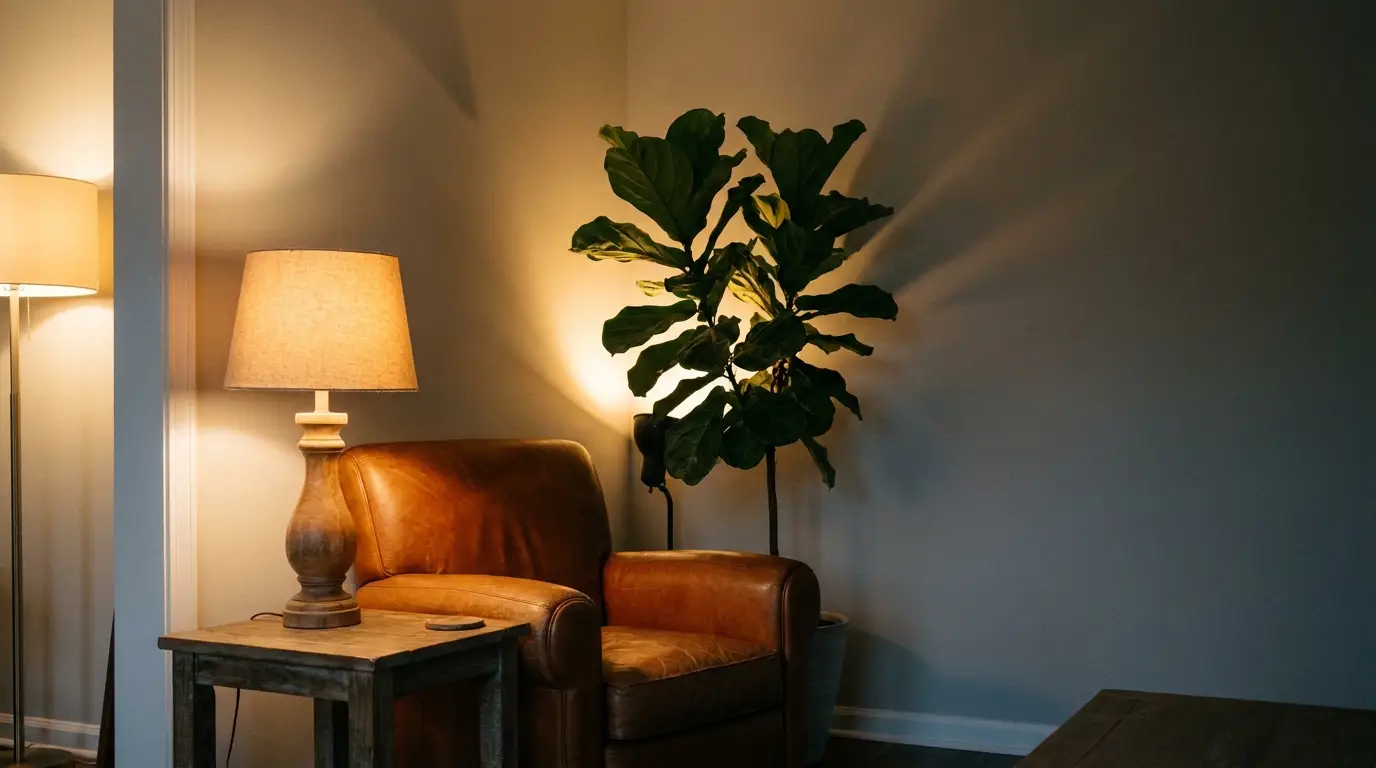
Accent lamps are what bring it all together. They highlight the little details that give your room its own character. The goal isn’t to light up the whole space. It’s to create small points of interest.
There are plenty of ways to do this. A small lamp on a bookcase. A picture light above your favorite artwork. An uplight behind a leafy plant. You could even tuck LED strips beneath a shelf to spotlight a few favorite objects.
But remember to keep your accent lights soft and subtle. They shouldn’t overpower your main light sources. Otherwise, they may distract the eye rather than add the extra depth you’re looking for.
Not surprisingly, there’s a growing interest in this type of lighting. The global LED accent lighting market, which was about $6.8 billion in 2025, is expected to hit $13.2 billion by 2035, according to Data Insight Reports.
A Simple Formula for Putting It All Together
Layering light is easy when you follow a quick set of rules to keep things balanced.
- Try to use at least three different lamps in the main living areas
- Place your lamps in a triangle around the room and don’t bunch them together
- Keep all your bulbs around 2700K so the room looks cohesive
- Add a plug-in dimmer or smart bulbs to switch scenes with a single tap
As a rule of thumb, 10 to 20 lumens per square foot works for basic living areas. So for a typical 150-square-foot living room, you’re looking at roughly 1,500 to 3,000 total lumens. Just spread that across your floor lamp, table lamp, and accent lamps, and you’re in good shape.
The table below shows what the lumens could look like elsewhere in the home, where you can also have layered lighting.
| Room | Lumens Per Sq Ft | Dimmer Or No Dimmer |
| Living Room | 10 – 20 | With dimmer |
| Bedroom | 10 – 20 | With dimmer |
| Dining Room | 10 – 20 | With dimmer |
| Home Office | 30 – 50 | With dimmer |
| Entry Foyer | 5 – 10 | No dimmer |
FAQs
How Many Lamps Are Required for a Room?
A minimum of three lamps is a good start. However, if the size of the room is large enough, more than three can work well. Just don’t put them all in the same area. Spread them out.
What Bulb Color Is Best for a Living Room?
It totally depends on your choice. However, many experts recommend warm white lights, ideally between 2700K and 3000K for living spaces. This temperature creates a cozy ambiance.
Can Lamps Be Used in Place of Overhead Lights?
Absolutely. Using a good mix of floor, table, and accent lamps can provide plenty of light so that you don’t need ceiling fixtures. Many people actually turn their overhead lights off at night and use only lamps for a softer feel.
Wrapping Up
You don’t have to live under a harsh overhead light if you don’t want to. Layered lighting can totally transform how your space looks and feels, and this guide has shown you how to pull it off with lamps.
Even better, it doesn’t require expensive remodeling or any rewiring. Just get your floor lamp, table lamp, and accent lamps, and you’re on your way to giving your home the soul it deserves.
Don’t go overboard, though. Start with one lamp, see how it feels, then build from there.