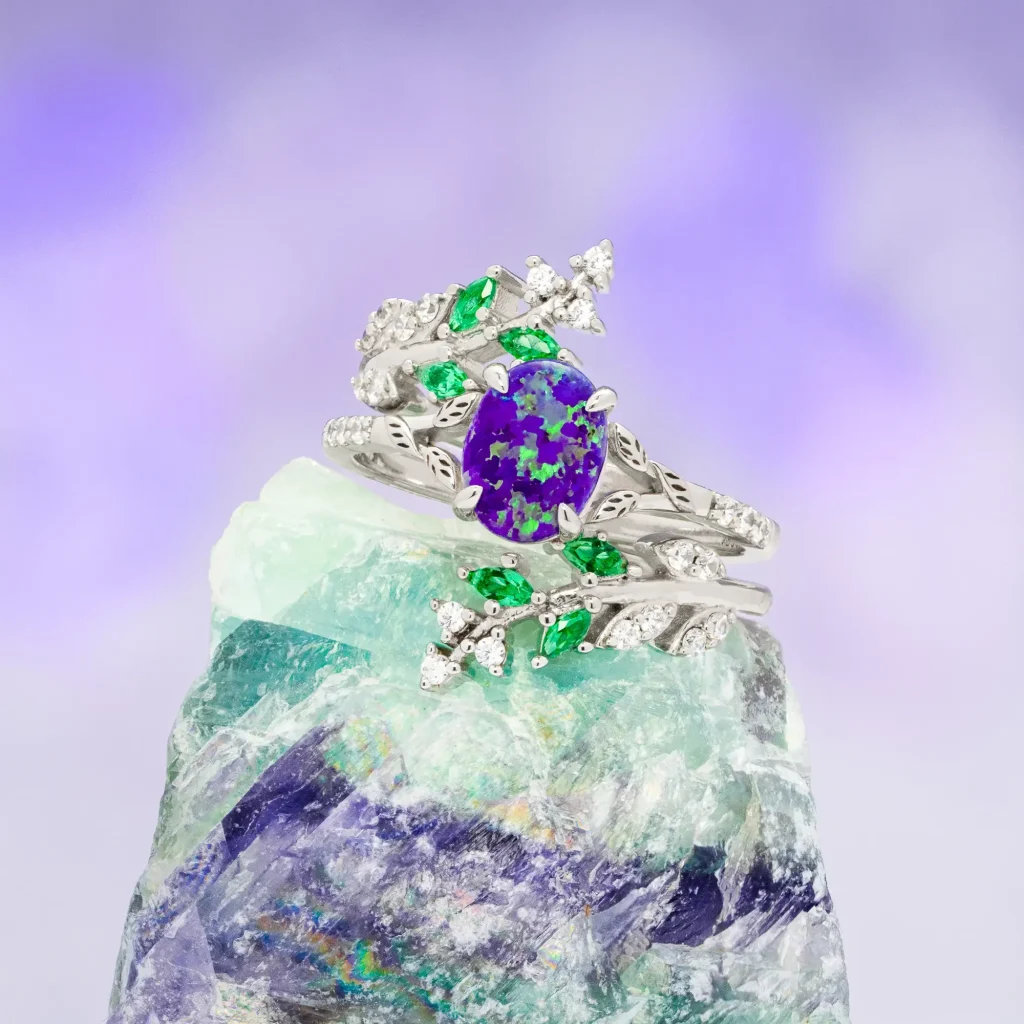
Opal is one of the few gemstones that never looks the same twice. Tilt it under different light and the colors shift, flash, and reorganize themselves in ways that photographs rarely capture accurately. That quality has made the opal engagement ring a popular alternative to traditional diamond settings, but it’s also a stone that asks a little more of the person wearing it. Opal is softer than a diamond or sapphire, it reacts to changes in temperature and humidity, and no two stones are cut or colored the same way. Choosing one well means understanding what you’re actually buying.
This guide walks through how opal is formed, what separates a good stone from a mediocre one, how handmade gemstone rings differ from mass-manufactured settings, and what ongoing care an opal ring realistically needs.
What Makes Opal Different From Other Gemstones
Most gemstones get their color from trace minerals locked into a crystal structure. Opal works differently. It’s non-crystalline, made of tiny silica spheres stacked in a grid. When light passes through the gaps between those spheres, it bends and splits into individual wavelengths. This is called diffraction, and it’s the reason opal displays “play-of-color” rather than a single fixed hue.
This structure is also why opal is softer and more porous than stones like sapphire or diamond. It rates around 5.5–6.5 on the Mohs hardness scale, compared to a diamond’s 10. That difference matters most for an opal engagement ring meant to be worn daily, since rings absorb more impact and friction than earrings or pendants.
It’s also worth knowing that opal isn’t the only “phenomenal” gem with this soft, light-catching character. If opal’s shifting play-of-color appeals to you, moonstone offers a related effect — a floating blue sheen called adularescence rather than opal’s rainbow flashes — and a moonstone engagement ring carries the same ethereal, alternative-to-diamond appeal with its own distinct personality.
The Main Types of Opal Used in Rings
Not all opals look or perform the same way, and the type used has a real effect on both appearance and how the ring should be worn.
White opal has a light or milky base tone with pastel flashes of color. It’s the most widely available type and tends to be the most budget-accessible.
Black opal has a dark base -sometimes true black, sometimes deep grey or navy -which makes its color flashes appear far more saturated and vivid. It’s rarer and generally more valuable than white opal.
Boulder opal forms as a thin layer attached to its host ironstone rock. Rather than being cut away from the base, the ironstone is left intact as a natural backing, which also makes the stone more durable than solid opal of the same thickness.
Fire opal is usually transparent to translucent with a warm orange, red, or yellow body color, and it may or may not show play-of-color. It behaves differently in daily wear than the varieties above and is more commonly faceted like a traditional gemstone.
Each type carries different care requirements, so it’s worth knowing which one you’re looking at before settling on a setting style.
Solid Opal vs Doublets and Triplets
Opal is sold in a few different construction formats, and this affects both appearance and longevity.
A solid opal is a single, natural piece of stone with no backing or layering added. It’s the most durable option in a ring setting because there’s no adhesive layer that can separate or discolor over time.
A doublet is a thin slice of opal glued onto a dark backing (often ironstone or glass) to intensify the color, since natural opal in its raw form is sometimes too thin to stand on its own.
A triplet adds a domed, clear quartz or glass cap on top of a doublet, which protects the thin opal layer but also gives it a slightly artificial, overly glossy look under close inspection.
Doublets and triplets are generally less expensive and more fragile than solid opal, since the layered construction can be affected by water exposure, heat, or age. For a ring intended for regular, everyday wear, solid opal typically holds up better over the years.
What “Handmade” Actually Means in Gemstone Rings
The term “handmade” gets used loosely in jewelry marketing, so it helps to know what it actually refers to in practice. Handmade gemstone rings are typically shaped, set, and finished by a jeweler working the metal directly, carving wax models, hand-fabricating the band, or hand-setting each stone, rather than being cast from a mold used across thousands of identical units. The practical differences between handmade gemstone rings and mass-produced alternatives show up in a few key areas:
- Setting precision -a hand-set stone is fitted to its specific shape and irregularities, which matters more for opal than for uniformly cut stones like round diamonds, since natural opal often has an irregular outline.
- Metal finishing -hand-finished bands tend to have more refined transitions between the shank, gallery, and setting, since a jeweler adjusts each piece individually rather than relying on a single mold cavity.
- One-off design elements -handmade pieces are more likely to include asymmetry, custom bezels, or organic shapes that wouldn’t be practical to mass-produce.
Handmade doesn’t automatically mean better quality -a skilled factory setting can be extremely well made, and a rushed handmade piece can have flaws too. What it does mean is that more individual judgment goes into each ring, which tends to matter more with a stone as variable as opal.
Setting Styles That Suit Opal
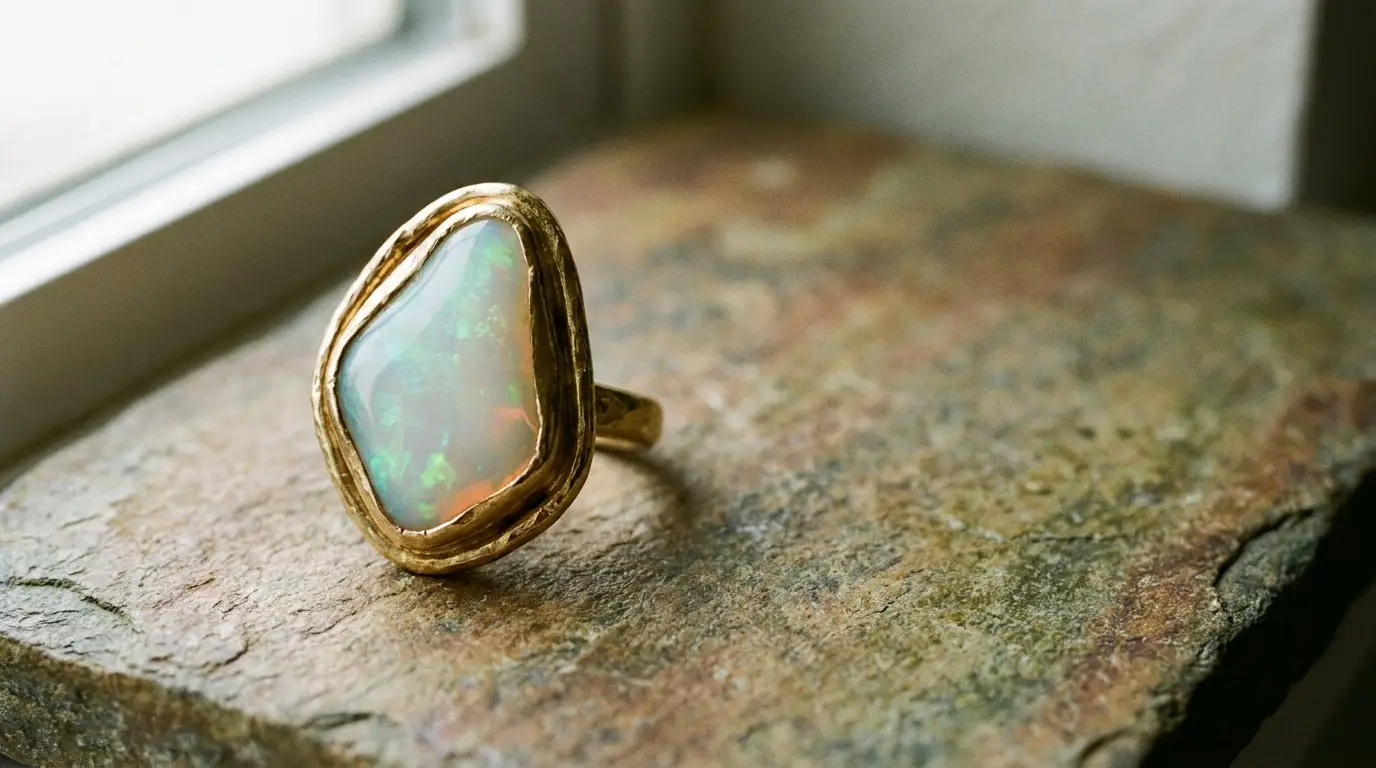
Because opal is softer and more prone to chipping than many other gemstones, the setting style has more influence on longevity than it does with harder stones.
Bezel settings wrap a metal rim around the entire edge of the stone, which protects it from knocks and reduces water exposure at the girdle -often considered the safest setting for opal.
Prong settings expose more of the stone and allow more light to reach it from the sides, which can enhance play-of-color, but the exposed edges are more vulnerable to chipping if the ring is knocked against a hard surface.
Halo settings surround the opal with smaller accent stones, which adds visual protection at the perimeter while still allowing a fair amount of light into the main stone.
Recessed or flush settings sit the stone slightly below the metal surface, offering strong physical protection but reducing how much light reaches the opal from the sides.
There’s a genuine trade-off between protection and light exposure with every option, so the right choice usually depends on how the ring will actually be worn day to day.
Choosing a Metal for an Opal Ring
Metal choice affects both the look of the stone and how much upkeep the ring will need.
- Platinum is dense and doesn’t wear away as quickly as gold alloys, and it doesn’t require replating, though it can develop a matte “patina” over time that some people prefer to have polished periodically.
- Yellow gold tends to warm up the appearance of white and boulder opal, since the metal reflects a golden tone against the stone.
- White gold is usually rhodium-plated, meaning it needs occasional replating to maintain its bright white finish -something worth knowing before choosing it for a ring worn daily.
- Rose gold pairs distinctly with the cooler blue-green flashes common in many opals, creating more visual contrast than yellow or white settings.
Caring for an Opal Ring Long-Term
Opal has two vulnerabilities that matter more than with most other gemstones: physical impact and moisture loss.
Because opal contains a percentage of water within its structure (often 3–20%), extreme dryness or heat can cause it to crack over time -a phenomenon sometimes called “crazing.” This means opal rings shouldn’t be left in very dry environments, direct sunlight for extended periods, or exposed to sudden temperature swings, like going from a hot car into an air-conditioned room.
Because of its softness, it’s also worth removing an opal ring for manual labor, sports, gardening, or anything involving repeated impact. Household chemicals -particularly bleach, ammonia-based cleaners, and some perfumes -can also affect the surface of the stone over time, so many jewelers recommend removing the ring before cleaning or applying cosmetics.
Cleaning is best done with lukewarm water and a soft cloth rather than ultrasonic cleaners, which can worsen existing internal fractures through vibration.
What to Look for When Evaluating a Gemstone Ring
A few practical checkpoints apply whether the ring is set with opal or another gemstone:
- Color consistency and pattern -for opal specifically, look at how the play-of-color behaves as the stone is tilted, rather than judging it from a single angle.
- Surface condition -check for visible cracks, chips, or cloudy patches, which are more noticeable in opal than in transparent faceted stones.
- Setting security -the stone shouldn’t move or rattle within its setting, and prongs or bezels should sit flush against the stone’s edge.
- Band construction -look for even thickness around the shank and a comfortable interior finish, particularly at the point where the band meets the setting.
- Proportions -a stone that sits too high above the finger is more prone to catching on things; one set too low can trap dirt and moisture against the skin.
Frequently Asked Questions
Is opal too fragile for an engagement ring worn every day?
Opal is softer than diamonds or sapphires, but that doesn’t rule it out for daily wear. A well-chosen setting -particularly a bezel or halo -combined with reasonable care around impact and chemical exposure allows many opal rings to hold up well over years of regular use. It simply requires more attentiveness than harder stones.
How can I tell if an opal is natural or a doublet/triplet?
A side view of the ring usually reveals the layering in a doublet or triplet, since a visible seam line or a domed clear cap will be present. A jeweler can also check under magnification, since solid opal has a continuous, uninterrupted structure with no adhesive layer.
Does opal need to be kept in water to stay healthy?
No -this is a common misconception. Opal doesn’t need to be submerged, but it does need to avoid prolonged extreme dryness or heat. Normal indoor conditions are fine; the concern is specifically things like sitting in direct sun for hours or being stored somewhere very hot and dry for long periods.
What’s the actual difference between a handmade ring and a factory-made one?
The distinction is in the process rather than a fixed quality guarantee. Handmade pieces are typically shaped and set through direct, individual work by a jeweler, which allows for more customization and precision fitting -especially useful for irregularly shaped stones like natural opal. Factory-made pieces are cast from a mold and tend to be more uniform but less adaptable to a specific stone’s shape.
Which setting protects opal best without hiding it completely?
A bezel setting is generally considered the best balance -it shields the vulnerable edges of the stone from impact while still leaving the top surface exposed to light, which is what produces the visible play-of-color.