Do you remember primary classes as a kid? Where the teacher used to teach you fun color combinations.
Yellow and blue make green, and white and red make pink.
And you might have learned that red is a primary color, but what two colors make red? And how can you make different shades of it?
Read till the end and know everything about red.
What Colors Make Red: Across All Color Models
Red is one of the most basic primary colors that everyone learns first. But the interesting thing is that not every color model works the same way.
Red in RYB
In the traditional RYB (Red, Yellow, Blue) color model, the one taught in most art classes, red is a primary color. That means it stands alone.
You don’t create it by mixing two other colors. It’s a base, a starting point.
Red in RGB
Red in the RGB (Red, Green, Blue) color model is also a primary color.
It is used for digital displays and light-based color mixing. In this model, red is one of the three core light wavelengths that create all colors on screens, TVs, and digital devices.
Red in CMYK
In CMYK (Cyan, Magenta, Yellow, Key), the color model used in printing, red is not a primary color.
You can actually mix two specific colors to produce it, which is, magenta and yellow combined create red.
The CMYK model is useful for understanding which colors make red in the context of commercial printing and paint mixing.
Undertones of Red
Red has subtle hints of other colors mixed in that shift how the red appears and behaves when you’re mixing it.
Some reds lean warm and contain hints of orange or yellow undertones, and these are called “warm reds” or “scarlet-leaning reds.”
These warmer versions come from mixing red with small amounts of yellow or orange.
Other reds have cooler undertones with hints of blue or purple, and the “cool reds” or “crimson-leaning reds” are what you get when you mix red with blue.
The undertone of your red matters when you’re working toward a specific color goal.
If you need a warm, bright red-orange for your painting, you’ll want to start with a warm red base and add orange.
If you’re after a deeper, cooler red with purple notes, you’ll mix in blue instead.
What Two Colors Make Red? Making Dark Red
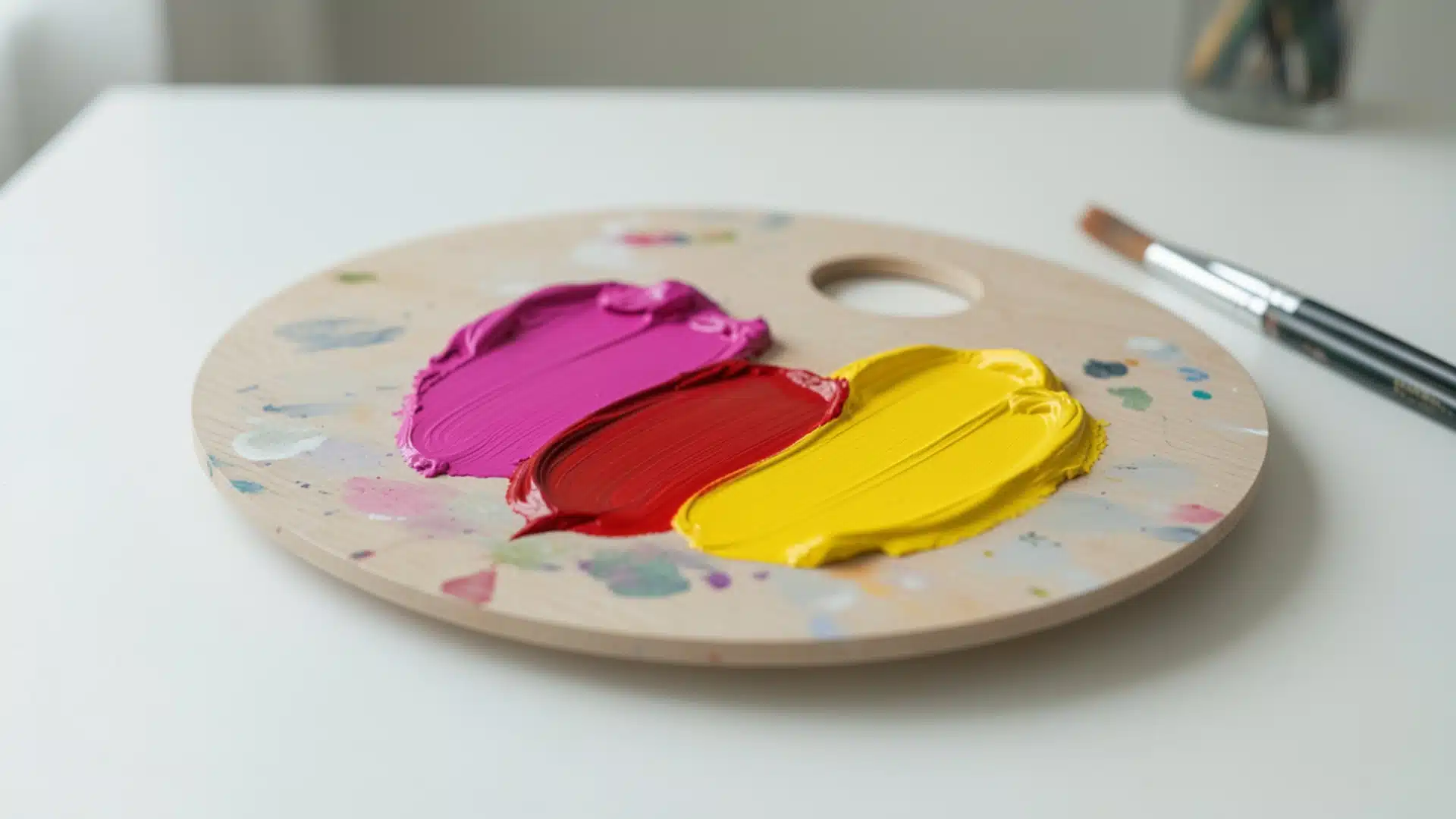
Red itself is a primary color in the RYB model, so you can’t technically make it from two other colors.
However, in other color models like CMYK, magenta and yellow combine to create red.
And if you’re aiming for dark red specifically, take your base red and add black in a 5:1 ratio, red to black.
Alternatively, mix red with a touch of blue and brown to deepen the shade while maintaining its richness. Dark red is a #8B0000 on the hex scale.
How to Make Light Red?
To make light red, mix red paint with white paint in a 3:1 ratio (three parts red to one part white).
Start with your base red and gradually add white until you reach the desired lightness. You can always add more white, but you can’t remove it.
For a softer, pastel-like light red, increase the white ratio to 1:1 or even 2:1, depending on how pale you want it.
The resulting light red should fall somewhere in the hex code range of #FF9999 to #FFCCCC, depending on how much white you’ve added.
How to Make Maroon?
Maroon is a darker, stronger version of red that’s been toned down and cooled off.
To achieve this rich, deep burgundy shade, combine red paint with brown in a 2:1 ratio, then add just a touch of blue to increase that moody undertone.
Alternatively, you can mix red with a small amount of black (around a 4:1 ratio), but go easy since black overpowers quickly.
The final color should fall within the hex range of #800000 to #A01050, giving you the luxurious, wine-like hue.
How to Make Crimson Red?
Crimson red is a deep red you see in jewels and luxurious fabrics.
It’s bold and saturated without being too dark.
To make this color, start with a high-quality red paint and blend it with a modest amount of blue (roughly a 5:1 ratio of red to blue) to push it toward that cooler, more dramatic tone.
If your red feels too bright or orange-leaning, adding even just a whisper of blue shifts it into true crimson territory.
For painters working with acrylics or oils, you might also add a tiny hint of black (around an 8:1 ratio) to deepen the saturation.
Crimson in the hex spectrum is around #DC143C to #990000.
How to Make Cherry Red?
Cherry red pulls from nature itself, it’s the color of ripe cherries, which means you’re after a red that’s bright yet slightly darkened with purple undertones.
Start with a base red and introduce a small amount of purple or violet paint (around a 6:1 ratio) to give it that slightly cooler tone.
If you don’t have purple on hand, mixing red with a touch of blue and just a bit of black gives similar results.
It’ll be around #C41E3A and #8B0000 on the hex scale.
How to Make Wine Red?
Wine red is the color of a fine Bordeaux, deep and mysterious.
Take your red base and merge it with both blue and a touch of black in careful measure, approximately 4 parts red, 1 part blue, and a half part black.
This trio creates an almost burgundy appearance without veering into purple territory.
Your final shade will be around #722F37 to #800020, giving you that luxury, wine-glass-worthy hue.
How to Make Brick Red?
Brick red is warm, the color of aged clay, terracotta roofing, and vintage brickwork.
Unlike wine red’s cool, brick red leans into its rustic, warm side.
Mix red with orange and a small amount of yellow (around a 3:1:0.5 ratio) to create that weathered, sun-baked appearance.
You’re pushing red toward the orange spectrum while keeping it grounded and muted.
Your target hex range: #CB4154 to #A0522D, delivering that warm, nostalgic brick-like charm.
If your mixture feels too bright, tone it down with a hint of brown or gray to get that worn-in quality brick carries.
What Colors Can You Make Using Red?
Red is one of the most adaptable primary colors in the spectrum, capable of producing a wide range of hues depending on what it’s mixed with.
The following are the key colors you can create using red:
- Orange: Mix red with yellow. More yellow gives a bright orange; less creates a deeper, burnt tone.
- Pink: Add white to red. The more white, the softer and lighter the pink.
- Purple/Violet: Combine red with blue. Adjust the ratio to shift between warm purples and cooler violets.
- Brown: Mix red with green, or add black and yellow to red.
- Maroon/Burgundy: Add a touch of black or dark blue to deepen red into rich, moody shades.
The exact result always depends on the proportions used and whether you’re working with light (additive) or pigment (subtractive) color mixing.
What Color do Red and Orange Make?
Red and orange make a fiery shade that leans more toward red when you use more red in the mix.
It’s a great color for sunset-inspired tones.
Mixing magenta with a tiny touch of orange is also an option worth trying. This gives you a bright, vivid red with a fiery feel.
Another option is combining magenta, yellow, and a very small amount of brown.
This trio brings you closer to a natural, earthy red.
Don’t limit yourself to just one formula. Try different combinations and see what works best for your project.
Final Thoughts
So, what two colors make red?
It all comes down to mixing magenta and yellow in the right amounts. Get the ratio right, and you have a clean, bright red. Simple as that.
The more you practice, the better your results get. Don’t stress if your first few attempts look a little off. That’s completely normal.
Got questions about your mix? Drop them in the comments below.
Frequently Asked Questions (FAQs)
1. What Three Colors Cannot be Mixed Together?
Red, blue, and yellow cannot be mixed from other colors. These are primary colors in the RYB model. They are the base colors used to create all other colors.
2. What Undertones Can I Add to Red?
You can add blue undertones for a cooler red or yellow undertones for a warmer, more orange-leaning red.
3. Why Does My Mixed Red Look Muddy?
Muddy red happens when you mix too many colors together. Stick to two clean, pure pigments only.