Cathedral ceilings can make a living room feel expansive and memorable, but the extra height changes how light, air movement, furniture, sound, and ceiling fixtures behave. The most successful rooms treat those decisions as one composition.
A cathedral ceiling gives a living room something a flat ceiling cannot: a strong sense of vertical space. The height can pull daylight deeper into a room, frame tall windows, emphasize a fireplace, or make exposed structure part of the architecture. It can also make an otherwise ordinary footprint feel far more generous.
That added volume, however, needs to be designed rather than simply admired. A room can look dramatic in a photograph and still feel dim at night, too cool or too warm at the seating level, visually under-furnished, or acoustically hard. The goal is not to fill every inch of the upper space. It is to make the room feel expansive without losing comfort at human scale.
The best approach is to consider ceiling geometry, lighting, airflow, furniture, materials, and overhead fixtures together. Each choice affects the others, especially in a room where the ceiling is one of the dominant visual elements.
Start With the Architecture of the Cathedral Ceiling
Before choosing fixtures or furniture, read the room as an architectural volume. Note the position of the ridge, the direction and steepness of the slopes, the location of beams, the height of the lowest and highest points, and the relationship between the ceiling and the room’s main focal points.
Cathedral Ceiling vs. Vaulted Ceiling
The terms are often used interchangeably, but they are not always identical. A cathedral ceiling typically follows two sloping planes that rise toward a central ridge, often echoing the roof form. “Vaulted ceiling” is a broader term that can describe many elevated ceiling shapes, including asymmetrical, curved, or single-slope forms.
For an interior, the distinction matters less than the geometry itself. The slope determines where recessed or directional lighting can aim, where a pendant can hang cleanly, how a ceiling fan can be mounted, and how much visual weight an overhead fixture can carry.
Measure the Room Before Choosing Fixtures
A tall ceiling should not be treated as a single number. Record the floor dimensions, peak height, lower ceiling height, ridge position, beam spacing, major windows, fireplace, and intended seating area. A fixture that looks appropriately scaled from the floor plan may feel too small once it is suspended in a much larger vertical volume.
Also consider the view from adjoining spaces. In an open-plan home, a chandelier, pendant, or fan may be visible from the kitchen, entry, stair, or upper landing. Its height and silhouette therefore influence more than the room directly beneath it.
Build a Layered Lighting Plan
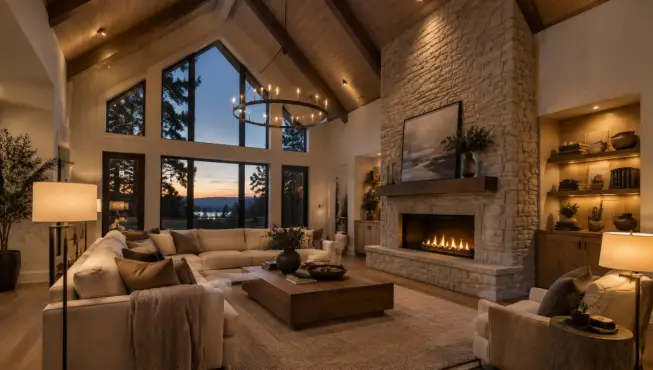
Cathedral ceilings invite dramatic fixtures, but a dramatic fixture is not the same thing as a complete lighting plan. One of the most common mistakes in a tall living room is asking a single chandelier or pendant to provide all of the useful light.
Do Not Rely on One Oversized Fixture
A central fixture can establish a focal point, but it rarely lights the room evenly on its own. The farther the ceiling rises from the occupied zone, the more important it becomes to build light at several heights rather than concentrating everything overhead.
A balanced plan can combine:
- Ambient light for general visibility, using recessed, directional, cove, or broad ceiling illumination where the architecture allows it.
- Task light close to where people read, work, or gather, such as floor lamps and table lamps.
- Accent light that gives dimension to artwork, stone, wood, shelving, beams, or other architectural surfaces.
- A decorative fixture that contributes to the composition even when it is not the room’s only source of light.
Use Lighting at More Than One Height
Tall rooms can feel visually top-heavy when all the light comes from the ceiling. Wall sconces, lamps, and low-level accent light pull some illumination back toward eye level, where people actually experience the room. This also helps the seating area feel more intimate after dark.
If the ceiling has strong architectural features, use light to reveal them selectively rather than washing every surface evenly. Grazing a stone chimney, highlighting a timber beam, or directing light toward a textured wall can give the upper volume depth without turning the ceiling into a brightly lit display.
Let the Architecture Choose the Focal Point
The geometric center of the room is not always the visual center. A fireplace, a double-height window wall, or a primary seating arrangement may deserve more emphasis than the midpoint of the floor plan. Before centering a pendant or chandelier, check how it aligns with the ridge, windows, furniture, and the main approach into the room.
Plan Airflow for the Room’s Vertical Volume
A cathedral ceiling increases the amount of air contained in the room without increasing the floor area. That changes how the space feels as temperatures shift. Warm air naturally moves upward, and in a tall room it can collect well above the seating zone while the lower part of the room feels different.

Air movement should therefore be planned around the occupied area rather than the peak alone. The aim is not simply to move as much air as possible, but to create comfortable circulation without turning the ceiling into a collection of unrelated mechanical and decorative objects.
Combine Functions When the Ceiling Is Visually Busy
In living rooms where illumination and air movement need to come from the same central zone, ceiling fans with lights can reduce the number of competing fixtures overhead. The important design decision is not simply whether to add a fan, but whether its blade span, hanging height, finish, and light output feel proportionate to the room.
Treat Hanging Height as a Visual Decision as Well as a Practical One
A fan or pendant placed too close to a very high ridge can look visually disconnected from the room below. Suspended too low, it can interrupt sight lines and make the space feel compressed. The appropriate position depends on ceiling height, room dimensions, slope, clearances, and the requirements of the specific fixture.
For sloped ceilings, confirm that the mounting system is designed for the angle and that any downrod or adapter is compatible with the fixture. Manufacturer instructions and local installation requirements should always take priority over a purely visual preference.
Choose Furniture That Can Hold Its Own in a Tall Room
A cathedral ceiling can make normal-size furniture appear smaller than expected. The answer is not to oversize every piece, but to create enough visual mass at floor level that the room feels anchored.

Build a Strong Seating Composition
Start with the conversation area rather than the ceiling. A generously scaled rug, a substantial sofa, and well-proportioned chairs can establish a clear zone within the larger volume. Coffee tables, side tables, and floor lamps then help define the perimeter of that zone.
This is especially important in open-plan rooms. If the furniture floats too far apart simply because the room feels large, conversation becomes less comfortable and the floor plan loses cohesion. A tall room can still have an intimate center.
Keep Human Scale in the Foreground
People experience a living room from the sofa, not from the ridge. Upholstery, side lighting, rugs, tables, and art placed at eye level should therefore do much of the work of making the room feel comfortable. The upper volume can remain quieter and more open.
Use the Upper Walls Without Filling Every Inch
Tall walls often tempt homeowners to keep adding objects until the blank surface disappears. That can weaken one of the best qualities of a cathedral ceiling: the sense of breathing room.
Instead, choose a few elements that connect the lower room to the upper architecture. Full-height drapery can emphasize tall windows. A fireplace chimney can create a vertical anchor. Large-scale art can work when it relates to the furniture below rather than floating by itself in the upper wall.
Exposed wood, stone, plaster, paneling, or other textural materials can also carry visual interest upward without requiring additional decoration. Negative space is not wasted space; in a cathedral-ceiling room, it is often part of the architecture.
Make the Ceiling Fixture Part of the Composition
Overhead fixtures in a cathedral-ceiling room are highly visible. Their shape, material, and finish can either reinforce the architecture or become an unrelated object suspended in front of it.
Match the Fixture to the Room, Not Just the Ceiling Height
Scale matters, but so do silhouette and material. A room with exposed timber may benefit from a fixture that relates to the warmth of the wood without copying it exactly. A crisp contemporary interior may need a quieter form that leaves the ridge, glazing, or fireplace as the primary statement.
For tall or sloped rooms, downrod ceiling fans with lights should be treated as part of the room’s visual composition rather than as equipment added after the design is finished. Blade shape, housing profile, visible hardware, finish, and the character of the light all contribute to how the fixture reads from the floor.
Coordinate, Do Not Over-Match
A room rarely needs every metal finish to match. A black window frame does not automatically require a black fan, nor does a wood ceiling require wood blades. What matters is whether the fixture belongs to the same material story as the rest of the room.
Look for repetition in tone, line, and proportion. A slender fixture may echo narrow window mullions; a darker housing may balance a fireplace surround; a warmer finish may soften a pale room. These relationships are often more convincing than an exact color match.
Make the Room Feel Warm, Comfortable, and Acoustically Balanced
Height can make a room impressive, but comfort comes from what happens closer to the body. Texture, softness, lighting, and sound control all help bring a cathedral-ceiling room back to human scale.

Add Softness Where People Actually Live
Large rugs, upholstered seating, curtains, throws, cushions, and tactile materials can make a tall room feel warmer without diminishing its openness. These elements are most effective around the seating area rather than scattered equally through the entire space.
Do Not Treat Acoustics as an Afterthought
Tall ceilings, hard floors, glass, and large wall surfaces can increase sound reflection. In a quiet room this may show up as echo; in a social room it can make conversation feel louder and less comfortable.
Soft finishes help. Rugs, upholstery, drapery, bookshelves, textured wall treatments, and other absorptive surfaces can reduce the amount of sound bouncing through the volume. The goal is not to deaden the room, but to prevent the architecture from making ordinary activity feel harsh.
Work With Beams Instead of Designing Around Them
Exposed beams can give a cathedral ceiling rhythm and structure, but they also affect fixture placement. Lighting, fans, and pendants should relate to that rhythm rather than appearing to cut across it arbitrarily.
Before locating a fixture, look at beam spacing, ridge position, electrical access, and the way the beams frame the room from the main viewpoints. A well-positioned fixture can sit comfortably within the architecture; a poorly positioned one can make even beautiful beams feel visually cluttered.
Directional lighting can also use beams to advantage by emphasizing their texture or creating soft contrast on the ceiling planes. The effect is usually stronger when only selected surfaces are highlighted rather than every beam being lit equally.
Common Cathedral-Ceiling Living Room Mistakes
- Using one ceiling fixture as the entire lighting plan. A dramatic chandelier can be a focal point, but it rarely replaces task and lower-level ambient light.
- Choosing furniture only by floor area. The room’s vertical volume affects how substantial sofas, rugs, tables, and art feel in context.
- Ignoring airflow until after the ceiling is finished. Fan mounting, electrical locations, beams, slope, and lighting positions are easier to coordinate early.
- Hanging fixtures without checking sight lines. A fixture should look intentional from the sofa, the entry, adjoining rooms, and any upper-level view.
- Filling every tall wall. Leaving some upper surfaces quiet often makes the architecture feel more confident.
- Mixing too many materials overhead. Beams, lights, fans, vents, and trim should feel like one composition rather than separate additions.
- Forgetting acoustics. A beautiful hard-surfaced room can still be uncomfortable if sound reflects excessively through the tall volume.
A Practical Design Checklist
Before finalizing a cathedral-ceiling living room, check the following:
- Ceiling geometry: ridge, slope, beams, peak height, and lower ceiling height.
- Lighting layers: general light, task light, accent light, and decorative fixtures.
- Fixture placement: scale, drop, sight lines, and relationship to the room’s focal point.
- Air movement: room volume, fan position, mounting compatibility, and clearances.
- Furniture: a clearly anchored seating zone with enough visual weight for the room.
- Windows: daylight direction, glare, privacy, and the visual role of drapery or shades.
- Materials: a coherent relationship between ceiling, walls, flooring, fixtures, and furnishings.
- Acoustics: enough soft or textured surfaces to keep conversation comfortable.
- Maintenance: practical access to high fixtures, bulbs, fans, and other ceiling-mounted components.
Cathedral-Ceiling Living Room FAQs
What Is the Difference Between a Cathedral Ceiling and a Vaulted Ceiling?
A cathedral ceiling usually has two sloping sides that rise toward a central ridge, often following the roof form. A vaulted ceiling is a broader category and may be curved, asymmetrical, or sloped in other ways. For interior planning, the important issue is the actual geometry because it affects lighting, mounting, and visual proportion.
What Is the Best Type of Lighting for a Cathedral Ceiling?
There is no single best fixture. Cathedral ceilings are usually more comfortable when lighting is layered: general illumination for the room, task lighting near seating, accent lighting for architecture or art, and a decorative fixture when the space benefits from one.
How Do You Light a Living Room With a Cathedral Ceiling?
Avoid concentrating all the light at the highest point. Combine ceiling or directional lighting with lamps, sconces, and other sources closer to eye level. This keeps the upper volume visible while making the seating area feel warmer and more useful after dark.
How Do You Make a Cathedral-Ceiling Living Room Feel Cozy?
Create a strong human-scale zone within the larger room. Use a substantial rug, grouped seating, warm side lighting, upholstery, drapery, and tactile materials. The room can remain visually tall while the area where people sit feels intimate.
What Kind of Ceiling Fan Works With a Cathedral Ceiling?
Look for a fan whose mounting system is compatible with the ceiling slope and whose size and hanging position suit the room. Blade clearance, downrod compatibility, airflow needs, and the manufacturer’s installation requirements should all be checked before selecting a model.
How Do You Improve Air Circulation in a Room With Cathedral Ceilings?
Plan air movement around the occupied zone rather than the peak alone. A properly placed ceiling fan can help circulate air through the room, but its mounting height, direction of operation, and speed should suit the season and the specific space.
How Should Tall Walls Be Decorated in a Cathedral-Ceiling Living Room?
Use a few elements with enough scale to relate to the architecture: tall drapery, a fireplace chimney, large artwork, shelving, or textural finishes. Avoid filling every upper surface. Some negative space helps preserve the sense of height.
What Are the Most Common Cathedral-Ceiling Design Mistakes?
The most common problems are relying on one overhead light, under-scaling the furniture, ignoring airflow and acoustics, hanging fixtures without considering sight lines, and over-decorating the upper walls. Most of these issues are easier to solve when the ceiling, lighting, furniture, and mechanical elements are planned together.
Design the Volume, Not Just the Ceiling
The strongest cathedral-ceiling living rooms do not depend on height alone. They use that height to create a sense of space while keeping light, air, furniture, and sound comfortable at the level where people live.
When the architecture and the furnishings are treated as one system, the room can feel both expansive and grounded. The ceiling remains a defining feature, but it supports the living space rather than overwhelming it.