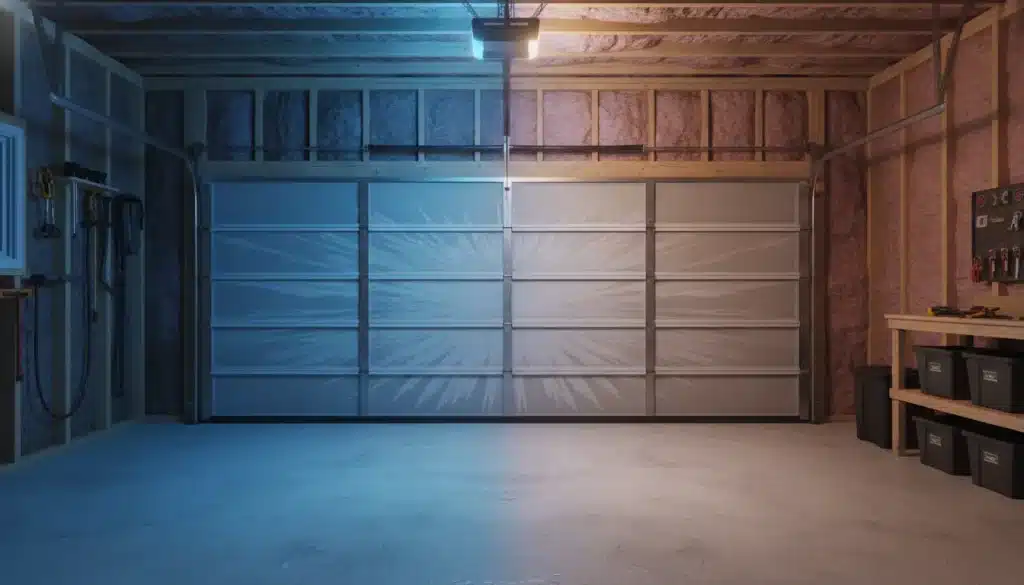
People tend to overlook the garage when it comes to energy consumption optimization in their homes. However, this is what makes it one of the least energy-efficient places in the house.
The “Buffer Zone” Fallacy
There is a popular concept that the garage is something between “inside” and “outside” – a neutral zone that doesn’t really affect either one. People assume “extreme” temperatures stay in the garage, and the house remains comfortable on its own. The truth is, however, that physics doesn’t work that way.
Your garage shares walls, and in many cases the ceiling, with your living space. That thin wall between your fridge and your car isn’t a wall between “inside” and “neutral.” It’s a wall between conditioned living space and a space that could shift by 40 degrees Fahrenheit in the course of an afternoon.
And every degree of that swing is another degree that your poor HVAC system has to make up. In winter, your garage is a cold sink that your furnace has to somehow counteract, sucking up money.
In summer, it’s a heat box that raises your air conditioning bill for every room adjacent to it.
The buffer zone concept isn’t just wrong. It’s expensive.
Why the Numbers Tell the Real Story
An exterior home wall with proper insulation generally has a thermal resistance ranging from R-13 to R-21, depending on the climate zone and the age of construction.
Now, let’s compare that to the wall on the opposite side of your garage: a standard metal garage door that usually has a thermal resistance between R-0 and R-2. This isn’t a minor difference. This is the equivalent of leaving a window open the entire length of your front wall.
And it gets worse because the thermal bridge problem is compounded even further. Heat travels through the easiest path available to it, and those un-insulated metal studs, door frames, and the door itself are like highways for heat transfer that bypass whatever insulation exists nearby.
According to DASMA (Door & Access Systems Manufacturers Association), replacing an uninsulated garage door with an insulated model can reduce heat loss through the garage by up to 71%, which meaningfully stabilizes temperatures in adjacent living spaces.
That’s not a marginal improvement. It’s a structural fix to a structural problem.
The Weight and Balance Hazard Nobody Talks About
Here’s where DIY garage insulation projects may cause a major mechanical issue. When you attach insulation panels to an existing garage door – whether polystyrene kits or custom-cut foam – you’re applying weight to a system that was tuned exactly without it.
Garage doors are tuned by torsion springs, which retain mechanical energy to neutralize the weight of the door and let the opener motor lift it with minimal force. When the door weight rises, the spring force must be retuned to suit.
If it’s not, the opener motor will compensate by working more than it is supposed to, reducing its lifespan by a lot. Also, an unbalanced door under strong spring force poses a physical danger while being opened manually.
This is not a calibration most homeowners should handle themselves. Torsion springs retain a lot of mechanical energy and can cause serious injury if not handled using the right tools and training.
Contacting a specialist like Supreme Garage Door Repair to safely adjust or update the torsion springs – and make any required garage door repairs to suit the new thermal load – is the right step after any major change to door weight. The expense is minimal compared to a damaged opener or a door that behaves unpredictably.
Polyurethane vs. Polystyrene – It’s Not Just About Price
Once homeowners begin looking into insulated garage doors or retrofit kits, they eventually encounter the choice between two types of foam: polystyrene and polyurethane. Most people choose polystyrene because it’s a few hundred dollars less, and that makes sense. But the performance gap is real.
Polystyrene panels are cut to shape and placed into the door sections. They are lightweight, easy to work with and offer a relatively good R-value for their cost. The issue is that they don’t bond to the door skin, which means there’s still an air gap where infiltration can occur. They also don’t contribute structurally to the door panel.
Polyurethane, on the other hand, is not added to the door after fabrication, but spray-injected between the inside and outside skins as part of the manufacturing process. It expands to fill the entire cavity with no air gaps, and it bonds to both the inside and outside skins.
As a result, it actually provides additional structural rigidity to the door panel.
Most importantly, the thermal performance is more consistent because there are no air gaps undermining it. The R-value per inch is also higher than polystyrene.
If you are going to buy a new insulated garage door, the polyurethane variety is worth the extra money. If you are retrofitting an existing door with panels, you’re getting a partial solution – which is better than nothing, but it’s worth understanding what you’re getting.
Start With the Shared Wall and Ceiling, Not the Door
Most homeowners who choose to insulate the garage start with the door. That’s the wrong approach. It’s the visible part, the part people see, the part that moves – that’s where we put our attention.
But the greatest and most continuous energy losses occur at the unheated house/garage common wall (often referred to as the firewall in construction) and the ceiling. These surfaces are in constant thermal contact with your living space. The garage door swings open and closed. The shared wall never stops transferring heat.
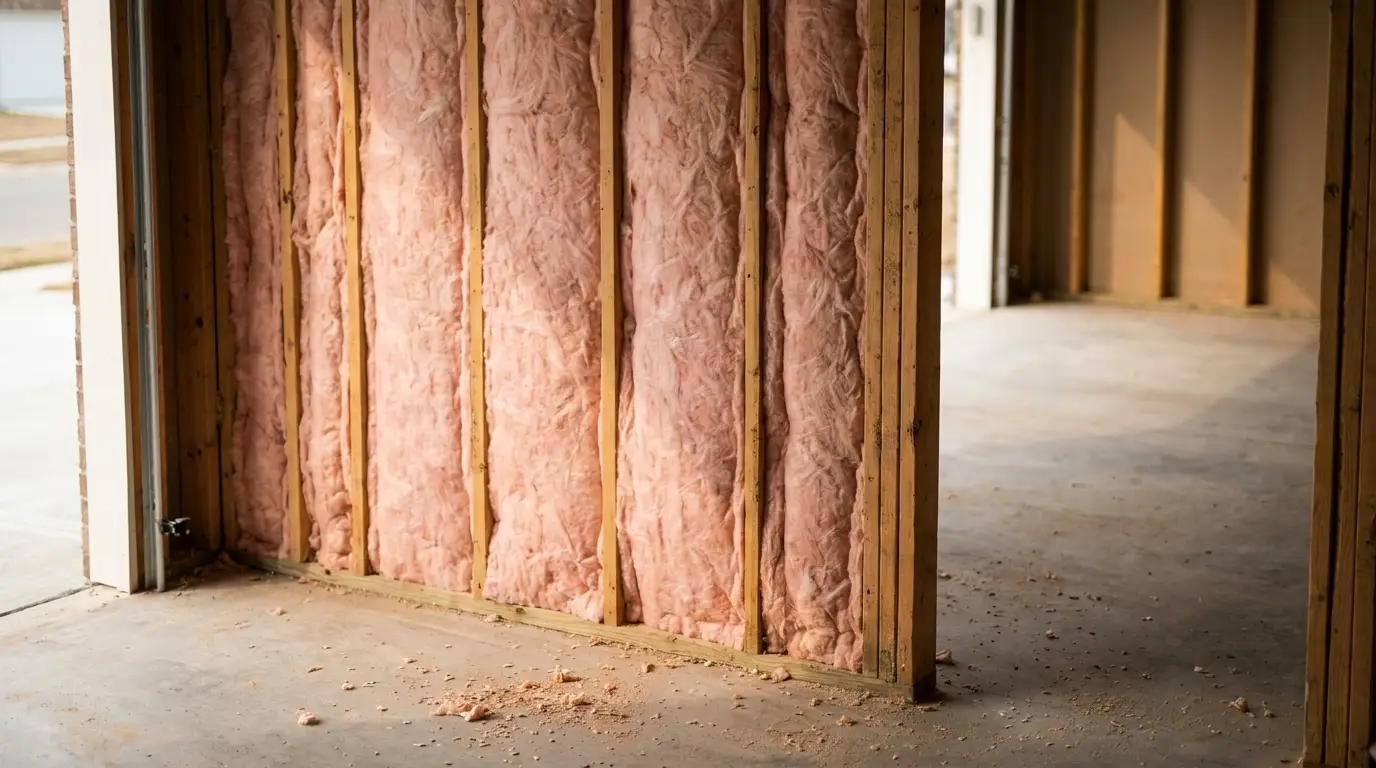
For the shared wall, if the wall cavity is still open, then installing fiberglass batt insulation between the studs is the traditional way to go. It works wonderfully… if the installation is gap-free and completely fills the cavity without compression.
If the cavity is already enclosed, then blown-in cellulose is a cleaner, easier, and superior solution as it fills the space and goes around wires, junction boxes, conduit, and other obstructions in the cavity that batts cannot neatly accommodate.
The ceiling is even more important if there is a living space above the garage. An uninsulated garage ceiling with a heated room overhead is an enormous energy sieve. Those rooms above the garage will always be harder to cool in summer and harder to heat in winter regardless of what the thermostat settings are.
Air Sealing Is Where Most Projects Fail
Insulation with a high R-value that’s installed in a leaky envelope doesn’t perform as well as the numbers would suggest. R-19 in a wall that has significant air infiltration is not the same as R-19 in a wall that’s properly sealed. The leaks short-circuit the insulation’s performance entirely.
For the garage door specifically, it’s the weatherstripping component most often either ignored or found in poor condition. The perimeter seals and the bottom seal on most doors degrade over time – they crack, compress unevenly, or just pull away from the frame. A door with a good R-value rating but failed weatherstripping will still let cold air flow around the edges with ease.
A proper air sealing job on a garage door incorporates high-quality PVC stop molding on the sides and top, a compression fit bottom seal that contacts the floor surface evenly across the full width, and, ideally, a threshold seal mounted to the floor itself.
These three components working together create the air barrier that makes the insulation’s R-value meaningful.
Moisture, Exhaust, and What Happens When You Seal Too Well
An uninsulated garage breathes. There’s enough air movement through gaps and cracks that the small amount of exhaust from a car startup, the paint fumes from that can on the shelf, the carbon monoxide from a gas-powered tool – all of it just dissipates before it can accumulate to dangerous levels.
An insulated, and air-sealed garage doesn’t breathe in the same way.
And if you seal the envelope effectively without a plan for providing ventilation too, you create a contained space where those same fumes can concentrate. Carbon monoxide doesn’t smell. You won’t know it’s becoming a problem until it already is one.
Mechanical exhaust ventilation is not optional in a well-sealed garage. Even a basic exhaust fan with a timer or humidity sensor provides the air exchange you need to prevent buildup.
The other moisture issue is vapor migration. If you’re insulating garage walls in a cold-winter climate, warm humid air from the inside can migrate into the wall cavity, hit a cold surface, and condense. Over time, that moisture will support mold growth inside the wall. A vapor barrier – typically a plastic or foil membrane – installed on the warm side of the insulation prevents this by blocking vapor movement before it reaches the cold zone.
What Stable Temperatures Actually Protect
In addition to your energy bills, there is a very good “real-world” reason for insulating the garage that is seldom discussed. The garage is the place where you store things that we would prefer not to freeze.
Paint freezes and is ruined. Lithium-ion batteries used in power tools and all kinds of gadgets lose capacity and will ultimately be destroyed by repeated freezing. Lawn equipment often contains leftover fuel, which degrades and loses octane with each temperature cycle. Frozen lubricants ruin machines. Adhesives, caulk, and solvents all have assumed life expectancies that assume reasonable storage temperatures. Many housing designs locate water supply piping in the garage walls or ceiling. An overnight garage freeze can wreck that piping. A single burst pipe during a cold snap can do more dollar damage than the cost of insulating the garage in the first place.
Keeping the garage above freezing, especially when the outdoor temperature cools down in the fall or heats up in the spring, is wise.
The Return on the Investment
Working on garage insulation might not be as exciting as remodeling a kitchen, but it makes good financial sense. When less heat escapes through the garage, your HVAC system runs less.
When it runs less, you use less energy, receive lower bills, and put less strain on the system. An HVAC system that runs fewer hours will need servicing less often and will last longer before needing replacement.
When you eventually sell the house, buyers will recognize that an insulated garage, especially one with a high-quality insulated door, is an upgrade. It shows that the energy performance of the house was a priority, and that increasingly factors into buyers’ prioritization of energy bills.
The garage is not a space you can afford to leave out while bringing the rest of the house up to snuff. It’s directly tied to all of those objectives: your energy budget, your comfort, the value of what you store in the garage, and the primary mechanical systems.
Treating the garage as a component of the house rather than as an accessory outbuilding is a significant mindset change.