Ask three contractors for a quote on the same kitchen, and you’ll probably get three different numbers.
It’s frustrating when you’re just trying to figure out what’s normal, and there’s rarely a clear explanation for the gap.
The cost of quartz countertops installed depends on more than just the slab. Slab grade, edge style, cutouts, and labor all play a part, and most homeowners never see how those pieces actually add up.
Below, you’ll get a real look at 2026 pricing and how to judge whether your quote actually makes sense.
Average Cost of Quartz Countertops Installed
That quote you got isn’t just paying for the slab. Labor, fabrication, and the materials are all baked into that one number. So you’re really paying for the cutting, the edge work, and the crew that shows up to install it.
- Average Installed Cost: Most full kitchens run $2,500 to $5,500, with people landing around $3,500 once it’s all added up.
- Cost per Square Foot: Expect $50 to $120 per square foot. Builder’s grade stays around $50 to $60, commercial grade runs $60 to $80, and premium quartz can go $80 and up.
- Price by Kitchen Size: A small kitchen runs $1,800 to $3,000, a medium kitchen $2,600 to $4,500, and a large kitchen $4,000 to $7,200.
Other projects add their own costs. An island runs $800 to $2,000, a bathroom vanity lands at $400 to $1,200, and a backsplash costs $600 to $1,500, more for full height.
Quartz Countertop Installation Cost Breakdown
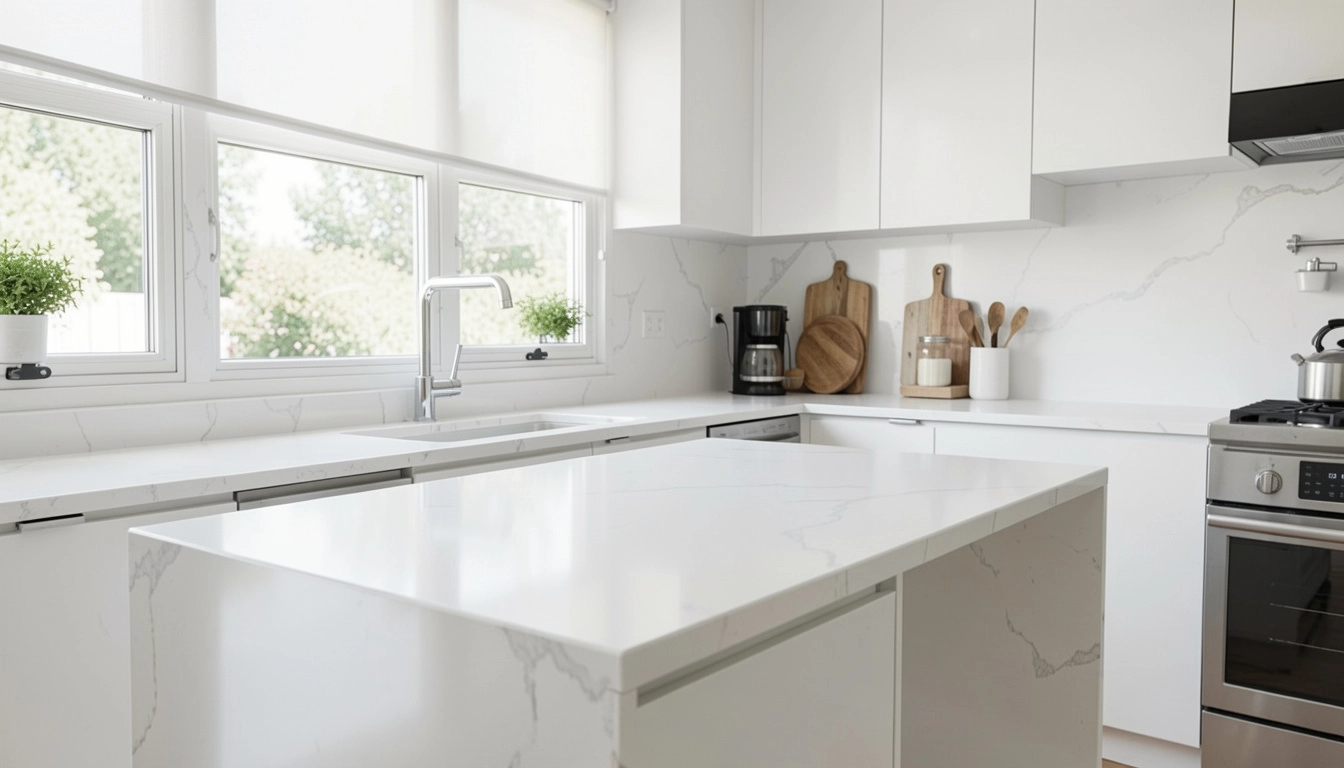
The price on a quartz countertop quote is never just about the stone. It covers measuring, cutting, cutouts, edges, delivery, and installation labor, all rolled into one number.
Once you know what each part actually costs, comparing two contractor quotes gets a lot easier, because you can see exactly where the money is going.
Quartz Slab Material
Quality level is the biggest driver of price, and the slab itself usually makes up 40 to 50 percent of your total bill.
Higher resin content generally means a cheaper slab, but less durability over time.
Measuring, Templating, and Fabrication
A pro measures your space and builds a template before any cutting starts, usually included in the price.
The slab is then cut to your exact layout, including
curves and overhangs, which typically accounts for 15 to 20 percent of the total cost. This skilled step is why quartz costs more than laminate.
Sink, Cooktop, and Faucet Cutouts
Each cutout adds labor and risk, since one bad cut can ruin the slab. This usually accounts for 3 to 5 percent of the total, and most quotes cover a set number of cutouts, with extra ones costing more.
Professional Installation and Reconnection
Quartz is heavy, so installation takes two or more people and typically runs 20 to 25 percent of the total price. Rushed work is a common cause of cracked countertops later.
Disconnecting and reconnecting fixtures like a sink or cooktop is usually billed separately and may require a licensed plumber or electrician.
Delivery and Old Countertop Removal
Moving the slab from the shop to the home isn’t easy; some companies include this in the total, others bill it separately by distance.
Tear-out usually makes up 5 to 8 percent of the total and is often billed on its own, especially for heavy materials like granite or tile. Doing it yourself can save money.
Quick Cost Comparison
This is roughly how the total bill breaks down by category. It’s a good starting point before you compare quotes.
| Cost Component | Typical Share | Average Cost | Included |
| Quartz slab | 40–50% | $20–55/sq. ft. | yes |
| Fabrication | 15–20% | $8–18/sq. ft. | yes |
| Installation labor | 20–25% | $10–30/sq. ft. | yes |
| Cutouts | 3–5% | $100–300 each | Usually, limits may apply |
| Removal | 5–8% | $200–800 | No, often billed separately |
That’s the basic split on a quartz job. Keep these numbers in mind when you’re comparing quotes.
What Affects the Cost of Quartz Countertops Installed?
Many small factors stack up to shape your final number. Here’s what actually moves the needle:
Countertop Size and Kitchen Layout
More square footage means a higher bill, and a tricky layout with lots of angles or an island adds extra labor time.
Slab Quality, Brand, and Thickness
Premium brands and thicker 3cm slabs cost more than builder-grade or 2cm options, since they use less resin and need less backing support.
Edge Style
A simple straight edge costs the least, while beveled, rounded, or waterfall edges take more shop time and raise the price.
Cutouts and seams
Each sink, cooktop, or faucet cutout adds labor and risk, and more seams in a large kitchen mean more time spent matching and finishing joints.
Removal, Plumbing, and Location
Hauling away old counters, reconnecting fixtures, and local labor rates in your area can all add to the total, sometimes as separate charges.
This ties back to what you already know about pricing. It just breaks down which choices actually push those numbers up or down for your kitchen.
Is Your Quartz Quote Reasonable?
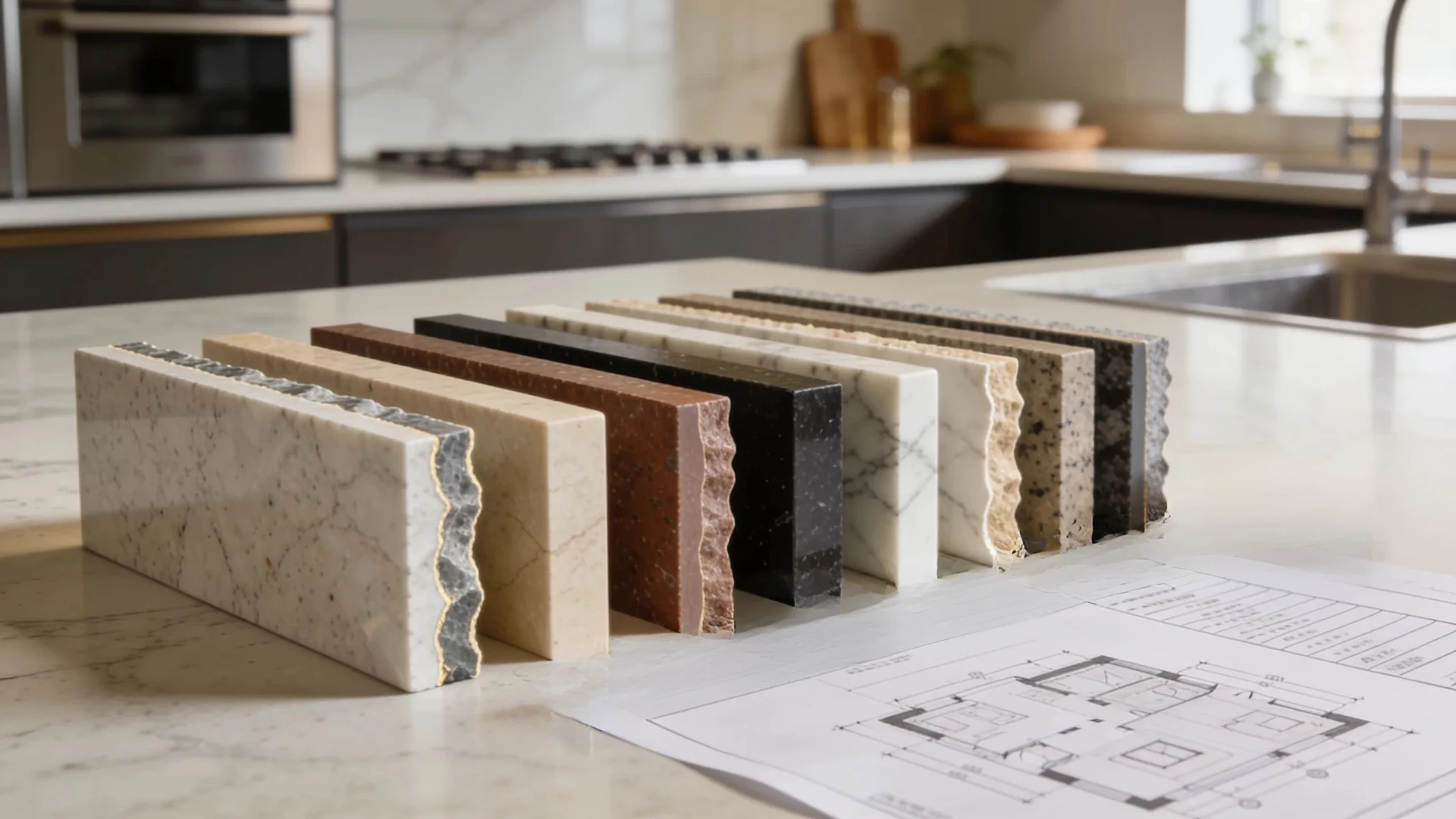
A quote can look fine at first glance and still miss things that end up costing you more later.
The best way to check it is to look at what’s actually written down, know which charges tend to pop up mid-job, and understand when paying more is actually worth it.
A good estimate should list:
- Square footage and slab brand
- Thickness and edge profile
- How many cutouts are included
- Tear-out and delivery
- Warranty details
Some costs tend to show up later, even with a decent estimate, such as travel fees, plumbing reconnection, hauling away old counters, upgraded edges, or rushed fabrication.
These rarely make the first estimate but often end up on the final bill.
A bigger number isn’t always bad news. It might mean a better warranty, a more skilled fabricator, or a better slab. Watch out if fabrication isn’t broken out, there’s no warranty, or templating gets skipped.
For a 40-square-foot kitchen, the cost of quartz countertops installed usually comes to around $4,200.
Which Quartz Choice Fits Your Budget?
Picking quartz isn’t just about color. Every choice you make at the store nudges your bill up or down, sometimes more than you’d think.
- Grade: This matters most. Builder-grade uses more resin and costs less, while premium quartz costs more but gives you richer color and holds up better over time.
- Origin: Domestic slabs are usually cheaper. Imported ones cost more, but you get patterns and veining you won’t find locally.
- Color: Plain colors are easy on the wallet. Marble-look costs more because copying that natural veining takes real skill.
- Thickness: 2cm saves you money upfront. 3cm costs a bit more but skips the extra backing and feels sturdier.
- Brand: Go with a lesser-known name to save some cash, or stick with Caesarstone, Silestone, or Cambria if you want quality you can count on.
Conclusion
Quartz is a long-term investment, so the sticker price only tells part of the story.
What matters more is understanding what’s actually driving the cost of quartz countertops installed: the slab quality, the labor, and everything in between.
A fair estimate should be upfront about what’s included, and a good installer won’t hesitate to explain every line item.
Before committing to anything, compare a couple of quotes against what you now know. Reach out to a local fabricator today and ask for a full, itemized breakdown.
Frequenty Asked Questions (FAQ’s)
1. How Much Does 30 Sq. Ft of Quartz Countertop Cost?
For 30 square feet, expect around $1,800 to $3,000 installed, depending on slab grade and edge style.
2. Are Quartz Countertops Cheaper than Granite?
Not usually. Pricing is similar per square foot, though granite can run cheaper in lower grades.
3. How Do You Clean Quartz Countertops?
Wipe with mild soap and water, and skip harsh chemicals like bleach.
4. How Much Does it Cost to Remove Old Countertops?
Usually $5 to $15 per square foot on top of new installation costs.
5. Are Quartz Countertops Worth the Money?
Yes, for most homeowners because they resist stains and scratches well and rarely need sealing.