The new kitchen has a schedule. The sofa, the dining table and the painted dresser in the hall usually do not. Furniture is the part of a remodel that gets planned last, and it sits in the way for longer than most people expect. In the 2024 U.S. Houzz & Home Study, which drew on more than 30,000 homeowners, kitchen renovations done in 2023 took 5.1 months of building on average, and living rooms took 4.1.
Temporary storage during a renovation comes down to four places: the house itself, the garage, a container in the driveway, or a storage facility off site. Each one is right for some pieces and wrong for others.
Decide What Has to Leave Before You Decide Where
Walk the house with the contractor’s scope of work in hand and sort every piece into three groups.
- Stays put: furniture in rooms nobody will work in, behind a door you can close and seal.
- Leaves: anything in the work zone or on the path the trades will use, plus upholstery, rugs, mattresses and framed art from the rooms next to it. Soft pieces collect dust, and framed pieces get knocked.
- Goes for good: the chair nobody sits in, the bookcase you were already tired of.
That last group matters more than it looks. Everything you keep has to be wrapped, moved out and moved back, and paid for if it goes off site, so a renovation is the cheapest moment you will get to edit. Before anything valuable leaves the room, photograph it, so you have its condition on record when it comes home.
Option One: Leave It in the House
Leaving furniture where it is costs nothing, and it is the right call when the work is contained: one bathroom, a closet, an exterior job. Push the pieces to the middle of an untouched room, cover them with plastic sheeting taped to itself and never to a finish, and keep the door shut.
It stops working once the project reaches into the rooms you live in, and it is a poor choice in an older house.
The EPA is direct about the risk: “Any renovation, repair or painting project in a pre-1978 home or building that has lead-based paint can easily create dangerous lead dust.”
That is dust you do not want worked into a sofa cushion or a wool rug. If your house was built before 1978, the soft furnishings leave before the first wall is opened.
Option Two: The Garage
Storing furniture in the garage is tempting because it is free and a few steps away. For wood furniture it can be the worst place on this list.
Wood takes on and gives up moisture with the air around it. The USDA Forest Products Laboratory’s Wood Handbook tabulates the effect: at 70°F, wood settles at 7.7 percent moisture content in 40 percent relative humidity and at 13.1 percent in 70 percent humidity. The handbook is blunt about what follows: “This shrinking and swelling can result in warping, checking, and splitting of the wood.”
A coat of paint will not fully protect the dresser you spent a weekend refinishing, either. The same handbook says moisture content changes “can be retarded, but not prevented, by protective coatings such as varnish, lacquer, or paint.”
Now picture a garage through a Dallas summer. The National Weather Service’s 1991 to 2020 normals for DFW record 20.2 days of 100°F-plus heat in a normal year, and outdoor relative humidity normally sits at 70 percent in May and 67 percent in June.
Both months are over the 65 percent line the National Archives draws for family photographs and papers, which it also tells people to keep “out of damp basements, garages, and hot attics.”
The garage is fine for metal patio furniture, boxed dishes and anything you would leave on a covered porch. It is the wrong place for veneer, leather, artwork or electronics.
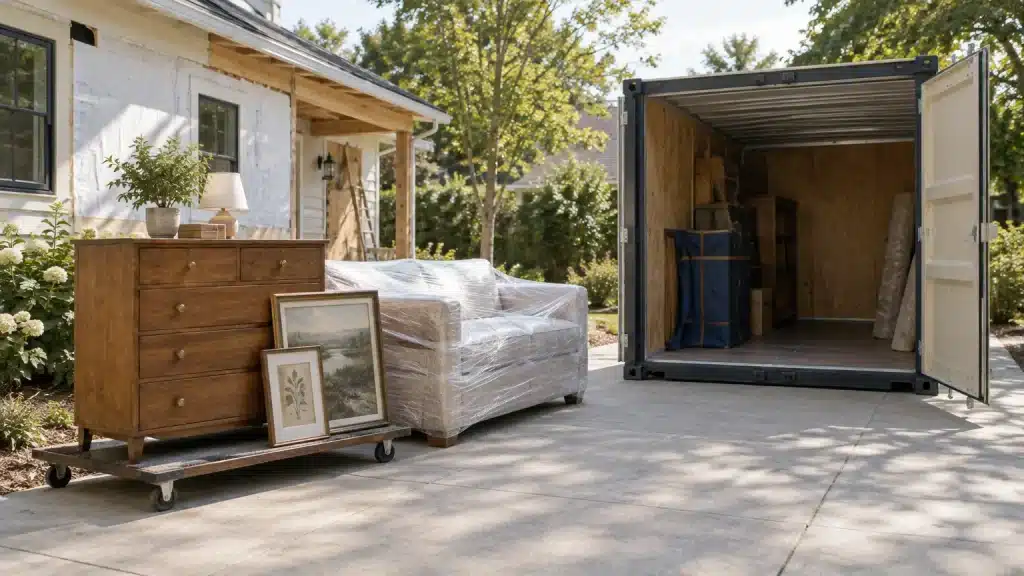
Option Three: A Container in the Driveway
A portable storage container splits the difference. A container sits on site, so you can fetch the slow cooker on a Tuesday, and you load it at your own pace.
For a long remodel where you need things often, that convenience is real, and it spares you a truck rental.
It is still a box sitting on a driveway. PODS answers the question in its own FAQ: it “doesn’t offer climate-controlled storage,” and its storage centers “aren’t humidity- or temperature-controlled.” Treat a container like the garage for anything wooden, upholstered or framed.
Before you book, check two things: whether your HOA or city limits how long a container can stay out front, and whether the contractor needs the driveway for a dumpster or deliveries.
Option Four: Storage Off Site
Off-site renovation storage is the only option here that gets everything out of the house and, if you choose a conditioned space, out of the weather. It comes in two versions.
Self-storage means renting a unit and doing every lift yourself, from loading the truck to stacking the back wall. It suits someone with a truck, a strong friend and a free weekend at each end of the project.
Whether you need climate-controlled storage depends on what goes in it: for wood, upholstery, art, electronics and photographs through a summer like the one above, the answer is yes, so ask before you sign.
The second version hands the whole job to a moving crew.
They wrap and inventory each piece, take it to a warehouse and bring it back when the house is ready, which takes the truck rental and both days of lifting off your list. For a whole-house remodel that runs through a Texas summer, the version worth pricing is full-service storage in Dallas with climate control, so nothing sits in a hot garage waiting for someone to rent a truck. For a single bathroom with nothing fragile in the way, it is more than you need.
Bringing It Back Without Ruining the New Room
Furniture should be the last thing to come back, after the paint, the floors and the final clean.
- Paint: Benjamin Moore’s care guidance says that “the space can be used lightly after 24 hours” but that the paint “will not be fully cured for about 30 days,” and it advises you to “avoid pushing furniture against the walls for the first seven to ten days after painting.” Leave a gap behind the sofa for the first week and a half.
- Floors: new or refinished wood floors have their own cure schedule. Ask the floor contractor how long the specific finish needs before rugs and heavy pieces go down, and put felt pads on every leg before anything lands.
- Furniture: unwrap each piece and check it against the photos you took on the way out, before the wrapping goes in the recycling.
Match each piece to the place that suits it. Hard goods can wait in the garage or a driveway container.
Anything wooden, upholstered, framed or electronic needs conditioned air, whether that is a sealed spare room or a storage warehouse. Sort them before the demolition starts, and the furniture comes back to a finished room in the shape it left.