You know that feeling when you open the door to your storage unit and realize your couch is wedged in at an angle, your boxes are stacked to the ceiling, and you can’t walk two feet inside without playing human Tetris? We’ve all been there. Renting storage is easy. Renting the right size is where people stumble.
Here’s the deal. Most folks either overpay for space they don’t use or cram everything into a unit that’s too small and end up damaging their stuff. This guide walks through what actually fits in each common small unit size, so you can match your belongings to the space without guessing.
By the end, you’ll know exactly which size to book, what to stack, and why the square footage number on the website doesn’t tell the whole story.
Why Most People Get the Size Wrong
The biggest mistake I see? People measure their stuff in terms of furniture pieces, not volume. A sectional sofa isn’t a “couch.” It’s a 7-foot-long, 3-foot-deep object that eats floor space fast. And a storage unit’s dimensions don’t account for the wasted air between your bike handlebars and the ceiling.
Another factor that trips people up is the difference between neat packing and sloppy packing. If you toss boxes in without a plan, that 5×10 unit fills up in about twenty minutes. Stack strategically, and the same unit holds twice as much. Your storage habits matter as much as your storage size.
And there’s one more thing. According to data from the Bureau of Labor Statistics, household moves happen for all kinds of reasons, job changes, downsizing, seasonal shifts. Each scenario brings a different mix of belongings. A college student moving into a dorm needs far less space than a family of four between houses.
Unit Sizes Explained in Plain Terms
Self-storage facilities standardize their small unit sizes fairly consistently, but the exact dimensions can vary by a few inches between properties. Here’s the breakdown of what you’ll typically see.
| Unit Size | Square Footage | Roughly Equivalent To | Best For |
|---|---|---|---|
| 5×5 | 25 sq ft | A large walk-in closet | Boxes, seasonal decor, small furniture |
| 5×10 | 50 sq ft | A small bathroom or half of a garage | Studio apartment contents, bikes, shelves |
| 5×15 | 75 sq ft | A large shed | One-bedroom apartment contents |
| 10×10 | 100 sq ft | A standard bedroom | One to two-bedroom home contents |
Now, here’s the nuance most sizing guides skip. The square footage alone doesn’t tell you what fits. Ceiling height matters. Most units run 8 feet tall, but some facilities offer 10-foot ceilings. That extra height lets you double-stack furniture and boxes in ways a shorter unit won’t allow.
I’d rather have a 5×10 with high ceilings than a 10×10 with standard height, assuming my stuff is mostly boxes and stackable items. Vertical space is free real estate, and most people leave it untouched.
The 5×5 Unit: More Than a Closet
Let’s talk about the smallest option first. A 5×5 unit sounds tiny, and honestly, it is. But for the right situation, it’s perfect.
What actually fits in a 5×5 unit, packed properly:
- 25 to 30 standard banker’s boxes, stacked five high
- Seasonal decorations (Christmas tree, ornaments, wreaths)
- A dresser or a desk, one piece of large furniture
- Four to six trash bags of clothing on hangers
- Outdoor gear like camping equipment or fishing rods
- A motorcycle, if you angle it correctly
What does not fit, no matter how you spin it:
- A full-size mattress and box spring
- A sectional couch
- A washer or dryer
- Anything you need to walk into and browse
That last point is crucial. A 5×5 is a reach-in unit, not a walk-in unit. You’re storing things you won’t need access to often. If you’re rotating holiday decorations or keeping tax documents for the IRS’s recommended retention period, this size works. If you’re storing your entire apartment between leases, you’re going to have a bad time.
The 5×10 Unit: The Sweet Spot for Small Storage
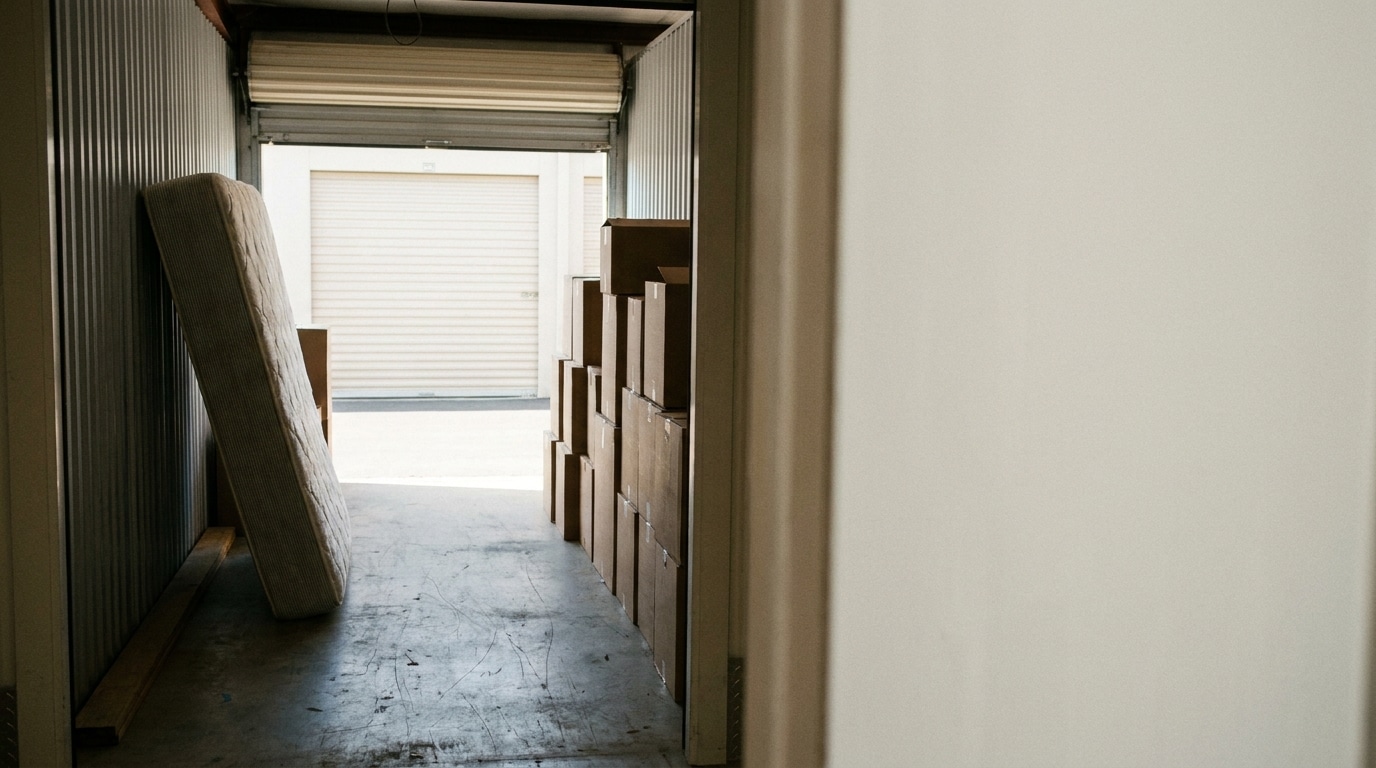
Here’s where things get interesting. The 5×10 unit is arguably the most versatile size in the storage industry, and it’s what most people mean when they search for affordable small storage units for rent and want something that actually handles real furniture.
Think of a 5×10 as a covered parking spot that’s 8 feet tall. You get a narrow but deep rectangle, roughly 10 feet long and 5 feet wide. That layout lets you store furniture along the back wall and stack boxes in front.
What fits in a 5×10:
- A studio or small one-bedroom apartment’s contents
- Full mattress and box spring, standing on end
- Two to three large furniture pieces (couch, dresser, bookshelf)
- Bicycles, lawn mower, or other outdoor equipment
- 40 to 50 boxes when stacked efficiently
- A kayak stored vertically
The key with a 5×10 is leaving a walking path. If you stack everything wall to wall, you lose the ability to access items in the back. My advice? Create an aisle down the middle, about 18 inches wide. You lose a little storage capacity, but you gain the ability to actually find things without unloading everything.
For anyone looking for small storage units for rent that balance capacity and cost, the 5×10 is usually the smartest money. It’s cheaper than a 10×10 by a meaningful margin, and most people discover they don’t need the extra width if they pack vertically.
When to Size Up to a 5×15 or 10×10
So when does a 5×10 stop being enough? Watch for these warning signs during your packing assessment.
First, if you own large appliances, skip anything smaller than a 10×10. A refrigerator takes up roughly 30 square feet of floor space by itself. Add a washer and dryer, and you’ve consumed over half of a 5×10 before you load a single box.
Second, think about your access frequency. If you’re storing your grandmother’s china cabinet but plan to visit monthly to rotate seasonal items, the 5×10 with a walking aisle works. If you’re staging a house and need to pull furniture in and out regularly, you’ll want the wider 10×10 layout.
Third, consider your furniture’s shape. A 5×10 unit is only 5 feet wide. A queen-size bed frame, when disassembled, fits fine along the wall. But a full-size couch that’s 7 feet long needs to go lengthwise, and then you’re blocking access to everything behind it.
The Federal Trade Commission has published practical guidance on moving and storage consumer protection, and their core advice boils down to this: never assume, always measure. Before you rent, measure your largest furniture pieces and mentally place them in the unit’s footprint.
Packing Strategies That Squeeze More Into Less Space
Here’s the part where most storage guides go soft. They tell you to “pack efficiently” without showing you how. I’ll show you.
- Disassemble everything that comes apart. Bed frames lose 70 percent of their volume when you remove the headboard and footboard. Table legs come off. Couch cushions can be stacked separately. Every piece you break down creates flat panels you can lean against the wall.
- Buy uniform boxes. This sounds boring, but it’s the highest-impact decision you’ll make. When all your boxes are the same size, they stack in clean columns with no wasted gaps. Mixing random grocery store boxes creates dead air pockets that eat square footage fast.
- Go vertical with hanging storage. For clothes, use wardrobe boxes with built-in bars. A single wardrobe box holds a full closet’s worth of hanging garments in a 2-foot cube of space. That’s significantly more efficient than packing clothes flat in dresser drawers.
- Store furniture on its side. Not every piece handles this well, but bookshelves and desks often survive being laid flat and leaned against a wall. This turns a piece that would take up 3 feet of floor space into one that takes up 1 foot.
Here’s a scenario I see constantly. A client rents a 10×10 unit because they’re “moving a two-bedroom apartment.” They arrive with their stuff and discover they only filled half the unit. They spent an extra $40 a month for a year, which is $480 wasted on empty floor. Meanwhile, their neighbor fit the same amount of stuff in a 5×10 by disassembling furniture and stacking boxes floor to ceiling.
That’s the difference between reading a sizing chart and actually understanding volume. The chart tells you dimensions. Understanding volume tells you what those dimensions can physically hold.
Ceiling Height, Climate Control, and Other Hidden Variables
Two units with identical floor dimensions can hold wildly different amounts of stuff. The culprit is almost always ceiling height.
A standard unit has 8-foot ceilings. Some newer facilities, particularly those converted from industrial warehouses, offer 10 or even 12-foot ceilings. That extra height lets you stack boxes six or seven high instead of five, or stand furniture vertically that would otherwise need to lie flat.
Climate control is another factor that changes the math. Climate-controlled units maintain consistent temperature and humidity levels, which matters for wood furniture, electronics, photographs, and documents. According to the Department of the Interior, proper environmental conditions are essential for preserving paper-based materials over long periods. If you’re storing anything susceptible to warping or moisture damage, the controlled environment is worth the premium.
The cost difference between a 5×10 and a 10×10 typically runs 40 to 60 percent in favor of the smaller unit. And if you’re storing small storage units for rent are the budget-friendly entry point, especially when you rent for three months or longer, many facilities drop the monthly rate.
Making the Final Call
Let’s boil this down to a quick assessment you can run in ten minutes.
Count your large furniture pieces first. If you have more than three, skip the 5×5 entirely. If you have a full-size mattress, start at the 5×10. If you own appliances beyond a small fridge, go straight to a 10×10. Boxes alone, regardless of count, fit fine in any of these sizes as long as you stack them properly.
Then ask yourself the access question. Will you need to walk inside this unit? If yes, add 20 percent more space than your stuff technically requires. The most common regret among storage renters isn’t renting too little space, it’s renting space they can’t comfortably use.
Finally, think about your timeline. A three-month rental between moves calls for a different calculus than a year of storing your late mother’s furniture while you decide what to keep. Longer storage commitments give you more time to sort, so you can afford to start smaller and upgrade later if needed.
Most facilities let you upgrade to a larger unit mid-lease without penalty, but downgrading is rarely allowed. So start conservative, and only size up if you genuinely need to.
The right small storage unit isn’t the one with the biggest square footage. It’s the one where your stuff fits, you can reach what you need, and you’re not paying for empty air. Measure your furniture, count your boxes, and be honest about how often you’ll visit. That’s the whole secret.
So before you sign that rental agreement, stand in your living room and look at your couch, your mattress, your bookshelf. Picture them in a 5×10 with a walking aisle down the middle. If you can see it working, you’ve found your answer.
And if you’re still unsure, rent the smaller size first. You can always upgrade. Your wallet will thank you, and honestly, the storage company won’t mind either way.