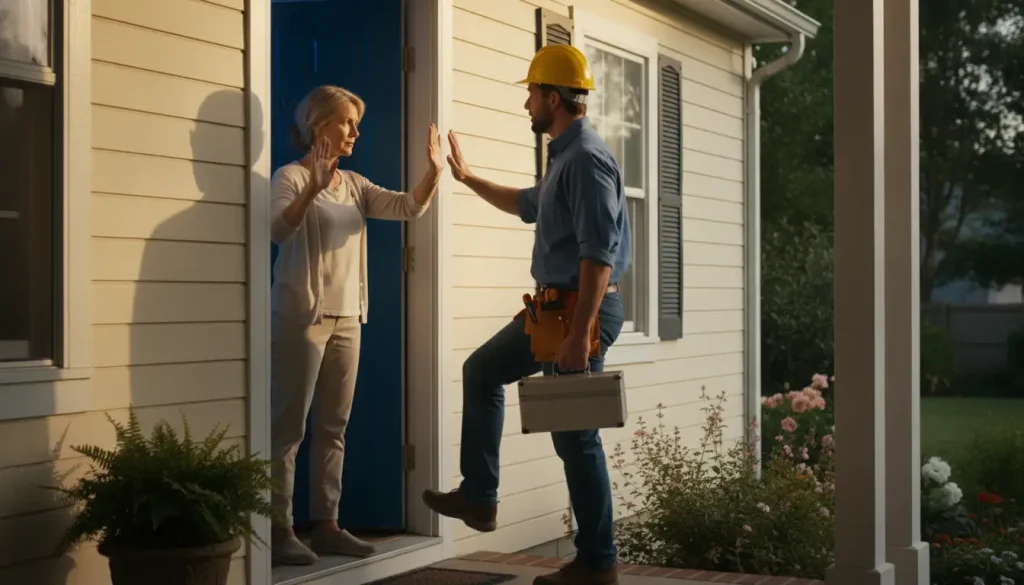
Proper liability coverage for a handyman costs $30 to $60 a month. Remember that number, because it is the quiet answer to a question every homeowner eventually faces: when the person you hired says insurance is too expensive, what they are really telling you is that they skipped a bill smaller than their phone plan. And the risk they skipped lands on you.
Here is the uncomfortable math. If an uninsured worker falls off a ladder in your hallway, the injury claim looks for the nearest policy, and that is usually your homeowners insurance. If an uninsured plumber floods your newly finished bathroom, you may spend months chasing someone with no coverage and few assets. Contractors Liability, an online brokerage that arranges coverage for construction trades across the country, puts it simply: the homeowner who checks insurance before the work starts almost never becomes the homeowner telling this story afterward.
The One Document That Does the Checking for You
You do not need to become an insurance expert. You need one page: the certificate of insurance. It lists the contractor’s coverage types, their limits, and the policy dates, and any properly insured pro can get you one fast.
Three details make the certificate worth the ask. First, request that it come directly from the contractor’s insurance agency, not as a file forwarded from the contractor’s phone. Certificates get doctored, and an agency can email a real one the same day, often within hours. Second, look at the general liability line: $1 million per occurrence is the standard a legitimate business carries, and liability insurance for contractors at that level is what responds if your property gets damaged or someone who does not work for the contractor gets hurt. Third, check the dates against your project schedule. A certificate that expires in the middle of your kitchen remodel protects the first half of your kitchen remodel.
If a crew is involved, ask about workers compensation too. That is the coverage that pays when an employee gets hurt on the job. Without it, the injured worker’s bills come looking for the property owner. You.
Knowing What Coverage Costs Helps You Spot the Corner-Cutters
The reason “insurance is too expensive” is a red flag is that it is not true, and the numbers prove it. A solo handyman or small trade pays $30 to $60 a month for handyman insurance with the standard $1 million limit. A general contractor pays about 0.75 percent of annual revenue, with a floor around $1,600 a year, so a contractor doing $340,000 in projects pays roughly $2,550. Roofers pay the most, about 1 percent of revenue with a $2,800 floor, because carriers treat roofing as the riskiest trade they will write.
Set those numbers against what the contractor charges you for a single project and the picture gets clear. A pro who cannot afford $50 a month is not running a business. A pro who chooses not to pay it is running the risk through your homeowners policy instead.
The Red Flags Show Up Before the First Invoice
A few patterns repeat in almost every uninsured-contractor story. The certificate is always coming next week. The price is dramatically below every other bid, which is often the insurance and the permits missing from the math. You are asked to pull the building permit yourself, which puts the project’s legal responsibility in your name instead of the contractor’s. And the crew that shows up is different from the person you vetted, with no word on who actually employs them.
The green flags are just as recognizable. The certificate arrives from the agency within a day. The license number sits right on the estimate. And when you ask to be added as an additional insured for the project, meaning the contractor’s policy also protects you for their work, the answer is a shrug and a yes. Agencies handle that request routinely, usually at no charge, and pros who carry real coverage treat it as normal paperwork instead of an insult.
The Script, If You Want It Word for Word
Three sentences cover it. “Can you have your insurance agency email me a certificate of insurance before we sign?” “Does your general liability carry at least $1 million, and do you have workers comp for your crew?” “Can I be added as an additional insured for this project?” A legitimate contractor has heard all three a hundred times and answers without blinking. The ones who get offended just saved you a much more expensive conversation later.
Five minutes, one document, three questions. Then go back to the fun part of the project, because arguing about paint colors is a much better use of a Saturday than arguing with an adjuster.