Do you need a commercial interior designer, or can you handle this yourself?
It’s a fair question. Most business owners can pick finishes and order furniture without help. What they often miss is how much time and energy it takes to manage everything together: the design choices, the vendors, the contractors, the timeline – all while they’re still running the business that space serves.
That’s usually where DIY projects can run into trouble. There’s simply too much to manage at once.
If you’re planning an office, clinic, salon, or retail space, this article will help. We’ll cover when it’s time to hire a commercial interior designer, when you can reasonably handle things yourself, and what to look for when you decide to bring in expert help.
What Does a Commercial Interior Designer Do?
A commercial interior designer plans, specifies, and manages the full transformation of a business space. That covers layout, materials, furniture, and installation, all built around function, durability, and how well the space represents your brand.
Commercial spaces have to meet building codes that don’t apply to homes. They use commercial-grade materials built to handle daily wear from dozens or hundreds of people. They need to account for higher foot traffic than any house ever sees. And they have to meet ADA compliance requirements, which affect everything from doorway widths to restroom layouts.
The work of a commercial interior designer usually spans several stages:
- Space planning – figuring out how people will move through the space and what needs to sit where.
- Material and finish selection – choosing surfaces and furnishings that hold up under commercial use.
- 3D visualization – showing you what the space will look like before construction starts.
- Furniture procurement – sourcing and ordering everything, often at commercial pricing and lead times residential retailers don’t offer
- Contractor coordination – making sure the people building the space and the people designing it work from the same plan.
- Final photography – documenting the finished space for marketing, portfolios, or your own records.
Some firms handle all of this in-house, while others outsource pieces of it to separate vendors.
5 Signs It’s Time to Hire a Commercial Interior Designer
Here are 5 signs that usually mean it’s time to bring in a professional designer:
- You’re opening a new location or relocating. New space means new decisions about layout, code compliance and buildout. All under a timeline you probably don’t have room to get wrong.
- Your current space no longer reflects your brand or business stage. A space that made sense five years ago, or five employees ago, can start working against you instead of for you.
- You’ve had a DIY project go over budget or off schedule. This is one of the clearest signals. Once a project starts slipping on cost or time, bringing in someone who manages this professionally usually saves more than it costs.
- You need procurement, contractor coordination, or permitting at scale. Ordering furniture for a dozen offices, managing multiple contractors and pulling permits are not tasks most business owners have bandwidth for on top of running the business itself.
- Your space isn’t converting. Clients walk in and don’t come back. Employees seem disengaged in certain areas. When a space isn’t doing its job, that’s a design problem.
Any one of these on its own is worth paying attention to. A few of them together usually means the DIY approach has run its course.
When DIY Is Acceptable (And When It Isn’t)
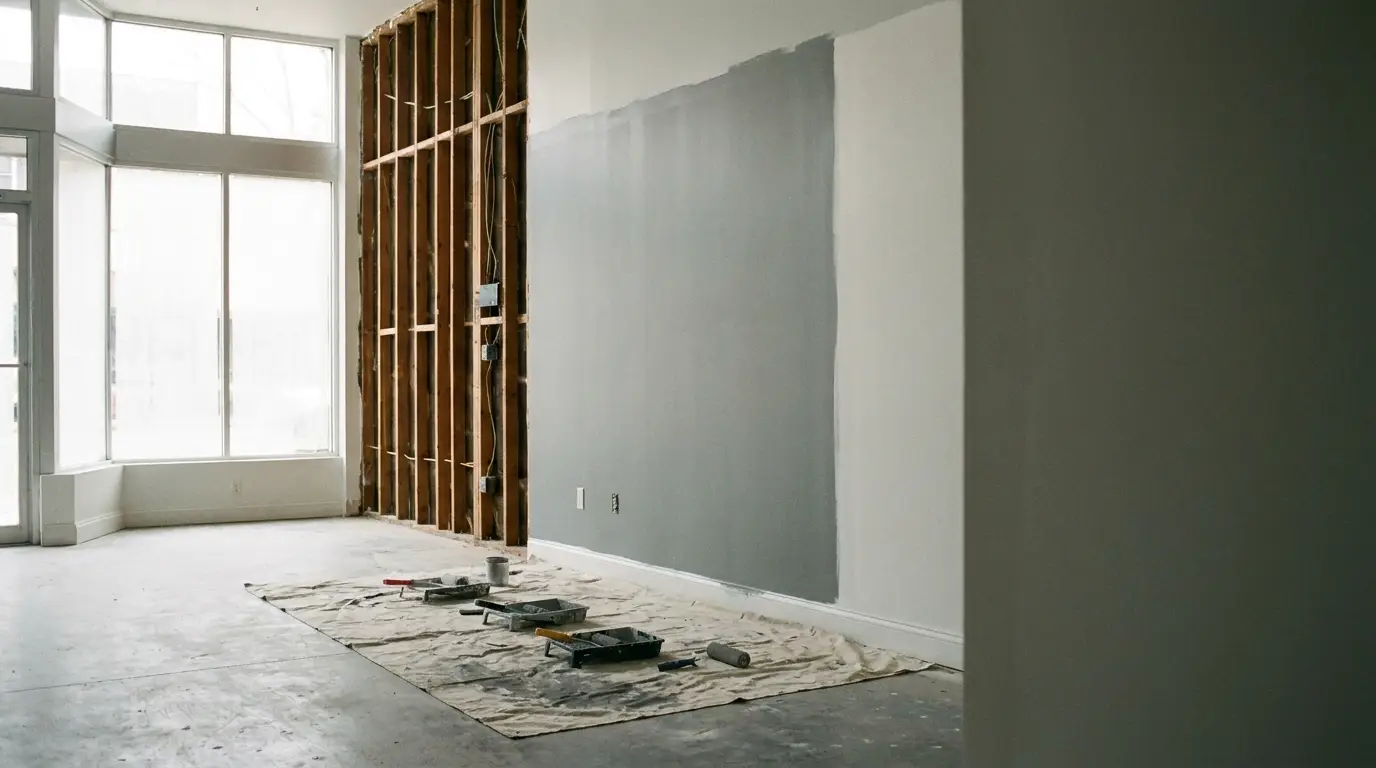
Cosmetic updates can reasonably be handled without a designer. Paint, minor furniture swaps and accent decor fall into this category. Structural changes, full buildouts and multi-vendor renovations almost always benefit from professional oversight.
The line between these two categories comes down to scale and risk. A single room refresh with new paint and furniture rarely needs outside help. But when it comes to full space reconfiguration or any project touching multiple contractors, it is a different situation entirely.
Here’s what tends to fall in each zone:
Usually fine to DIY:
- Paint and color updates.
- Furniture swaps within an existing layout.
- Signage and small decor changes.
Should bring in a professional:
- Full buildouts or relocations involving structural changes.
- Projects requiring permits, ADA compliance, or occupancy approval.
- Any renovation involving multiple contractors working from the same plan.
- Procurement at scale – furniture for multiple rooms or departments with commercial lead times.
- Spaces where client perception directly affects revenue: clinics, salons, retail, and hospitality.
One important thing to address when it comes to DIY is potential risks. The most common ones include:
- Procurement mismatches – happen when furniture or materials ordered for one space don’t fit the final layout, or arrive on a different timeline than the construction.
- Code violations – take place when someone without commercial design experience misses a requirement that only shows up during inspection, sometimes after the work is already done.
- Timeline overruns – happen when there’s no single person coordinating contractors, vendors and delivery schedules, so delays in one area quietly push back everything else.
But the most expensive risk (the worst-case scenario) is the do-over when a space that gets built doesn’t work the way the business needs it to. As a result, it has to be reworked at a cost well above what it would have taken to plan it correctly the first time.
What to Look for in a Commercial Interior Design Firm
When you evaluate a firm, a few things matter more than others:
- In-house vs. outsourced services. Ask who handles each stage of the project, and who you’d hold accountable if something goes wrong. Firms that keep design, procurement, and installation under one roof, TNT Commercial, for example, cut out the vendor-to-vendor handoffs that usually cause delays and give you a single point of contact if something needs fixing. Firms that outsource these pieces add a layer of communication that can slow the project down or create gaps in accountability.
- Portfolio in your sector. A firm with experience in healthcare, hospitality, office, or retail spaces already understands the code requirements, traffic patterns, and functional needs specific to your type of business. That experience saves time and helps you avoid mistakes a generalist firm might make.
- 3D visualization capability. A firm that shows you the space before construction starts lets you catch layout problems and change design choices while they still cost little to change.
- Transparent timeline and procurement process. Ask how the firm handles orders, lead times, and delays. A firm that walks you through this clearly, before you sign anything, usually keeps the process under control once work begins.
The firms worth hiring can usually answer these questions clearly and specifically. The ones that give vague reassurances about experience or quality usually can’t.
How Much Does Commercial Interior Design Cost and Is It Worth It?
First off, there are a number of things that can impact the price of a project:
- Scope. A small cosmetic update costs far less than a full buildout or relocation.
- Square footage. Larger spaces need more materials, more furniture, and more coordination.
- Project complexity. A single-room office costs less to plan than a multi-department clinic with strict code requirements.
- In-house vs. outsourced firms. A firm that handles design, procurement, and installation under one roof often saves money that would otherwise go toward managing separate vendors and fixing miscommunications between them.
We won’t invent specific numbers here because they depend entirely on your project. But the direction is clear: professional design typically pays for itself through fewer procurement errors, fewer delays, and a space that works the first time correctly.
One thing worth keeping in mind is that cutting corners on good design can show up in all sorts of unexpected places:
- Client churn happens when a space just fails to inspire confidence or doesn’t work for the people using it.
- Employee experience takes a hit when a space that’s been poorly planned just makes work harder than it needs to be.
- Renovations that need redoing can end up being a real money pit. Often more costly than what good planning would have set you back in the first place.
All of which suggests that the only time it makes sense to go for a commercial interior designer is before all the problems start and you end up with a space that’s over budget or has to be torn apart because of a DIY that went wrong.
Assess your project scope and business stage honestly. If you’re opening, expanding, or rebranding, professional design typically pays for itself through time saved and the first impression your space makes every single day.