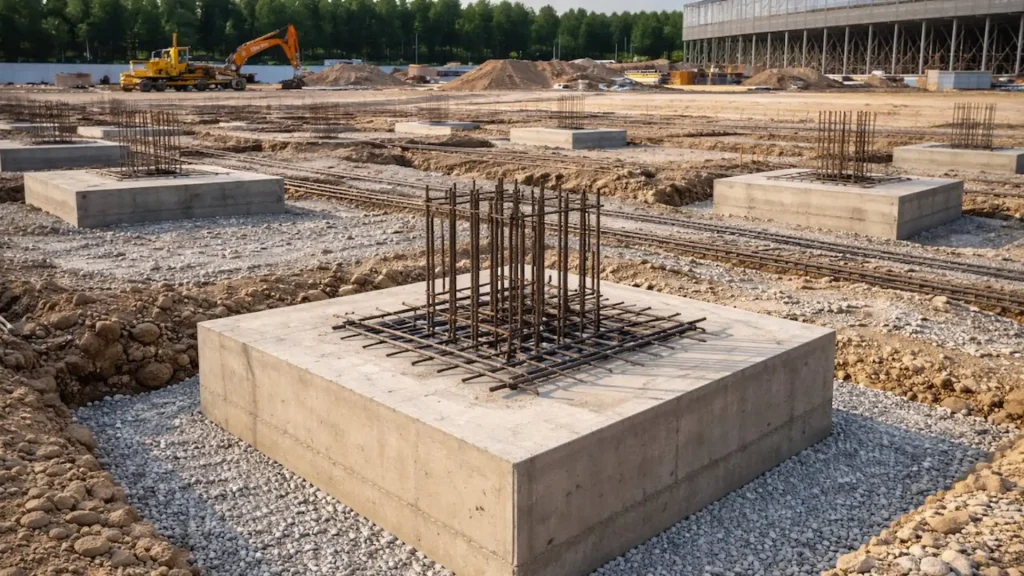
People often walk past a cracked wall or a sinking floor, and the builder is almost always blamed. But the main issue is in the underground.
But have you ever wondered about the strength that keeps any building standing strong?
It’s the concrete footing – this keeps the building from shifting, cracking, or sinking. But what is it?
What is Footing Concrete?
It is a thick layer of concrete placed deep in the ground just below a building’s foundation. Its job is to carry the full weight of the structure above and spread it evenly into the soil below.
Without the footings, a building shifts, cracks, or sinks.
Every building needs it because the footing provides the structure with a firm, stable base.
For most residential footing projects, M20 grade concrete (a 1:1.5:3 mix of cement, sand, and aggregate) is the standard.
It has a compressive strength of 20 MPa, which is enough for two to three-story buildings.
Go to M25 or above when you’re dealing with multi-story commercial structures, waterlogged soil, or high seismic zones.
Did You Know? The Burj Khalifa, the world’s tallest building, used over 45,000 cubic metres of concrete in its footings, going nearly 50 metres deep into the ground.
Is Footing and Foundation the Same?
No, they’re not the same thing! Let me give you a quick overview:
| Feature | Footing | Foundation |
|---|---|---|
| What it is | The base that sits below the foundation. | The structure that sits on top of the footing. |
| Purpose | Spreads the building’s load into the soil. | Supports and transfers the load from walls above. |
| Position | The deepest part of the structure. | Above the footing, below the walls. |
| Size | Wider than the foundation. | Narrower than the footing. |
| Material | Concrete, often with rebar. | Concrete, stone, or brick. |
How does a Footing Make a Foundation Strong?
A building is only as strong as what holds it up from below. The footing is the starting point as it connects the structure to the ground.
1. Load Distribution
A building carries a lot of weight. Footing spreads that weight evenly across the soil below.
Without this, pressure builds up in one spot, leading to uneven sinking and, over time, some serious structural damage.
2. Preventing Settlement
Soil is not always firm, and it can compress under heavy loads.
A well-built concrete footing stops the building from sinking into the ground, preventing the cracks in the walls, uneven floors, and doors.
3. Stability During Soil Movement
Soil shifts constantly, rain saturates it, heat dries it out, and earthquakes push it sideways.
It absorbs these small movements without affecting the structure above, keeping the building standing solid.
Types of Footing Concrete
Even when the basic function of every concrete footing is the same, every building does not need the same type of footing.
The type you choose depends on the soil, the load, and the size of the structure.
Isolated Footing
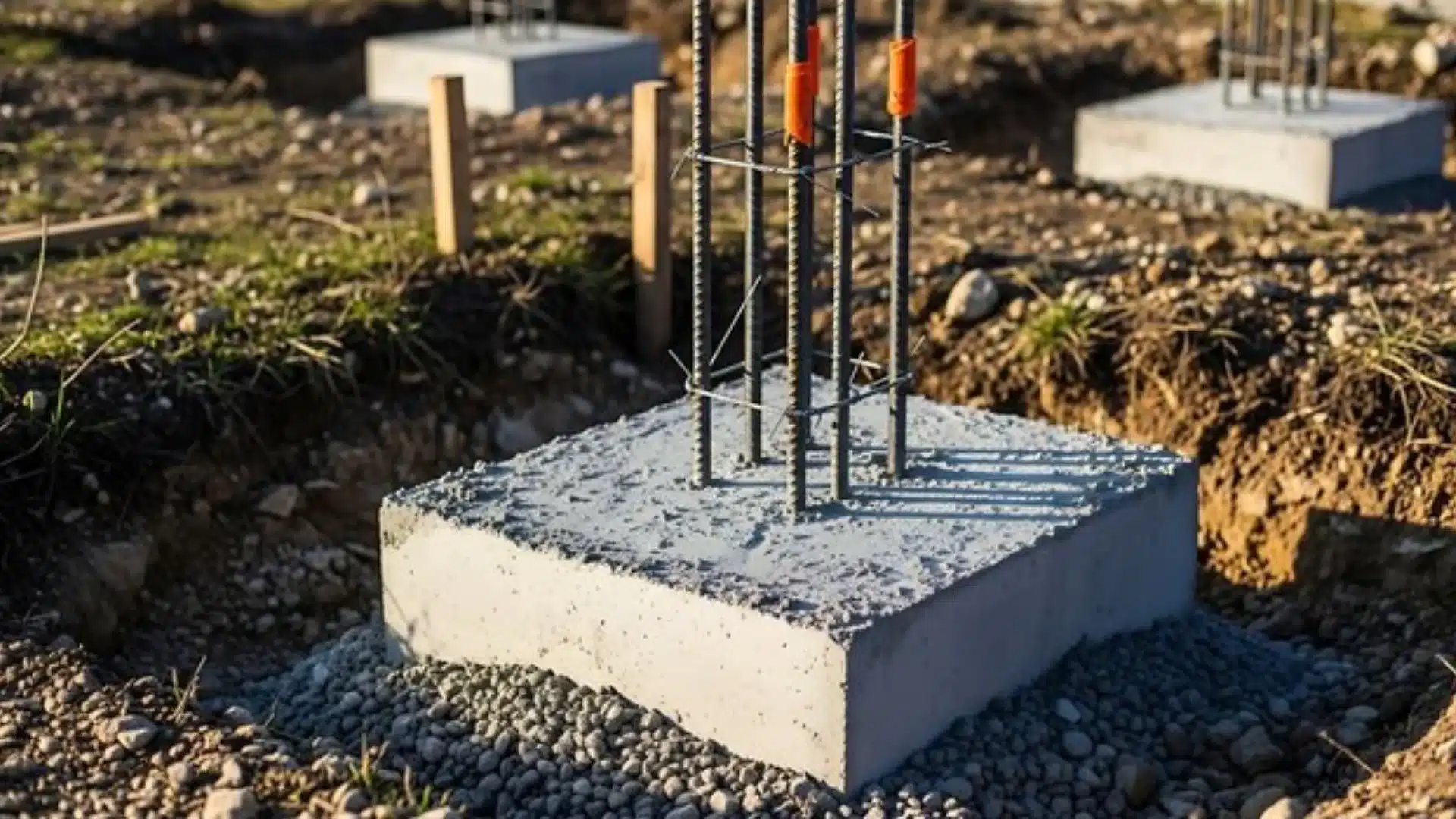
This type of footing supports a single column. It is one of the most common types used in construction.
The footing is placed directly under each column separately.
It carries the load of that one column and transfers it to the soil below, and is simple, cost-effective, and quick to build.
If you’re building a standard two-story house with columns spaced at least 2-3 meters apart, isolated footings are almost always the right type.
Strip Footing
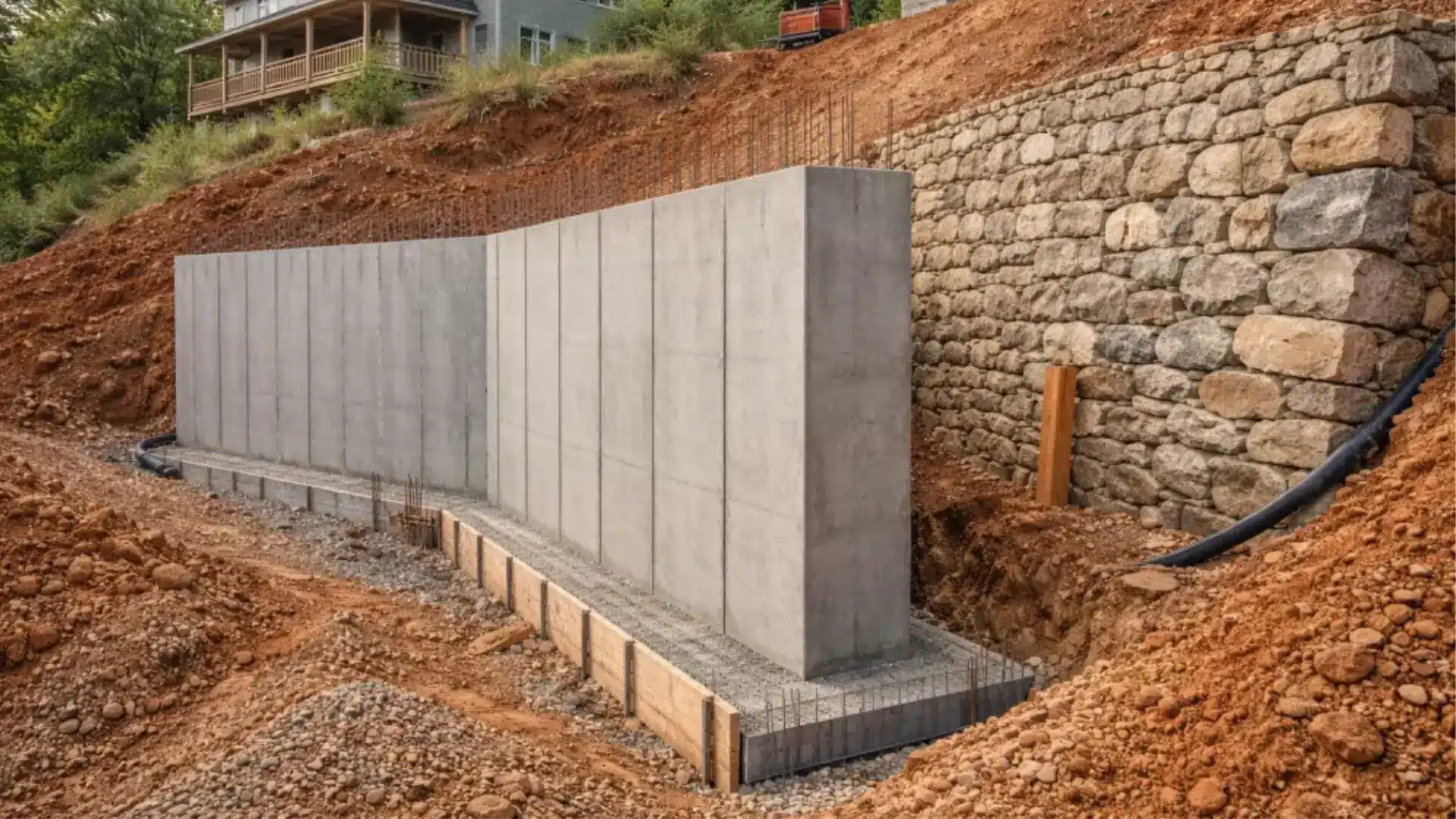
Strip footing runs in a long, continuous strip under walls or a row of columns.
It spreads the load evenly along its length, providing the wall with a stable, level base across its entire length.
Strip footings are widely used in load-bearing wall structures like houses, boundary walls, and low-rise residential or commercial buildings.
Combined Footing
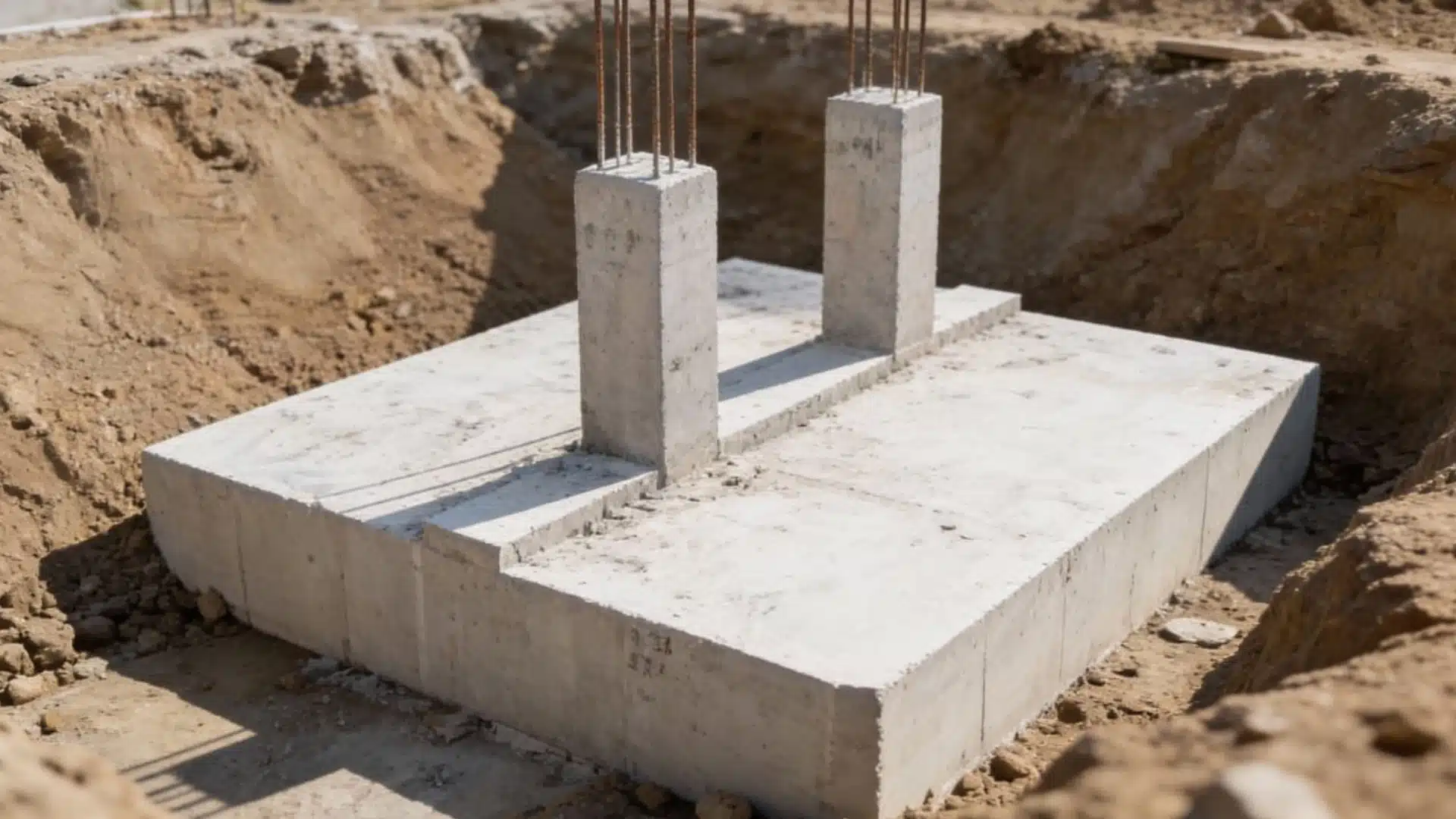
A combined footing supports two or more columns on a single base.
It is used when columns are too close together, as building separate footings is not possible. Its job is to support both columns and distribute the load evenly into the soil below.
Combined footings are commonly used in multi-storey buildings, factories, and structures where columns sit near property boundaries or shared walls.
Raft Footing
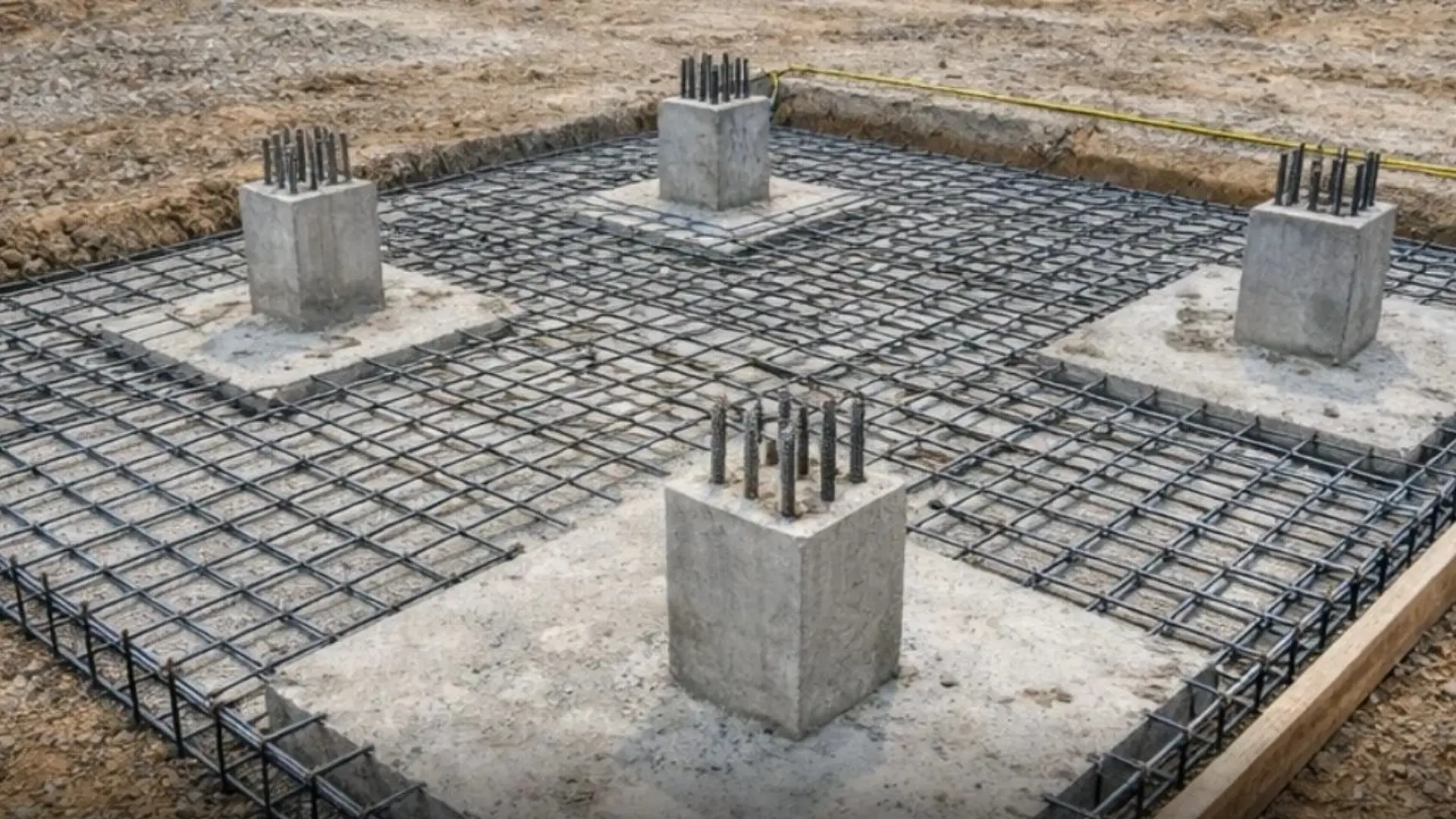
Also known as “mat footing,” it covers the entire area under a building.
It acts like a single concrete slab, used when the soil is weak or the building load is very high. It spreads the weight across the full base, reducing pressure on any one spot.
Raft footings are used in high-rise buildings, basements, bridges, and structures built on soft, loose, or waterlogged soil conditions.
How to Build a Footing Concrete: Step-by-Step
If you’re looking to build your own concrete footing for your project, then don’t worry, I’ve got you. Just keep the steps simple, proceed with patience, and you’ll do fine.
Step 1: Site Preparation
Before you dig anything, clear your site completely.
Remove rocks, roots, old debris, and any loose soil. Get the ground leveled and mark out exactly where your footing will go.
Always test your soil before starting.Weak or unstable soil needs to be treated before any footing work begins on your site.
Step 2: Excavation
And now the digging starts. The depth of your trench depends on your building size and soil type.
Use machines or hand tools to dig to the exact measurements required. If your trench is too shallow or uneven, your footing won’t sit right.
Step 3: Formwork Setup
Think of formwork as the mould for your footing. Set up wooden or metal panels inside your trench to hold the wet concrete in shape.
Make sure everything is straight, level, and firmly secured before you move forward.
Doing this is extremely important as gaps or loose panels in your formwork will cause your footing to lose its shape as it sets.
Step 4: Reinforcement Placement
Before you pour anything, place your steel rebar inside the formwork.
This is what gives your concrete footing its real strength. Tie the bars together in a grid pattern. Keep them away from the formwork edges so that the concrete fully covers them.
Never place the rebar too close to the edges. Your rebar needs enough concrete cover around it.
Step 5: Pouring Concrete
Now comes the most important part of your project.
Start by pouring your concrete evenly, without stopping mid-way. Smooth and level the surface once it has been poured.
A steady, continuous pour gives your footing a consistent strength throughout.
Step 6: Curing Process
Last but not the least, curing.
Curing is what turns freshly poured concrete into a strong, load-bearing footing. Cover it with wet burlap or plastic sheets to keep it moist.
Give it at least 7 days before applying any load. Full compressive strength takes 28 days, and that’s how long the cement hydration process runs.
Things You Should Avoid When Building Concrete Footings
To avoid a weak foundation, there are a few important things you should be aware of.
Small mistakes during construction can lead to big, expensive problems later. Cracks, sinking, and structural failures often trace back to avoidable errors made early on.
1. Skipping the soil test: Weak or loose soil cannot support a heavy footing, and it must be treated or replaced if found to be faulty.
2. Digging the wrong depth: Dig too shallow, and your footing sits in unstable ground. Too deep and you waste materials.
3. Using the wrong concrete mix: Using a weak or watered-down mix reduces the footing’s strength. Always use the correct grade mix.
4. Rushing the curing process: Removing formwork too early or skipping curing altogether leads to surface cracks and a weak, unreliable footing.
Final Thoughts
Get the footing concrete wrong, and you’re looking at a demolition – Get it right, and nothing you build above it will move for decades.
It carries the load, keeps the structure stable, and protects everything built above it.
And if you are planning a project, this manual will help you start.
Frequently Asked Questions (FAQs)
1. How Deep Should Footings Be?
Most footings should be at least 12 inches deep. However, the exact depth depends on your soil type, building load, and local frost line.
2. Can I Pour Concrete Directly Into the Ground?
Yes, for small projects like fence posts or garden slabs. But for structural footings, always use formwork.
3. Does 2 Inch Concrete Need Rebar?
No. Two inches is too thin for rebar. Rebar works best in concrete that is at least 3.5 inches thick. For thin slabs, use wire mesh instead.