You’ve had the couch for months, maybe years, and that wall behind it is still bare. That’s not laziness. That’s decision paralysis, and pretty much everyone who has ever furnished a living room has stood in that exact spot, staring up at blank drywall, wondering what on earth goes there.
Here’s the shift that actually helps: stop asking what to buy and start asking what the wall needs to do. A big empty living room wall can feel like an unsolved math problem, but it is really just a question of purpose. Does the room need color? Storage? A little more light bouncing around? Or does it just need permission to stay simple?
That’s the real starting point for any wall decor above couch project, and it’s the idea we’ll circle back to at the end of this guide. Some walls genuinely need styling. Others need almost nothing, just enough restraint to let the room breathe.
If you’re stuck on blank living room wall ideas, you’re not actually choosing between “art” and “nothing.” There’s a whole toolbox here: scale rules, gallery layouts, one big showstopper piece, mirrors, wallpaper, shelving, even a plan for renters who can’t drill a single hole. Whatever your setup, there’s a version of this that works for you.
So if you’ve been Googling what to do with an empty wall in living room at 11 p.m. with a tape measure in one hand, you’re in the right place. Let’s get your sofa wall sorted, one decision at a time.
The Math Behind the Perfect Layout: Spacing and Scale Rules
Most sofa wall decor fails for one reason. It’s sized wrong for the furniture underneath it. Fix the proportions first, and half the decorating problem solves itself.
The 2/3 Rule: Finding the Perfect Width
Your decor should span roughly half to two-thirds of your sofa’s width, no more and no less. A skinny 20-inch print above an 84-inch sofa reads like an afterthought, floating in a sea of blank wall. Go too wide, past the arms of the sofa, and the grouping tips into top-heavy, like it’s trying to fill space it hasn’t earned yet.
Grab a tape measure before you grab your wallet. Measure your sofa’s width, multiply by 0.5 and by 0.66, and that range is your target. A single canvas, a trio of framed prints, or a full gallery wall should all land somewhere inside those numbers. If you want the exact figures for your specific piece first, this breakdown of sofa dimensions is a good place to start.
Avoiding the Floating Pitfall: How High to Hang Your Art
Here’s the number that fixes almost every awkward gap: hang so the bottom of your frame or mirror sits 8 to 10 inches above the sofa back. Go higher and the piece disconnects from the furniture, floating up near the ceiling like it belongs to a different room. Go lower and you risk actual headaches for anyone who leans back a little too far.
This one rule solves more decorating wall over couch questions than any other trick in this guide. It’s the difference between a wall that looks intentional and one that looks like a leftover nail hole from the last owner.
Visual Weight vs. Physical Footprint
Not every sofa carries the same visual weight, and that changes what belongs above it. A deep, overstuffed sectional already reads as heavy and grounded, so art above the sofa can afford to be lighter and airier. A sleek sofa on slim exposed legs does the opposite. It reads light, so the wall behind it can carry a little more heft without tipping the room off balance.
Look at the furniture as a whole before committing to anything. Legs exposed, floor visible underneath? The room already feels larger, and your wall behind sofa decorating ideas can lean bolder. Legs hidden, low profile, heavy upholstery? Keep the wall a touch quieter so the room doesn’t feel like it’s closing in.
Symmetrical Grids vs. Asymmetrical Collages: How to Choose
Pick symmetry for calm, predictable elegance. Pick asymmetry for personality and story. Most rooms actually want a little of both, but knowing which one is doing the heavy lifting keeps the wall from feeling chaotic.
Symmetrical Grids: Sconces, Pairs and Polished Serenity
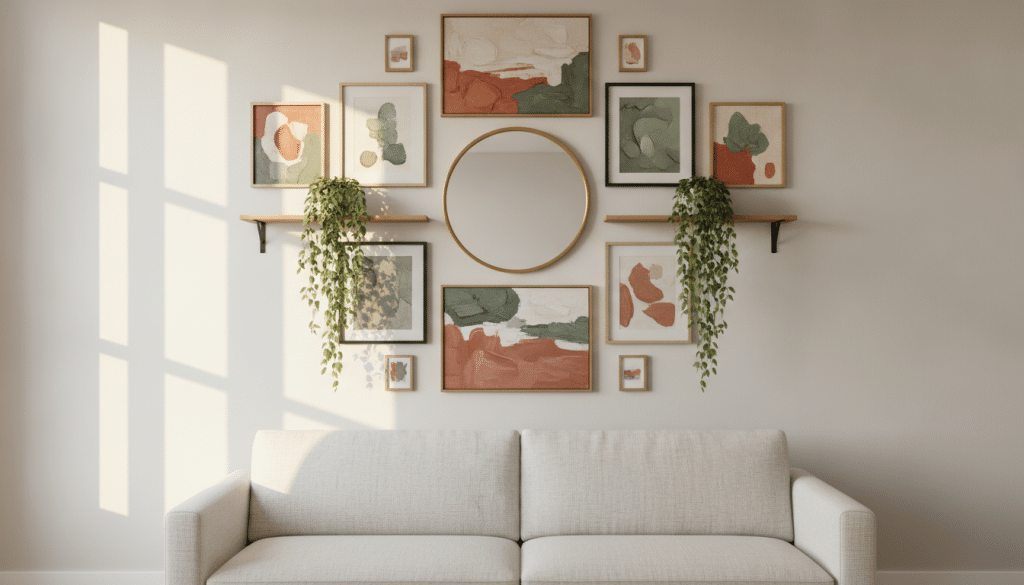
A symmetrical layout (a three-print grid, a matched pair of prints or mirrors, or two flanking sconces framing a single central piece) delivers order almost instantly. It’s the safest above the couch wall decor option because the math is already built in. Equal spacing, equal size, equal everything. Your eye doesn’t have to work.
Hardwired wall sconces flanking a central artwork add a layered, architectural feel a flat gallery wall can’t match on its own, and they double as real lighting once the sun goes down. If your room already leans traditional or formal, symmetry is going to feel like coming home.
Asymmetrical Gallery Walls: Curating a Meaningful Story
Asymmetrical gallery walls need one thing symmetry doesn’t: a unifying device. Without it, over sofa wall decor made from mismatched frames just looks like clutter that multiplied overnight. With it, the same mismatched frames look curated on purpose.
The trick is a tight, repeating palette. Pick two or three frame finishes, maybe black metal and natural wood, and repeat them across every piece even when sizes and shapes vary wildly. Mix a round mirror, a horizontal landscape print and a vertical portrait, and as long as the frames rhyme with each other, the whole thing reads as one idea instead of a yard sale.
Before you hammer a single nail, lay the whole arrangement out on the floor first. Shuffle pieces around, step back, snap a photo from across the room, and adjust again. It costs nothing and saves you a wall full of extra holes. If you’re building a collection slowly over time, photograph every thrifted find on your phone the moment you bring it home. That running catalog makes it far easier to see how a new piece will sit next to what you already own, instead of guessing from memory at the frame shop.
One note on shortcuts: pre-curated, ready-made gallery sets can genuinely work as a starting point for above couch art, especially if you’re short on time or patience for the floor-layout dance. Treat them as a base layer, then swap in one or two personal pieces, a travel photo, a kid’s drawing in a nicer frame, and the set stops looking like it came out of a box.
One Big Piece: When a Single Artwork Beats a Gallery Wall
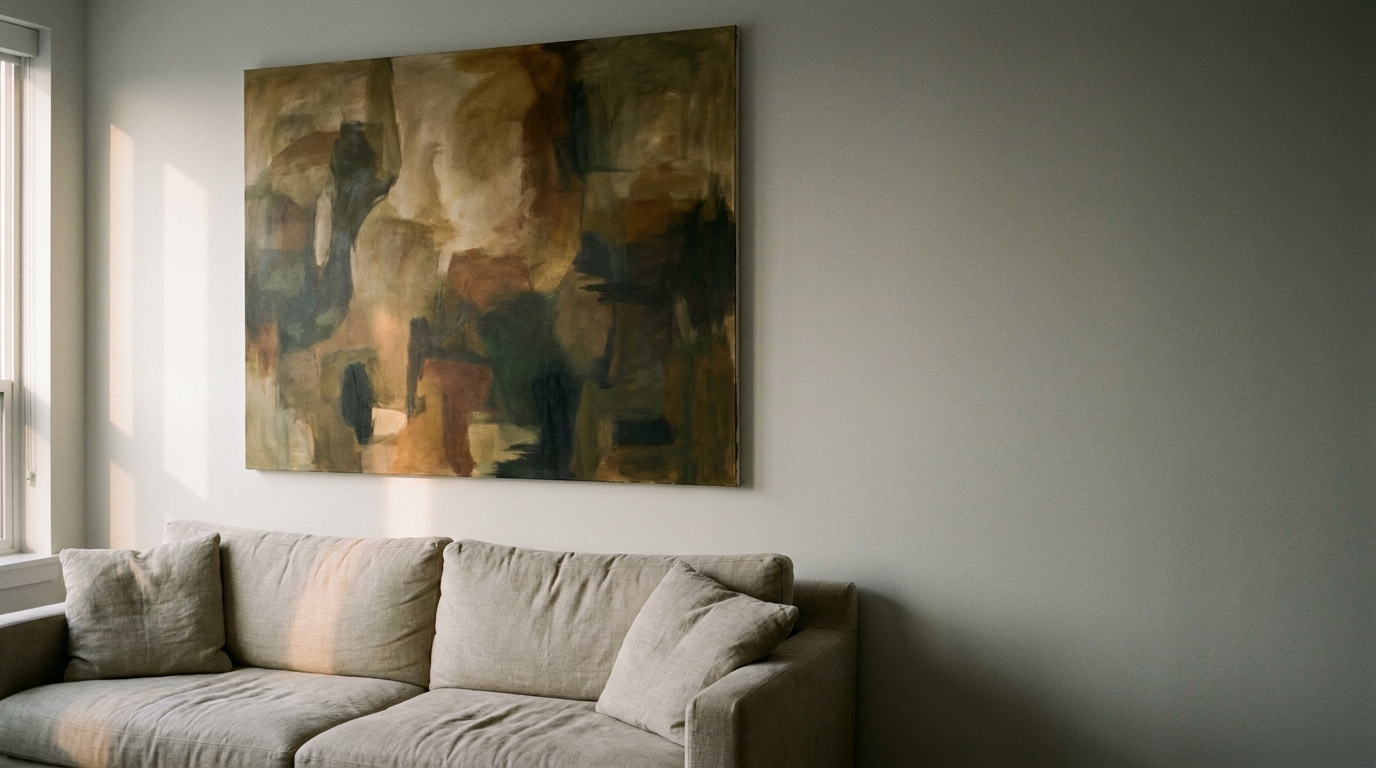
So what to hang above a sofa when you want the simplest possible answer? One large piece, hung once, done.
A single oversized artwork skips every headache that comes with a gallery wall. No arrangement anxiety, no laying frames out on the floor for an hour, no second-guessing whether the spacing looks off. One set of holes, immediate scale, and you’re finished before your coffee gets cold. For a lot of people, that’s not a compromise. That’s the whole appeal.
Format matters here more than people expect. A canvas print reads casual and textural, with a visible weave and no glass to catch glare from a nearby window, which makes it a natural fit for art above the sofa where afternoon light hits the wall. A framed print under glass feels a step more formal, more gallery, more considered. A framed poster splits the difference: budget-friendly, still finished, still worth treating as above couch art rather than propping it on a shelf.
Subject matter changes how loud the piece reads, too. An abstract with bold color and hard edges announces itself the second you walk in the room. A quieter subject does the opposite work entirely. A calm, large-scale nature scene is one of the easiest ways to fill a big wall without committing to a single loud statement, and that’s where landscape art earns its keep. It doesn’t demand a particular room style, and a peaceful coastal shot or a moody mountain view can anchor a traditional living room just as easily as a modern one.
Large landscape wall art solves the scale problem almost by accident. These scenes already contain depth of their own, a horizon, layered color, a sense of distance, so they can fill serious square footage without feeling like one flat block of color. Nature wall art in general tends to read as calming rather than commanding, which is exactly what a lot of busy living rooms are missing.
Beyond the Straight Wall: Decorating Around Tricky Sofa Layouts
Not every sofa sits against one clean, uninterrupted wall, and the rules above assume yours does. Corners, open floor plans and window walls all need their own playbook, and this section covers how to decorate wall behind couch setups when the usual advice doesn’t quite fit.
The Corner Conundrum: Wrapping Art Around L-Shaped Sectionals
An L-shaped sectional almost always leaves two blank walls meeting at a corner, and hanging one piece on just one side makes the whole layout feel lopsided. Treat the corner as one continuous wall instead of two separate ones.
Choose decor that turns the corner on purpose. A pair of matching vertical prints, one on each wall, mirrored a consistent distance from the corner seam, reads as a single wraparound moment rather than two unrelated stabs at behind sofa wall decor. Alternatively, one large horizontal piece on the longer wall paired with a slim vertical accent on the shorter return keeps the visual weight balanced without forcing symmetry where the architecture won’t allow it. Keep the same 8 to 10 inch height rule from earlier running across both walls so your eye doesn’t catch a jump in line height crossing the corner.
Floating Sofas: Console Tables, Bookshelf Towers and Plants
A floating sofa in an open floor plan has no wall behind it at all, and that throws the usual rules out entirely. Here, decor behind couch stops being about hanging things and starts being about placing them.
A double-level console table behind the sofa gives you a spot for lamps, a stack of books and a trailing plant, and it doubles as a visual boundary between the living area and whatever sits on the other side. For more height and presence, tall, open-backed Toulouse bookshelf towers work as a soft room divider, adding architecture without fully blocking sightlines or light. Group two or three at slightly different heights rather than one uniform row, and the whole thing starts to feel like furniture, not a barrier.
The No-Wall Solution: Sofas in Front of Windows
Sometimes there is no wall problem to solve, because there is no wall. A sofa parked in front of a window doesn’t need art competing with the view.
Let the window do the work. Simple drapery panels in a soft, textural fabric frame the glass without blocking light, and that’s often the whole answer. If you genuinely want something hung, a slim plastered pole mounted just above the window trim lets you drape a single textile or hang one lightweight piece across the top of the glass without drilling into the frame itself. Otherwise, resist the urge to force decor here. Couch ideas for living rooms with big windows behind them work best when the room lets the outside view be the art.
Mirrors, Wallpaper and Shelving: High-Impact Alternatives to Art
Art isn’t the only answer, and treating it that way undersells three of the strongest options in this guide. Mirrors, wallpaper and shelving all pull equal weight above a sofa.
Reflective Drama: Maximizing Light with Oversized Mirrors
One oversized mirror above couch, or a cluster of smaller round mirrors grouped together, bounces natural light back into the room and makes the whole space feel measurably bigger. It’s one of the fastest upgrades in this guide, and it costs one trip up a ladder to hang.
Position matters. An oversized mirror above couch works best angled to catch window light rather than facing a blank wall, since a mirror reflecting nothing but drywall wastes half its potential. If the mirror sits directly across from a television, watch for double reflections bouncing the screen glow back at you. A textured frame or a slightly angled hang usually breaks up the effect enough to stop it being distracting.
Wallpaper Panels: Designer Elegance Without Papering the Room
You don’t need to paper an entire wall to get a wallpaper moment. A single framed panel of grasscloth wallpaper backdrop, boxed out in contrasting trim, gives you scroll-stopping texture and depth in the footprint of a large painting, at a fraction of the cost and commitment of a full room.
For something with real designer pedigree, high-end options like de Gournay wallpaper panels bring hand-painted, layered detail no printed piece can fully replicate. It’s a splurge, but framed as one panel rather than four walls of it, the price tag shrinks considerably while the visual impact barely changes. Either way, wainscoting or simple geometric millwork built out around the panel adds architectural weight that makes the whole thing look built-in rather than applied.
The Limitless Ledge: Floating Shelves and Rotating Pottery
Floating shelves above couch installations solve a problem art can’t. They let your wall change with the seasons instead of staying frozen the day you hung it.
Above couch shelves work best mounted in a slightly staggered pair or trio rather than one single long ledge, since staggering gives you more surface area at different heights to style. Load floating shelves above sofa spots with a mix of heights and textures: pottery, a small framed print leaned rather than hung, a trailing plant, a stack of books. The rule of thumb is odd numbers of objects, varied heights, and at least one thing with a plant’s worth of green in it.
This is also the lowest-commitment option on the whole list. Swap out pottery for the season, rotate in a new plant, lean a different print against the wall behind what’s already there. Whether you land on mirrors, wallpaper or shelves above couch styling, this section is proof that over the couch wall decor doesn’t have to mean art at all.
Renter-Friendly Sofa Walls: Beautiful Decor Without Drywall Damage
You can get a fully styled sofa wall without a single hole in the drywall, and it doesn’t have to look like a dorm room to pull off.
Easy-Change Magnetic Frames and Rotating Kids’ Artwork
If you’re parenting a small artist who produces a new masterpiece every Tuesday, easy-change magnetic frames solve a real problem. Systems like Wexel Art plexiglass frames use a metal backing plate and a magnetic acrylic front, so a new drawing swaps in over an old one in seconds: no tools, no fresh holes, no crayon stains left behind on the wall.
The backing plate does need one mounting point, whether that’s a couple of small nails a landlord won’t blink at or a heavy-duty Command strips renter hack that holds real weight without touching the wall itself. Either way, the frame stays put while everything inside it rotates freely, which keeps this whole empty wall ideas living room search genuinely doable.
Lightweight Textiles: Tapestries, Macrame and Art Rails
Fabric solves the how to fill an empty wall in living room question without a single traditional frame. A woven Suzani tapestry hung from a slim wooden dowel adds pattern, color and texture in one move, and it weighs next to nothing, so the hanging hardware barely has to work.
A macrame wall hanging does similar work with more texture and less color, ideal if your room already has a busy palette and needs something quieter and more tactile instead. For a setup you can actually rearrange without repatching anything, thin picture rail systems mounted at the ceiling line let art, tapestries or frames hang from adjustable cords, with no wall damage at all, ever. If you’re renting the whole space rather than just decorating around it, this guide to furniture placement and sizing for rental properties covers the bigger picture.
Form Meets Function: Sound, Screens and Safety
A sofa wall isn’t just decoration. In the right room, decorating over sofa also means solving acoustic, technical and safety problems most people never think about until something goes wrong.
Acoustic Utility: Absorbing Echo with Textiles and Felt
High ceilings look impressive and sound terrible. Hard surfaces bounce noise around a room instead of absorbing it, and a bare wall above the couch is prime real estate for that echo to keep ricocheting.
Textile art and woven tapestries do double duty here, adding visual softness while genuinely absorbing sound the way a bare canvas or a framed print under glass never will. For rooms with a real echo problem, dedicated acoustic sound-dampening wall panels now come upholstered in enough colors and textures to double as above couch decor rather than looking like they were bolted on as an afterthought.
Disguising a Frame TV Inside a Gallery Wall
If the television lives on this wall too, a Frame TV gallery wall integration is the cleanest fix available. Surround the screen with real framed art in matching or complementary finishes, and the TV reads as one more framed piece in the grouping instead of the obvious focal point of the room.
The trick is consistency. Match the TV’s frame finish to the art around it, keep spacing even on all sides, and skip anything glossy right next to the screen that might catch a reflection when it’s off.
Safety Above Seating: Studs, Straps and Acrylic
Anything heavy hanging directly above where people sit and lean their heads back deserves a real safety check, not a guess.
Skip heavy glass-fronted frames and substantial iron mirrors directly above seating if you can help it. Acrylic glazing instead of glass gets you the same finished look at a fraction of the weight, and it won’t shatter if it ever comes down. Find the studs before hanging anything with real heft, and use drywall anchoring studs or mounting hardware rated for the actual weight of the piece, not just whatever hook came in the box. If you’re anywhere prone to shaking ground, earthquake-proof picture hangers with a security strap or wire backup are worth the extra five minutes at the hardware store.
Final Takeaways: Start With Your Why
Not every gap needs filling, and that’s worth remembering before you buy anything. A good living room gets assembled slowly, one honest decision at a time, not all in a single weekend scramble.
Go back to where we started. Some walls need styling. Others just need room to breathe, and knowing which kind of wall you’re staring at changes everything about what comes next. Before you hang a single nail or click “add to cart,” ask what this space actually needs to do. Color? Storage? More light bouncing around the room? A little visual quiet?
By now you’ve got a full menu of living room wall decor ideas to choose from, not just art. Once you know the answer, the options in this guide (art, mirrors, wallpaper, shelving, or genuinely nothing) stop being a list of choices and start being one obvious decision. Trust the wall. It’ll tell you what it needs.
Frequently Asked Questions
How high should I hang artwork or a mirror above my sofa?
Aim for 8 to 10 inches above the sofa back, measured from the bottom of the frame. Hang it higher and the piece disconnects from the furniture below it. Hang it lower and you risk bumping heads every time someone leans back.
What is the 2/3 rule when arranging wall art above a couch?
It means your decor, whether that’s one piece or a full arrangement, should span roughly half to two-thirds of your sofa’s width. Narrower than that and the piece looks lost on the wall. Wider than the sofa’s arms and the whole thing tips into top-heavy territory.
Can I hang a large mirror if it sits directly across from my television?
Yes, and the extra light and depth are usually worth it. Just watch for the screen bouncing back as a double reflection when the TV is on. A large canvas or a piece of textured wallpaper sidesteps the issue completely if the reflection bothers you.
I live in an earthquake zone. What is safest above a sofa?
Lightweight canvas, macrame or textile pieces beat anything heavy or glass-fronted. Choose acrylic glazing over glass wherever you can. Mount everything into studs with proper hardware, and add a security strap or earthquake-rated bracket for real peace of mind.
How do I make a small living room feel larger with wall decor?
Oversized mirrors are the fastest trick, bouncing light and visually doubling the depth of the room. Keep furniture legs exposed so the floor stays visible underneath, and let taller pieces draw the eye upward rather than filling the wall edge to edge.
How can I display my kids’ artwork without the room looking cluttered?
Easy-change magnetic acrylic frames are the answer. New drawings swap in over old ones in seconds, with no fresh holes and no crayon marks left behind. The layout on the wall stays exactly the same even as everything inside it keeps changing.
What goes behind a floating sofa in an open floor plan?
A double-level console table works well, giving you room for lamps, books and a plant while marking the boundary between zones. Tall, open-backed shelving does similar work if you want more height and a soft divider that still lets light through.
Is it okay to leave the wall above my sofa completely empty?
Yes, especially if the rest of the room is already busy. A blank wall gives the eye somewhere to rest, and a room doesn’t need every surface filled to feel finished. Sometimes restraint is the whole design.