A recipe requires kosher salt. There’s only table salt in the kitchen. Unconsciously grabbing a spoonful of either can ruin the entire meal.
Once in the pan, these two salts perform somewhat differently. You might also wonder whether table salt and kosher salt are interchangeable.
Kosher salt vs table salt is not just about taste. It modifies the outcome of a dish, and understanding the exchange guidelines ensures that every meal is appropriately seasoned.
Kosher Salt vs Table Salt
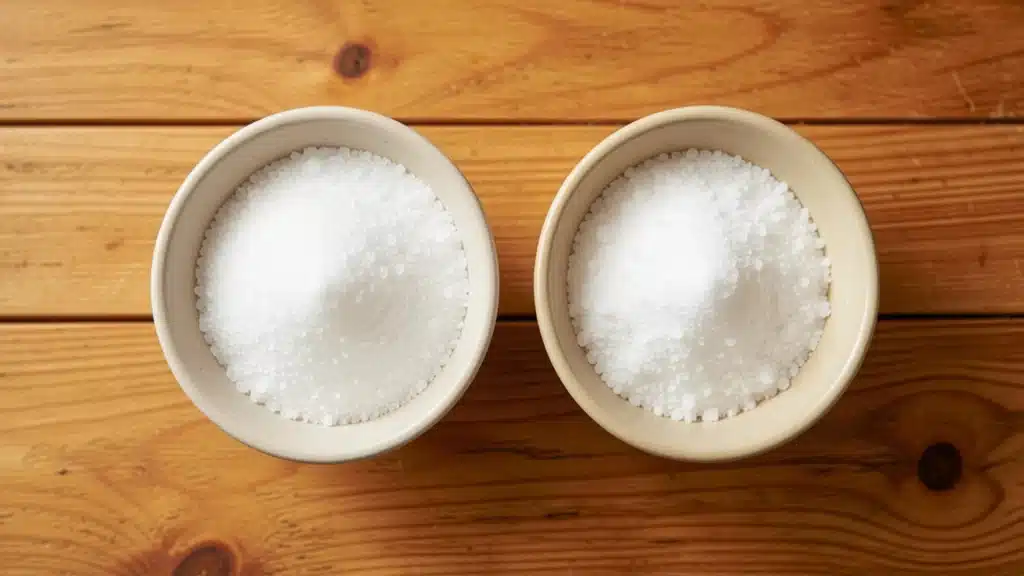
The basic component of both table salt and kosher salt is sodium chloride. In the kitchen, however, they act rather differently. The two are primarily different in terms of processing, crystal size, and the amount of salt that can be found in a teaspoon.
Table salt has more salt per teaspoon due to its fine, densely packed grains. Iodized, usually.
Coarse, flaky granules that weigh less by volume are known as kosher salt and are not iodized in most cases.
For the safest outcome, measure both by weight or use roughly half as much table salt as kosher salt.
What is Table Salt?
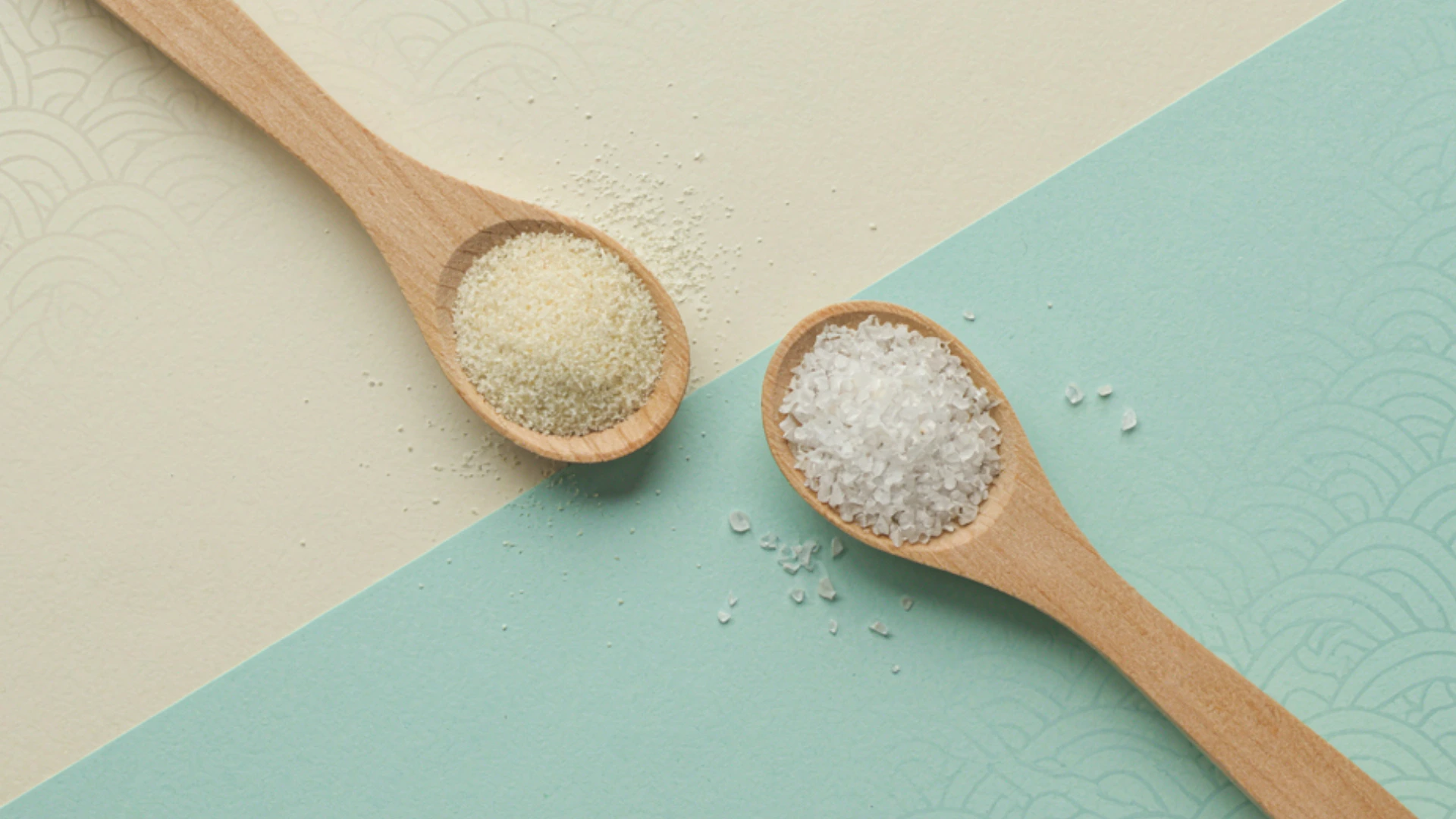
Before it reaches the shaker, table salt undergoes extensive processing after being extracted from subterranean salt mines.
It is ground into uniform, tiny grains by manufacturers, who frequently include iodine, a crucial component for thyroid function. In humid conditions, anti-caking chemicals prevent the grains from clumping together.
Table salt packs firmly into a spoon due to its extremely small granules. Compared to sea salt or kosher salt, a teaspoon of table salt has more sodium.
Because of this, substituting one teaspoon of salt for another might make a dish taste excessively salty.
In these few typical scenarios, cooks frequently go for table salt:
- Seasoning at the table every day
- In baking, precise measurements are crucial.
- Recipes that don’t specify the kind of salt
What is Kosher Salt?
The term “kosher salt” refers to the Jewish custom of removing blood from meat before cooking it.
The name merely refers to the purpose for which it was designed; it is not a certified kosher product in and of itself.
Manufacturers form kosher salt into large, coarse, flat flakes. The majority of kosher salt has a simpler, cleaner flavor because it doesn’t contain iodine or anti-caking chemicals.
Kosher salt takes up more room on a spoon since the flakes are larger and less thick. Additionally, compared to table salt, it contains less sodium per teaspoon.
There are several obvious reasons why chefs favor kosher salt:
- Simple to grasp and manipulate by hand.
- Evenly covers vegetables and meat.
- Dissolves at a constant, predictable rate.
Let’s Compare Everything About Kosher Salt vs Table Salt
Definitions and numbers only provide half the picture. When real cooks alternate between these two salts, they frequently observe the difference immediately.
Here are the opinions of those who cook with salt daily about how the argument plays out in real kitchens:
Size and Texture of Crystals
The grains of table salt are uniformly tiny. The crystals of kosher salt are big, flat, and flaky. Depending on the brand, sea salt can be fine or coarse.
The size variation changes how each salt spreads across food and feels between fingertips. It is simpler to pinch and manipulate larger, flakier crystals by hand.
Volume-Based Saltiness
Compared to kosher salt, a teaspoon of table salt tastes more salty. More salt can fit into the same space because fine grains pack closely together.
The larger flakes of kosher salt create spaces between the crystals. This means that depending on the type of salt used, a recipe specified in teaspoons requires various amounts.
Density
Density explains why different amounts of each salt can fit in the same spoon. Table salt weighs more per teaspoon because it is denser.
Because the flakes in kosher salt retain air pockets, it has a lower density, so a teaspoon of it weighs less than a teaspoon of table salt.
Since a kitchen scale measures by weight rather than space, it eliminates this issue.
Content of Iodine
Iodine, a crucial mineral for thyroid function, is added to most table salt. This processing step is typically omitted for sea salt and kosher salt.
Those who cook only with sea salt or kosher salt should make sure they’re getting enough iodine from other sources. Eggs, dairy products, and shellfish are excellent natural sources of iodine.
Additives
To prevent grains from clumping together, table salt often contains anti-caking chemicals. To stabilize the iodine, several products additionally include a tiny bit of sugar.
These ingredients are typically omitted from kosher salt, giving it a simpler, purer flavor. Although some brands may include anti-caking chemicals, sea salt remains mostly in its original state.
Cooking Efficiency
The bigger crystal size of kosher salt causes it to dissolve more slowly. Because of this, it is forgiving when seasoning meat or vegetables by hand.
Table salt works well in sauces, batters, and boiling water because it dissolves almost instantly. Although fine sea salt dissolves more quickly than coarse varieties, it functions more like kosher salt.
Accuracy of Measurements and Recipes
The sort of salt used during testing and development is rarely mentioned in recipes. Switching from table salt to kosher salt, or the other way around, can be confusing.
Since the sodium concentration remains constant by weight, measuring by weight eliminates all uncertainty. Recipes for bread and baking gain the most from this precise method.
Healthier
From a health perspective, sodium chloride is the common base ingredient for all three salts. None of them are intrinsically healthier or worse for the body.
Since iodine is only present in the majority of table salt, it continues to be the sole significant difference.
The gap is rarely an issue for those who eat balanced meals high in seafood or dairy.
Is Kosher Salt the Same as Sea Salt?
Although the names are sometimes used interchangeably, sea salt and kosher salt are not the same. Compared to sea salt, kosher salt typically comes from underground mines and undergoes further processing.
When ocean water evaporates, trace minerals like potassium and magnesium are left behind along with sodium chloride to produce sea salt.
Unlike most table salt, neither salt usually has iodine added to it. This means that habitual kosher or sea salt cooks should consider their iodine intake. Dairy, eggs, and salmon are additional excellent sources of iodine.
There are a few notable distinctions between the two:
- Kosher Salt: It is mined, flaky, gritty, and has a constant, mild flavor.
- Sea Salt: Evaporated from seawater, it has a fine-to-coarse texture and may have faint mineral undertones.
- Substitution: When measuring, coarse sea salt requires the same caution as kosher salt, although fine sea salt frequently replaces table salt in tiny amounts.
Kosher Salt vs Table Salt vs Sea Salt
Understanding how these salts differ only becomes useful when you use them. The majority of cooks are really interested in learning how to replace one without compromising a dish.
This is a step-by-step explanation of how the substitution truly operates.
| Basis | Table Salt | Kosher Salt | Sea Salt |
|---|---|---|---|
| Source | Mined from underground deposits | Mined, then processed into flakes | Evaporated from seawater |
| Sodium (per ¼ tsp) | About 590 mg | About 480 mg | About 580 mg (coarse) |
| Price range | Lowest cost | Mid-range | Highest cost |
| Common brands | Morton Iodized Salt | Diamond Crystal, Morton Coarse | Maldon, Celtic Sea Salt |
| Shelf life | Indefinite if kept dry | Indefinite if kept dry | Indefinite if kept dry |
How to Substitute Safely Between Kosher Salt vs Table Salt?
It’s customary to substitute table salt for kosher salt in recipes, but it requires some arithmetic. The two salts differ greatly in volume yet have the same weight.
The simplest way to make a dish taste too bland or too salty is to ignore that change.
- 1 teaspoon: 1¼ to 1½ teaspoons
- 1 tablespoon: 1¼ to 1½ tablespoons
- ¼ cup: ⅓ cup
Kosher Salt vs Table Salt for Cooking: Which is Better?
In every circumstance, neither salt prevails. For some cooking activities, each one performs better than the other.
The best choice depends on the food you’re preparing and the level of accuracy required.
To Season Meat: Season meat with kosher salt. Its large flakes spread uniformly across the surface and are easy to squeeze.
Additionally, the gritty texture draws out moisture, improving the crust of the seared meat.
Regarding Vegetables: Raw or roasted vegetables work well with kosher salt. Its flakes don’t dissolve instantly; instead, they rest softly on the surface.
Because table salt dissolves fast in water, it is ideal for cooking veggies.
For Sauces and Soups: Table salt works better in soups and sauces because it dissolves more quickly. It doesn’t leave a gritty texture when it dissolves into liquids.
Kosher salt is equally effective, but it takes more stirring to dissolve completely.
For Pasta Water: Either salt works well once the water reaches a rolling boil. Table salt dissolves almost instantly thanks to its fine grains, while kosher salt’s larger flakes take a little longer but dissolve fully with stirring.
For Brining: When brining meat and poultry, kosher salt is typically used. The brine remains transparent because it’s pure and free of iodine and anti-caking chemicals.
This reduces the likelihood that the soak will leave an unpleasant aftertaste.
Conclusion
Salt may seem like a single, basic ingredient. However, sea salt, table salt, and kosher salt all have distinct advantages.
Iodine content indicates the largest nutritional difference between them, while grain size determines how much salt ends up in a spoon. Unbeknownst to most, sea salt and kosher salt have a lot in common.
The iodine that table salt supplies is not replaced by either.
A kitchen scale makes a complicated switch easy and dependable. Kosher salt vs. table salt becomes second nature once the ratios are clear; instead of shrugging, the following dish demands salt precisely tailored to it.
Frequently Asked Questions (FAQs)
1. Can Kosher Salt Replace Table Salt in Baking?
Yes, but measure by weight or use about half as much table salt.
2. Does Kosher Salt Have Less Sodium than Table Salt?
Per teaspoon, yes. By weight, both salts have nearly identical sodium.
3. Why Do Chefs Prefer Kosher Salt?
Its large flakes are easy to pinch, spread evenly, and control while seasoning.
4. Does Kosher Salt Need Special Storage?
No. Store it in a sealed, dry container like any other salt.