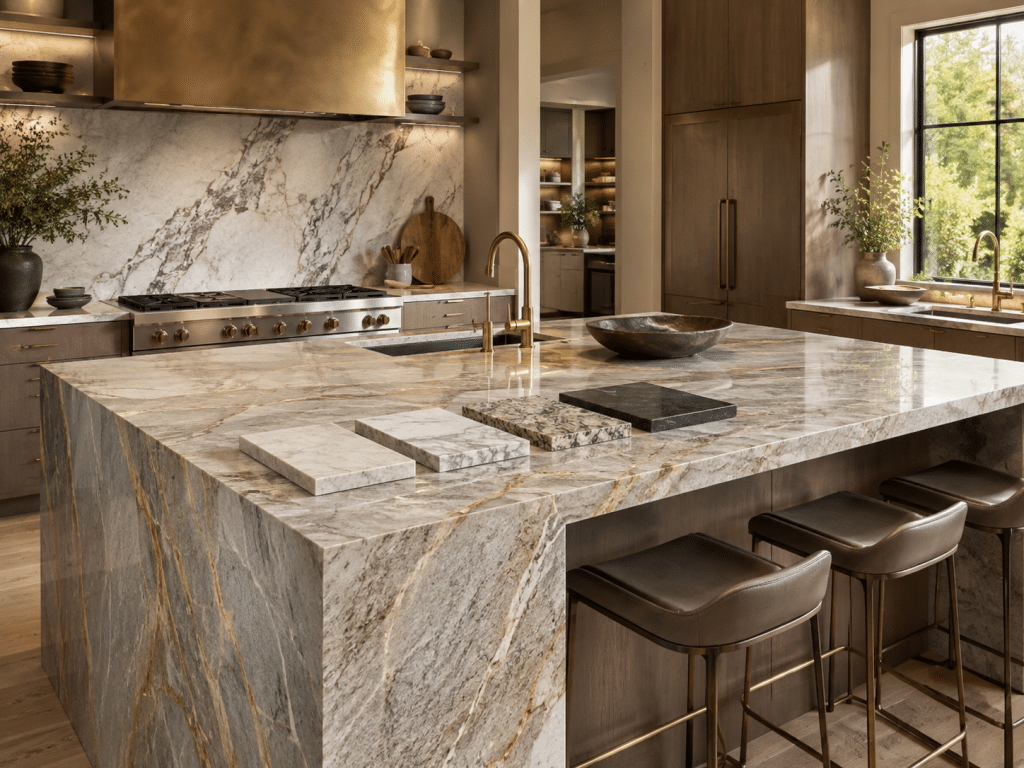
Choosing a kitchen countertop has become more complicated than simply deciding between light and dark stone.
Homeowners now have access to natural materials such as quartzite, marble, and granite alongside newer engineered surfaces such as sintered stone. All four can create beautiful kitchens, but they serve different priorities.
Some homeowners want the individuality of genuine natural stone.
Others care more about low maintenance.
Some want a dramatic island that becomes the focal point of the entire home, while others need a hardworking surface capable of handling busy family life with minimal attention.
That is why asking, “Which countertop is best?” rarely produces a useful answer.
The better question is:
Which countertop material best matches your lifestyle, design priorities, maintenance expectations, and actual kitchen use?
Quartzite can offer dramatic natural movement and strong countertop potential.
Marble provides timeless veining and a character that develops naturally over time.
Granite remains a practical natural-stone option for homeowners who prioritize durability and heat tolerance.
Sintered stone offers a different proposition: controlled appearance, low absorption, and relatively simple routine maintenance.
Understanding these differences before choosing a slab can prevent expensive disappointment later.
Start With How You Actually Use Your Kitchen
Before comparing colors or patterns, think about everyday behavior.
Ask:
- How often do you cook?
- Do children use the countertops?
- Are spills cleaned immediately?
- Do you frequently use citrus, vinegar, or wine?
- Do you place hot cookware near the work surface?
- Do you want natural variation?
- Would occasional surface changes bother you?
- Are you willing to seal natural stone when required?
- Is the island primarily practical or also decorative?
These questions matter because different countertops reward different lifestyles.
A design-focused kitchen that is used lightly may prioritize visual character.
A family kitchen used for breakfast, homework, cooking, entertaining, and daily meal preparation needs to place greater weight on performance and maintenance.
There is no reason to pay for a beautiful material that makes you nervous every time someone pours a glass of juice.
Quartzite: For Natural Stone Lovers Who Want More Countertop Performance
Quartzite has become increasingly desirable in luxury kitchens because it combines natural geological character with strong surface properties.
It is a metamorphic stone formed from quartz-rich sandstone subjected to heat and pressure over geological time.
Visually, quartzite can vary dramatically.
Some slabs are pale and relatively subtle.
Others contain:
- sweeping grey veins;
- blue-green mineral areas;
- gold movement;
- crystalline sections;
- warm cream backgrounds;
- dramatic black contrast.
This makes quartzite especially effective for oversized kitchen islands.
A single slab can contain enough natural movement to become the main decorative feature of the room.
For homeowners who want genuine stone rather than a repeated manufactured design, carefully selected quartzite countertops can provide the combination of natural individuality and visual impact that works particularly well in high-end kitchens.
When Quartzite Makes Sense
Choose quartzite when:
- natural stone is important;
- you want stronger scratch resistance than softer stones;
- the island should become a focal point;
- natural slab variation is desirable;
- you are comfortable with appropriate stone care.
When Quartzite May Not Be Ideal
Consider another material when:
- very consistent slab appearance is essential;
- you want the lowest possible maintenance;
- budget is tightly controlled;
- the kitchen requires several surfaces that must look almost identical.
Natural variation is one of quartzite’s advantages, but it can become a disadvantage when perfect consistency is expected.
Review the Actual Quartzite Slab
Natural stone should never be selected from a tiny sample alone.
A small piece may show:
- white background;
- one soft vein;
- relatively calm movement.
The full slab may contain a dramatic dark section or a large mineral band that changes the entire appearance.
For large islands, review the whole slab.
If several slabs are required, review them together.
This is particularly important when planning:
- waterfall edges;
- full-height backsplashes;
- long countertops;
- adjoining surfaces.
The best results occur when the slab pattern is treated as part of the design before fabrication begins.
Marble: The Classic Choice for Timeless Character
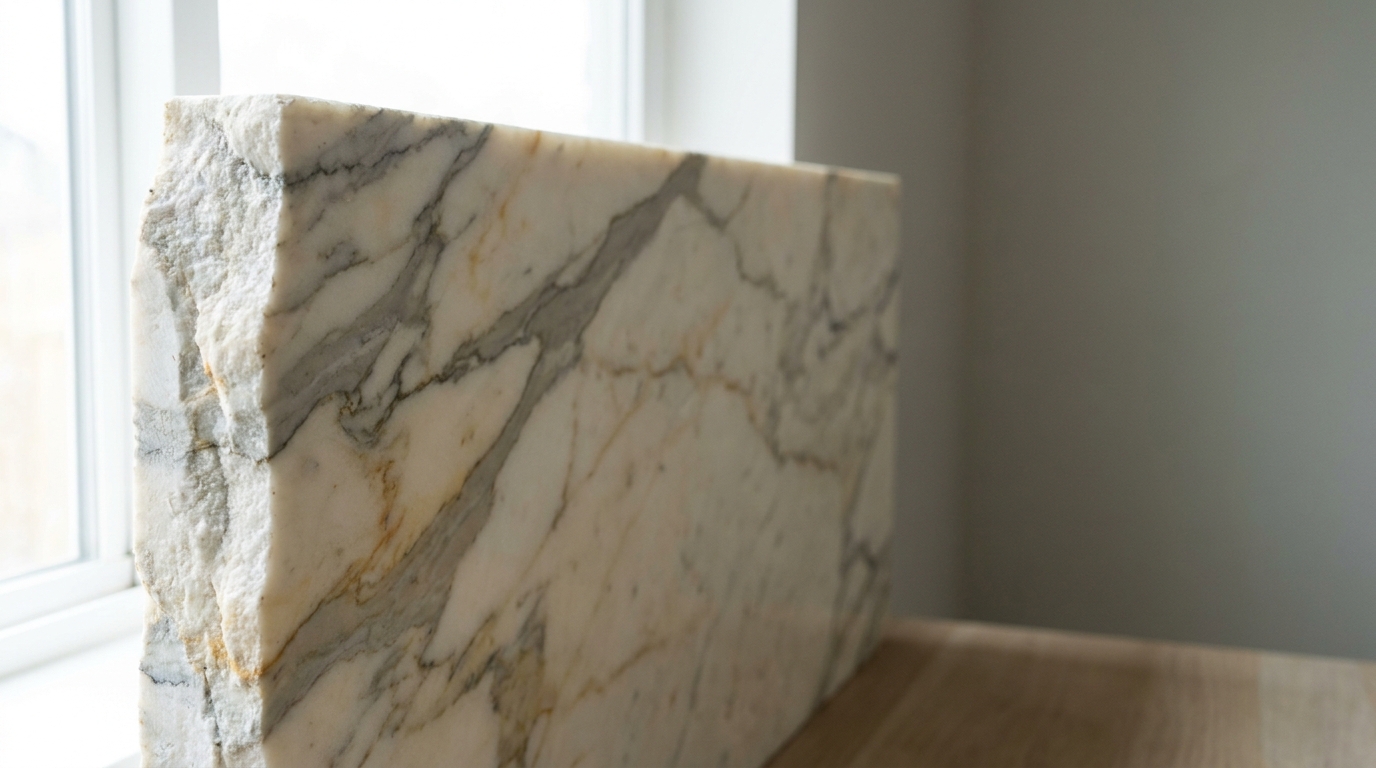
Few countertop materials carry the visual history of marble.
Its popularity has survived changing design trends because the stone can work across classical, transitional, contemporary, and minimalist kitchens.
Marble may contain:
- subtle grey veins;
- bold black movement;
- gold accents;
- warm beige areas;
- green or brown tones.
Its greatest strength is character.
Natural marble rarely looks perfectly uniform, and that is precisely why many homeowners choose it.
Why People Still Choose Marble
Marble can create a softer appearance than many harder surfaces.
It pairs particularly well with:
- white oak;
- walnut;
- painted cabinetry;
- brass;
- bronze;
- stainless steel.
For baking enthusiasts, marble’s naturally cool surface is also traditionally appreciated for pastry preparation.
But marble is not a maintenance-free material.
That needs to be understood before purchase.
The Main Marble Trade-Off: Etching
Marble is largely composed of calcite.
Acidic substances can react with that mineral and alter the finish.
Common kitchen substances include:
- lemon juice;
- vinegar;
- wine;
- tomato products;
- some household cleaners.
This reaction is known as etching.
It is different from staining.
Staining
A substance penetrates the stone and alters its color.
Etching
The acid reacts with the mineral surface and changes the finish.
Sealing may help reduce absorption and staining, but it does not make marble immune to acidic substances.
This is perhaps the most important expectation to understand.
Choose Marble If:
- timeless veining matters more than perfect uniformity;
- you appreciate natural materials that develop patina;
- you are comfortable using stone-safe cleaners;
- visual character is a major priority.
Avoid Marble If:
- every minor mark will bother you;
- the kitchen experiences frequent acidic spills;
- minimal maintenance is essential;
- you expect the surface to remain permanently unchanged.
Marble is not automatically a bad countertop.
It simply needs the right owner.
Granite: The Practical Natural-Stone Workhorse
Granite has been used for kitchen countertops for decades because it combines natural stone appearance with strong practical performance.
While some older granite styles became associated with specific design periods, the material category itself is far broader than those familiar speckled patterns.
Modern granite options can include:
- black;
- white;
- grey;
- brown;
- blue;
- green;
- strongly directional movement;
- relatively quiet patterns.
The aesthetic range can be surprisingly broad.
Why Granite Still Makes Sense
Granite can be attractive when homeowners want:
- genuine natural stone;
- strong resistance to everyday wear;
- good heat tolerance;
- a long-established countertop material;
- relatively straightforward care.
Properly selected granite can work particularly well in:
- busy family kitchens;
- rental properties;
- traditional homes;
- transitional interiors;
- cooking-focused kitchens.
Granite Has Its Own Trade-Offs
Natural granite is not perfectly uniform.
Different slabs may vary in:
- pattern;
- mineral concentration;
- background color;
- movement.
Depending on the material, sealing may also be appropriate.
Granite is also heavy, so proper cabinetry support and professional installation matter.
Choose Granite If:
- practical natural-stone performance matters;
- heat tolerance is important;
- you want lower anxiety around everyday use;
- natural variation is acceptable.
Consider Another Material If:
- you want highly marble-like dramatic veining;
- extremely thin architectural profiles are important;
- perfect visual consistency is required.
Granite may not receive the same social-media attention as exotic quartzite, but that does not make it less useful.
For many kitchens, practicality is a luxury in itself.
Quartzite vs Granite: Which Is Better?
Both can be excellent natural-stone countertops.
The decision is often visual.
Choose Quartzite When:
- marble-like or dramatic movement is important;
- the island is a major design feature;
- unusual geological patterns are desirable.
Choose Granite When:
- practicality carries greater weight;
- a proven natural-stone countertop is preferred;
- the homeowner wants a broad range of darker or more uniform options.
In other words:
If the countertop should become the artwork → quartzite may be stronger.
If the countertop should work hard without demanding all the attention → granite can be excellent.
Sintered Stone: The Low-Maintenance Alternative
Sintered stone belongs to a different category.
Unlike marble, granite, and quartzite, it is manufactured from mineral-based raw materials processed under intense heat and pressure.
This creates a dense architectural surface designed to offer controlled performance.
Modern sintered products are available in a wide variety of appearances, including surfaces inspired by:
- marble;
- concrete;
- limestone;
- solid colors;
- industrial materials.
The primary appeal is not natural slab individuality.
It is predictability.
For homeowners who value low absorption, heat resistance, consistent design, and straightforward maintenance, sintered stone surfaces can provide an alternative to traditional natural-stone countertops.
Why Homeowners Consider Sintered Stone
Potential advantages include:
- low water absorption;
- strong stain resistance;
- resistance to common household heat exposure;
- UV stability for appropriate outdoor applications;
- no routine sealing requirement;
- controlled colors and patterns.
This makes sintered stone particularly attractive for people who want an architectural stone appearance without many of the maintenance considerations associated with porous natural materials.
Sintered Stone Is Not Indestructible
Low maintenance does not mean impossible to damage.
Edges and corners still require appropriate fabrication and installation.
Strong impact can damage vulnerable areas.
Large-format slabs also need experienced handling because fabrication techniques differ from those used for some traditional stones.
The material’s practical performance should therefore not encourage careless installation.
A good surface can still produce a poor countertop if fabrication is weak.
Natural Stone or Manufactured Surface?
This is one of the biggest decisions.
Ask yourself what you value more:
individuality or predictability?
Natural Stone
Quartzite, marble, and granite offer geological variation.
No two slabs are exactly the same.
This creates stronger individuality.
Sintered Stone
Manufactured production allows greater control over appearance.
This can make it easier to coordinate several countertops or large residential projects.
If You Want a One-of-a-Kind Kitchen
→ Natural stone has the advantage.
If You Want Greater Visual Consistency
→ Sintered stone deserves consideration.
Neither approach is automatically superior.
They satisfy different buyer expectations.
Which Material Requires the Least Maintenance?
For homeowners prioritizing minimal routine care, sintered stone generally has a strong advantage because it does not depend on traditional sealing in the way many natural stones may.
Granite and quartzite can also be relatively manageable when properly selected and cared for.
Marble generally requires the greatest acceptance of natural change.
A simplified ranking might look like:
Lower maintenance priority → Sintered Stone
Moderate natural-stone care → Granite / Quartzite
Greater tolerance for patina → Marble
But maintenance should never be evaluated without considering appearance.
The easiest surface to maintain is not necessarily the surface you will enjoy looking at every day.
Which Countertop Handles Heat Best?
Heat performance matters in busy kitchens.
Granite and sintered stone are generally selected where heat tolerance is an important consideration.
Quartzite also performs well as a natural stone.
Marble can tolerate heat but may have other maintenance considerations.
However, using trivets remains a sensible habit regardless of material.
Extreme and sudden temperature changes can place unnecessary stress on countertop systems.
The objective should be protecting a significant investment, not proving how much punishment the surface can tolerate.
Which Countertop Is Best for a Statement Island?
For dramatic visual impact, quartzite and marble are usually the strongest candidates.
They offer true geological variation that can turn an island into a natural artwork.
Choose Dramatic Quartzite When:
- the kitchen is contemporary;
- cabinetry is restrained;
- unusual colors or strong movement are desired.
Choose Marble When:
- classical elegance matters;
- softer veining supports the architecture;
- natural patina is acceptable.
Choose Sintered Stone When:
- a dramatic look is desired with more controlled appearance;
- low maintenance matters more than geological uniqueness.
Choose Granite When:
- natural durability is the priority;
- a strong but less delicate visual direction works with the room.
Waterfall Islands Require Layout Planning
Waterfall edges continue the countertop vertically down the side of the island.
With natural stone, vein direction becomes critical.
Before cutting:
- identify the main vein;
- decide how it should travel across the top;
- position the waterfall panel;
- review the corner connection.
An expensive slab can look poorly fabricated if the pattern breaks awkwardly.
Sintered stone may offer more controlled pattern planning, but printed or surface designs still need to align appropriately at joints.
Full-Height Backsplashes Need Balance
Continuing countertop material up the wall can create a clean high-end kitchen.
But the island and backsplash should not always be equally dramatic.
A useful design rule is:
dramatic island → quieter backsplash
quiet island → stronger backsplash
This keeps the room balanced.
Consider Cabinet Color Before Choosing Stone
Countertops should be selected with cabinetry, not separately.
White Cabinets
Can support almost any material.
Use dramatic stone for contrast or quieter material for a calm look.
Oak Cabinets
Work particularly well with:
- white quartzite;
- warm marble;
- black granite;
- cream sintered stone.
Walnut Cabinets
Pair well with:
- green stone;
- warm white;
- gold veining;
- dark stone.
Dark Cabinets
Lighter countertops can create contrast.
Dark-on-dark combinations work too, but the kitchen needs adequate lighting.
Lighting Can Change Your Countertop Choice
Never judge stone under one lighting condition.
Warm artificial light can make:
- beige;
- cream;
- gold;
- brown
appear stronger.
Cool daylight may strengthen:
- white;
- grey;
- blue.
Polished surfaces also reflect more light than honed or matte finishes.
If possible, compare samples with the actual cabinet door, flooring, and lighting temperature.
Compare Installed Cost, Not Just Slab Price
Countertop cost involves more than material.
The final budget may include:
- templating;
- fabrication;
- edge profiles;
- sink openings;
- cooktop cut-outs;
- waterfall fabrication;
- backsplash;
- transportation;
- installation.
Highly directional natural stone may also create greater waste because attractive slab areas need to be positioned carefully.
A lower-priced slab can therefore produce a higher installed cost when fabrication becomes complicated.
Common Countertop Buying Mistakes
1. Choosing From a Tiny Sample
Natural stone needs full slab review.
2. Buying Marble Without Understanding Etching
Sealing does not prevent acid reactions.
3. Assuming Every Quartzite Is Identical
Natural materials vary.
4. Rejecting Granite Because of Outdated Design Associations
Granite includes far more than traditional speckled countertops.
5. Assuming Sintered Stone Cannot Be Damaged
Edges and fabrication still matter.
6. Choosing the Island Without Considering Cabinets
All major surfaces need to work together.
7. Comparing Material Price Instead of Installed Cost
Fabrication changes the final budget.
A Simple Buyer Decision Guide
If You Want a Dramatic Natural Statement
→ Choose quartzite.
If You Want Timeless Classical Character
→ Choose marble.
If You Want Proven Natural-Stone Practicality
→ Choose granite.
If You Want Low Maintenance and Controlled Appearance
→ Choose sintered stone.
If You Hate Natural Variation
→ Avoid highly variable natural slabs.
If Every Small Surface Change Will Bother You
→ Marble may not fit your lifestyle.
If You Cook Heavily Every Day
→ Put practical performance ahead of trend.
If the Island Is the Centerpiece of the Home
→ Review the complete slab before purchasing.
Micro Summary
Quartzite, marble, granite, and sintered stone can all create excellent countertops, but they solve different problems.
If unique natural drama matters most → choose quartzite.
If timeless beauty and patina matter most → choose marble.
If practical natural-stone performance matters → choose granite.
If low maintenance and predictable appearance matter → choose sintered stone.
The best countertop is not the material with the longest list of benefits. It is the material whose trade-offs match the way you actually live.
Final Recommendation: Choose the Trade-Off You Can Live With
Every countertop material requires compromise.
Quartzite provides exceptional natural character but requires buyers to accept slab variation and appropriate natural-stone care.
Marble delivers timeless beauty but asks homeowners to accept etching and patina as part of the material.
Granite offers dependable natural-stone performance but may not provide the same visual drama as the most expressive quartzites.
Sintered stone can simplify maintenance and provide greater design consistency, but it does not offer the same geological individuality as a natural slab.
There is no reason to declare one universal winner.
Instead, decide which compromise suits your household.
Think about:
- cooking habits;
- maintenance;
- design style;
- slab variation;
- heat exposure;
- budget;
- fabrication;
- long-term expectations.
Then review the actual material rather than relying only on online photographs.
For natural stone, inspect full slabs whenever possible.
For large islands, plan vein direction.
For waterfall edges, approve the layout before fabrication.
For manufactured surfaces, review the actual finish and edge details.
Most importantly, select the countertop for ordinary life rather than showroom day.
A kitchen surface may be used several times every day for many years.
The right countertop should make the kitchen more enjoyable, not turn every meal into a maintenance exercise.
Frequently Asked Questions
1. Is Quartzite Better Than Granite for Kitchen Countertops?
Neither is universally better.
Quartzite is often chosen when homeowners want dramatic natural veining and a more luxurious statement surface, while granite is attractive when practical natural-stone performance and heat tolerance are major priorities.
If design impact matters most → consider quartzite.
If practical everyday use matters most → consider granite.
The specific stone should still be evaluated before purchase.
2. Is Marble a Good Choice for Kitchen Countertops?
Yes, but only when the homeowner understands its characteristics.
Marble offers timeless natural veining but can etch when exposed to acids such as lemon juice, vinegar, and wine.
It can be an excellent choice for homeowners who appreciate patina.
If a permanently unchanged surface is expected, another material may be more appropriate.
3. Is Sintered Stone Better Than Granite?
Sintered stone and granite serve different priorities.
Sintered stone offers low absorption, controlled appearance, and limited routine maintenance.
Granite provides the individuality and geological character of natural stone.
If low maintenance matters most → consider sintered stone.
If authentic natural stone matters more → granite may be the stronger fit.
4. What Is the Most Durable Countertop Material?
There is no single countertop that is best in every type of durability.
Scratch resistance, heat resistance, stain resistance, impact resistance, and edge strength are different characteristics.
Quartzite, granite, and sintered stone can all perform strongly when correctly selected, fabricated, and installed.
Rather than choosing based on one durability claim, compare the type of wear your kitchen actually experiences.
5. Which Countertop Material Is Easiest to Maintain?
Sintered stone is generally attractive to homeowners seeking low routine maintenance because its dense surface does not typically require the same sealing approach as many natural stones.
Granite and quartzite can also be manageable with appropriate care.
Marble requires greater acceptance of natural ageing and acid sensitivity.
If minimum maintenance is your priority → consider sintered stone.
If natural slab individuality is worth some additional care → compare quartzite or granite.