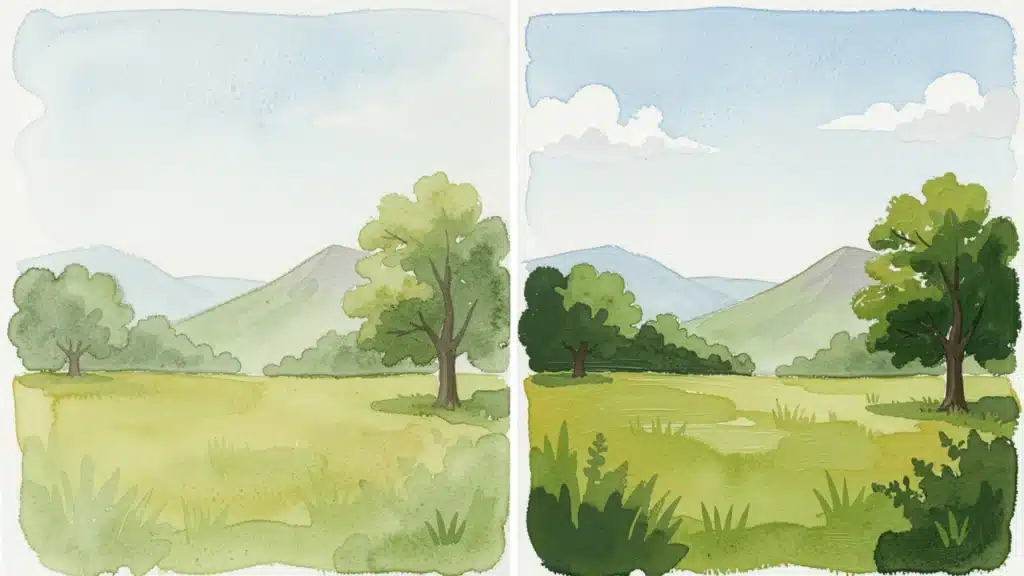
Gouache and watercolor sit side by side on art store shelves but behave quite differently. On paper, one remains pliable and transparent.
The other covers everything below it, sitting firmly and boldly. The distinction changes how artists plan each picture. Even a tiny drop of water can entirely alter the result.
This blog defines gouache and discusses how it differs from watercolor. It also covers how to choose the right paint for drawings, illustrations, or finished artwork.
By the end, choosing between gouache vs watercolor will feel far less confusing.
Gouache vs. Watercolor
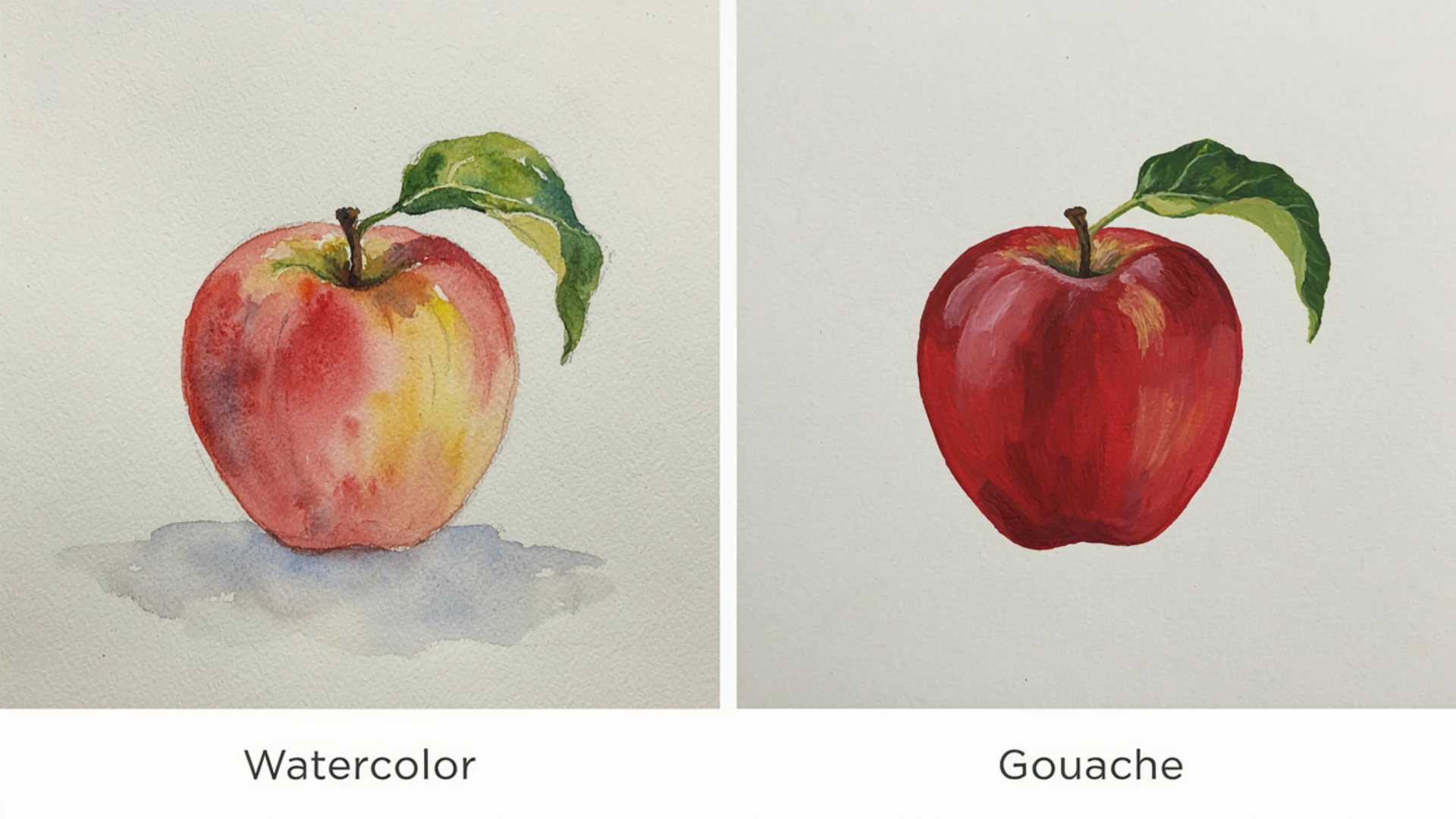
There are mainly five differences between gouache and watercolor. Watercolor is translucent, whereas gouache is opaque. Watercolor dries with a gentle sheen, but gouache dries with a matte finish.
Gouache also dries faster than watercolor. In gouache, mistakes are easy to fix, but in watercolor, they become harder to correct as it dries.
Watercolor is better for delicate washes and landscapes, whereas gouache is great for illustration and typography.
What Does Gouache Mean?
Gouache is a type of watercolor paint that is opaque.
The French word is pronounced “gwash.” It has a solid, flat appearance because it utilizes less water and more pigment than ordinary watercolor.
Because it shares many characteristics with ordinary watercolor paint, artists often call it “opaque watercolor.” Gum arabic is used as a binder in the paint, and white pigment or chalk is added for opacity.
Because of this, gouache is a popular option for designers, artists, and anybody else who needs vibrant, uniform color on paper.
What is Watercolor?
A minimal amount of binder is combined with pigment to create watercolor paint. When you thin it with water, it becomes translucent. This reveals the paper’s white, resulting in layers that are gentle and radiant.
Watercolor is renowned for its delicate color blending and airy, light feel. By stacking tiny washes on top of one another, artists create depth.
This paint works well for botanical art, landscapes, and any other piece that requires a delicate, organic appearance.
Gouache vs Watercolor: The Real Differences
Although gouache and watercolor share a similar substrate, they differ significantly.
Although both use the same ingredients- pigment, water, and gum arabic- they behave differently after application.
These variations affect how each paint appears, dries, and endures over time. Selecting the appropriate paint for each project is made simpler by being aware of them in advance.
Transparency
Layers beneath are visible because watercolor remains translucent. Gouache fully covers everything underneath it since it is opaque.
The characteristic shapes how each paint is used in a painting.
Finish
From satin to matte, watercolor dries with a gentle sheen. Gouache has a smooth, matte texture and dries totally flat. Gouache pieces are easy to scan or photograph for printing.
Change in Color After Drying
In most cases, watercolor dries lighter than it appears when it is wet. Gouache changes more: dark shades dry lighter, light shades dry darker.
To prevent surprises once they dry, test colors on scrap paper.
Structure of Pigments
Watercolor uses more binder and finer pigment particles. Gouache uses larger pigment particles and a higher pigment-to-binder ratio.
As a result, gouache lays down a thicker, more solid color.
Binder
Gum arabic is used as a binder in both paints. For added opacity, gouache frequently incorporates white pigment or chalk. This small change gives gouache its flat, covering strength.
Managing Light Areas
The white paper is left bare for accents by watercolor artists. Instead, gouache artists paint light colors directly over dark areas.
This gives painters more leeway to correct or modify highlights later.
Direction of Work
Typically, watercolor progresses from bright to dark hues. Gouache can be applied in either light or dark order. Gouache’s adaptability makes it easier to plan.
Surfaces
Watercolor works best on watercolor paper, while gouache can also be used on toned paper and illustration boards.
Gouache can also be used on toned paper and illustration boards. Both paints require a surface that can withstand repeated wet coats.
Ideal For
Watercolor works well for soft washes, botanicals, and landscapes. Gouache works well for flat, bold color work, illustrations, and posters.
Many artists choose their paint based on the emotion they want to convey.
Working With Gouache
A steady hand, a little water control, and patience are rewarded in gouache. Working in tiny pieces keeps colors uniform since it dries quickly.
Another way to soften edges before they set is to keep a small amount of water close by. Because gouache might dry out on the palette during a session, many artists mix tiny portions at a time.
- For a bright, flat hue, use less water.
- It’s easy to layer light tints over dark ones.
- Before adding a fresh color, let each layer dry.
- You can save leftover paint for later use on a palette.
Blending borders and adding fine detail become much easier when these fundamentals feel natural.
Working With Watercolor
Because errors are more difficult to conceal, watercolor requires painters to prepare ahead. Timing is important because once the paint contacts wet paper, it moves on its own.
Keep washes clean and colors uniform with a soft, steady touch. It takes practice to learn how much water is appropriate, but it gets easier over time.
- For highlights, don’t contact the white paper.
- Use thin washes to add color gradually.
- For smooth, blended edges, work wet-on-wet.
- To prevent muddy hues, keep your water jug clean.
With repetition, these actions become easy routines that improve every painting session.
How Gouache and Watercolor Are Alike?
Gouache and watercolor share more similarities than most artists realize. On paper, they both follow similar guidelines and belong to the same paint family.
| Feature | Similarity |
|---|---|
| Binder | Both use gum arabic, which dissolves in water |
| Reactivation | Both can be rewet after drying |
| Water content | More/less water controls thickness and boldness |
| Brushes | Watercolor brushes suit both media |
| Paper | Both work well on wet-media watercolor paper |
Which One Should You Use?
The outcome you want on the page matters more than skill level when choosing the right paint.
Watercolor Works If:
- You appreciate paintings that are gentle, light-filled, and have a natural shine.
- Wish to combine color with lines drawn in pen, pencil, or ink.
- Choose a portable painting kit that is lightweight and effective.
- Similar to gradually adding color with thin, layered washes.
- Are attracted to botanical, floral, or landscape themes.
- Are receptive to a paint that requires some control.
Gouache Works If:
- Like bright, flat hues with crisp, solid borders.
- Desire artwork that is suitable for digital application when photographed or scanned.
- Like having the ability to cover or correct errors while painting.
- Are engaged in projects such as illustrations, posters, or letters.
- Desire a paint that sits between acrylic and watercolor.
- Need color that dries quickly for brief sketching sessions.
To put it briefly, gouache allows painters to paint light wherever it is needed, whereas watercolor requires them to plan around the light on the paper.
Many artists are never forced to choose just one. Gouache sharpens the last details while watercolor establishes the mood in many paintings, sometimes even within the same piece.
Conclusion
Despite their shared foundation, gouache and watercolor each convey a distinct narrative on paper. Gouache is a strong, opaque color that is easy to cover and adjust.
With each wash, watercolor remains translucent and light, allowing the page to breathe.
The choice between gouache vs watercolor comes down to the mood an artist wants to create. Gouache is more prevalent in bold lettering and illustrations.
Watercolor is ideal for delicate landscapes and subtle details.
Some pieces even combine both, demonstrating that these two paints function more as partners in distinct rhythms than as competitors. Ultimately, each brushstroke conveys a unique narrative.
Frequently Asked Questions (FAQs)
1. What Does Gouache Mean in Painting?
Gouache means an opaque, water-based paint similar to watercolor but with more pigment.
2. Is Gouache Easier to Use than Watercolor?
Gouache forgives mistakes more easily, making it simpler for many beginners to control.
3. Which Paint Costs More, Gouache or Watercolor?
Prices vary by brand, but gouache often uses more paint per project due to its opacity.